Over the past year, I’ve had the opportunity to spend real time with the leadership team at enterprise local search marketing platform Lastmile. Those conversations began with CEO and co-founder Michael Carini, where we talked candidly about the risks of substituting AI hype for solid technology and sound business operations—and they left me wanting to go deeper.
One thing has been consistent across every interaction: Lastmile is unusually focused on its clients and their end customers. Not as a slogan, but as an operating principle. Shareholders only come up in the context of preserving the freedom to build for large enterprise needs, instead of bending the platform around short-term, VC-driven profit expectations. In SaaS and MarTech, that kind of restraint is rare.
That focus matters, because local businesses and their communities are often the first to feel the consequences of bad tech decisions made far upstream. Lastmile’s work is grounded in a simple idea that too many companies have drifted away from—help clients grow by helping them serve customers better.
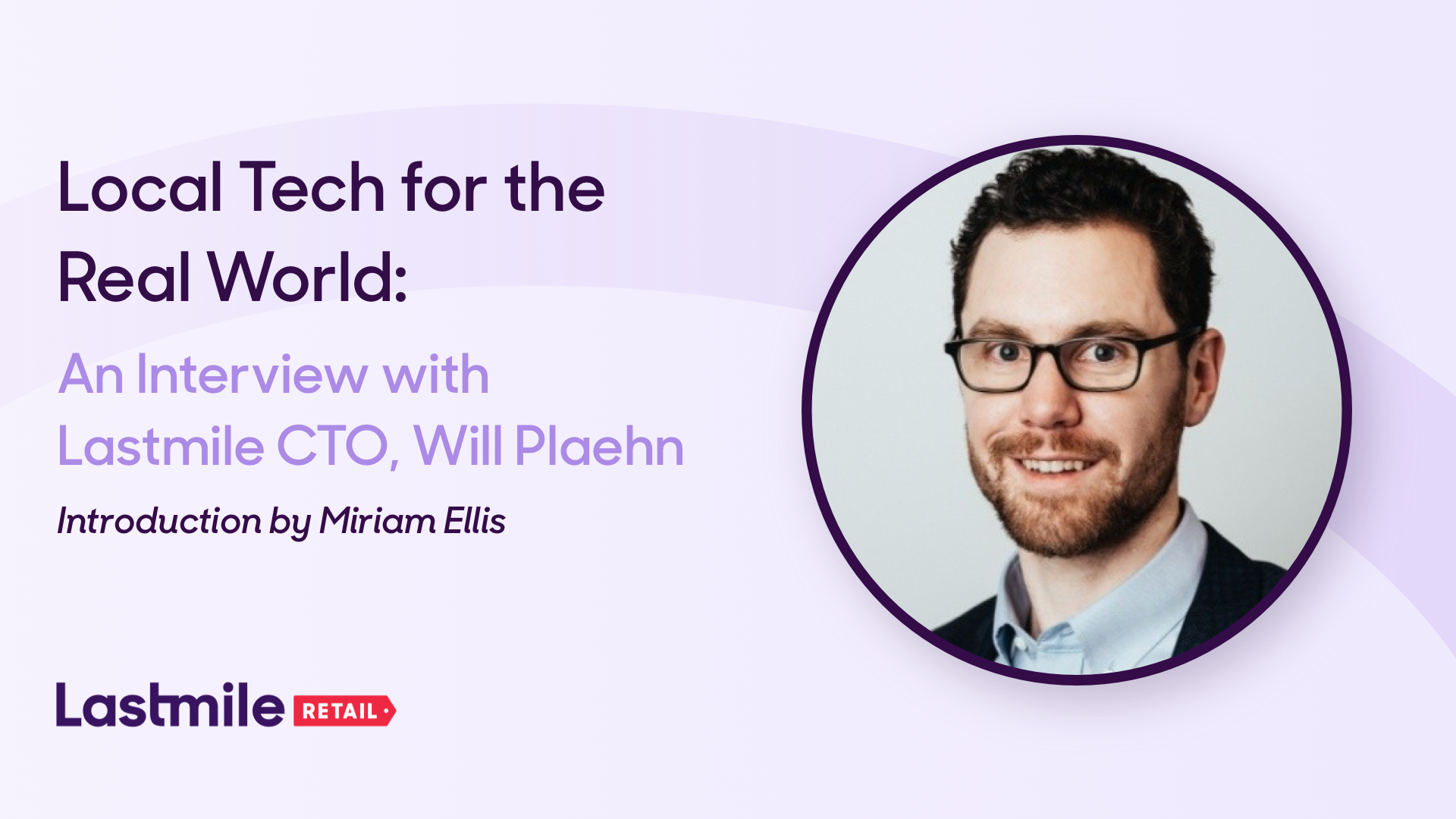
Which is why, as Lastmile crossed its 10-year mark, I wanted to sit down with CTO and co-founder Will Plaehn. After a decade of building and scaling the platform—and serving brands like T-Mobile, the U.S. Navy, and Hyatt International—I was curious how he thinks about what’s actually working in local SEM, and what still isn’t.
If you’re feeling a bit jaded by the noise in our industry, this conversation cuts through it. It’s a grounded look at what local brands and real customers actually need—and why getting the fundamentals right still matters more than chasing the next trend.

Will: I started my career at IBM, where I had the opportunity to work with a lot of really fantastic people and got exposed to a lot of large projects in a short time. Around that time, my college roommate from Colgate, Michael Carini—now our CEO—was working as a product manager at NASDAQ. But he kept circling back to a pain point he couldn’t let go of: the disconnect between how people actually shop and what they find online.
He pointed out that when customers searched locally for specific brands, products, or deals, they’d often come up empty—finding only generic store categories or nothing at all. That mismatch was the big a-ha moment for us. It was clear that even the most recognized retailers were missing the mark in local digital marketing. So we set out to fix it. That’s when his product management experience and his drive to solve a real business problem came together. I finally challenged him to prove there was a real gap in the market. At the time, we weren’t thinking about enterprise at all—Michael had been exploring this challenge from the lens of small retailers, shaped by a side business he ran back in college. In true Michael fashion, he came back with a deep dive (87 pages?)—well-researched, thoughtfully written, and complete with a starter business plan.
We started testing with a scrappy MVP for small retailers in Manhattan, and to our surprise, it worked. That early traction was the turning point. We realized this wasn’t just a small business problem—the biggest brands were feeling the same pain, and no one was solving it well. That convinced me, and we decided to team up to tackle the problem.
The rest is history, but one thing hasn’t changed—we still approach everything through this same lens. We constantly assess market gaps, challenges, and growth opportunities, both for our evolving platform and for our clients’ needs, thoughtfully leveraging technology to better serve customers where they are.
Will: It really came down to two things.
First, most local search platforms were—and honestly still are—built on a one-size-fits-all model. They’re designed to scale by serving SMBs through self-service, with minimal support. That works fine at the low end, but it breaks down fast when you’re dealing with enterprise complexity.
Content is a good example. A lot of platforms stop at basic tools and don’t integrate programmatic data at all. That means you can’t really optimize or manage local content at scale. You end up with a system that looks flexible on the surface but hits a ceiling pretty quickly.
The second issue was how outdated the workflows were. Location data managed through spreadsheets, point-in-time updates, static snapshots—that just doesn’t work when you’re managing hundreds or thousands of locations. So we built rules-based logic and bulk workflows directly into the platform, so data and content can be managed dynamically instead of through workarounds.
And despite all the talk about customer experience, most brands still aren’t delivering local relevance. Inventory, promotions, services—they exist, but they’re siloed. Local pages are often static, disconnected from what’s actually happening on the ground. That creates friction for customers and missed opportunity for brands. We knew there had to be a better way to do it.
Will: The first big decision was committing to enterprise. There are a lot of good solutions for small businesses, but the real challenge—and where we saw the biggest gap—was helping multi-location brands operate cleanly at scale.
Even the basics break down fast when you’re managing hundreds or thousands of locations. Doing it right requires automation, guardrails, and real operational support working together. If any one of those is missing, things slip.
Here’s a simple example. Say you’re in Boise looking for a new phone. You want to talk to someone in person, so you search for a nearby store, find the listing, and drive over—only to discover it’s closed because the Google Business Profile was suspended. No one caught it. No alerts, no checks, no ownership. That kind of thing happens all the time when we audit enterprise accounts.
On the flip side, another brand might actually have the best deal—but you’d never know it. Their local pages are missing the details that matter: inventory, current plans, local coverage. The offer exists, but it’s invisible where customers are actually making decisions.
That’s the real problem. Brands aren’t in control of their local digital presence, and customers pay the price. They waste time, miss opportunities, and lose trust—when all of it was avoidable with the right enterprise-level systems in place.
Will: From the customer side, things just work. They find the right location, the information is accurate, and what they see online actually reflects what’s available in that store—inventory, promos, services, all of it. The locator and local pages aren’t dead ends; they guide customers straight to a purchase or visit.
Behind that experience is a lot of hands-on work. Every client has a dedicated account team, and leadership stays involved. We almost always build custom integrations—often at no extra cost—so local pages can pull in real-time data from inventory systems, promo feeds, CMSs, and other core platforms. That’s what allows the experience to stay current and truly local.
On the operational side, Brand Z has real control. Corporate teams, regions, and franchisees all have the right level of access to manage their locations without breaking consistency. Our rules engine makes sure the right content shows up in the right places, automatically.
And if something goes wrong, they’re not waiting days for a ticket response—we respond within two hours. That alone is a big reason brands switch to us.
Most importantly, they get full attribution. Brand Z can see what local marketing actually drives visits and transactions, not just proxy signals like calls or direction requests. That visibility makes real optimization possible across their entire footprint—no guesswork.
Will: Because in this space, that’s not how it usually works. Most platforms charge for every bit of dev work, which is often a sign they’re really built around a self-serve model and treating enterprise needs as exceptions.
The reality is, no two enterprise clients are the same. You’ve got corporate teams, regions, franchisees, agencies—all with different priorities. An out-of-the-box solution just doesn’t cut it at that level. Our clients know their markets and their customers better than anyone, so our job is to build around their needs, not force them into a rigid platform.
What we see all the time is brands getting hit with massive bills just to make a platform usable for their situation. We think that kind of customization is table stakes for enterprise, not a premium upsell.
At the end of the day, this is about delivering a strong local experience wherever customers are searching. When we do that well, we become the connective tissue across teams and channels—supporting everything from local pages and mobile apps to booking flows and SMS campaigns. And we don’t nickel and dime clients to make that happen.
Will: From day one, we believed that if local retail was going to truly complement ecommerce, the experience had to feel just as easy and intuitive. Discovery, decision-making, purchase—customers expect that same level of clarity they get from Amazon, even when the end result is an in-store visit.
Michael touched on this earlier, but I’ll say it again: using AI to paper over bad tech or broken processes isn’t inspiring. It doesn’t solve the real problem.
What does matter to me is building better online-to-offline connections—helping real people find what they need in their own communities, at the right moment. When brands show up with accurate, relevant local information, customers notice.
We’ve seen this play out for years. Loyalty is built when customers are well served, and strong service directly impacts profitability. It sounds obvious, but it’s amazing how often it gets overlooked.
Multi-location brands actually have a huge advantage here. They can pair a clean, modern digital experience with great in-person service. The challenge is doing that locally, at scale. That’s where enterprise-ready tech, hands-on support, and a customer-first mindset really matter—and that’s been our focus for the past decade.
Request a Demo
Drive more local sales by pairing shoppers with real-time inventory and promotions through seamless online-to-offline capabilities that help clients transact now.