What steps should major multi-location brands be taking in 2026 in response to the rise of conversational AI like ChatGPT and Google AI Overviews?
What you won’t find in this article: AI hype. We don’t engage in that at Lastmile and are making an effort to offer good counsel to our clients amid change. Right now, more established interfaces like Google Business Profiles remain the dominant third-party drivers of local enterprise brand discovery for most businesses. A measured approach to making your company AI-ready is appropriate.
What you will find in this article: Practical tips for what your enterprise should be doing right now to ensure you’re making a wise investment in the necessary steps for AI inclusion.
What impact is AI having on local SEO right now in Google’s results?
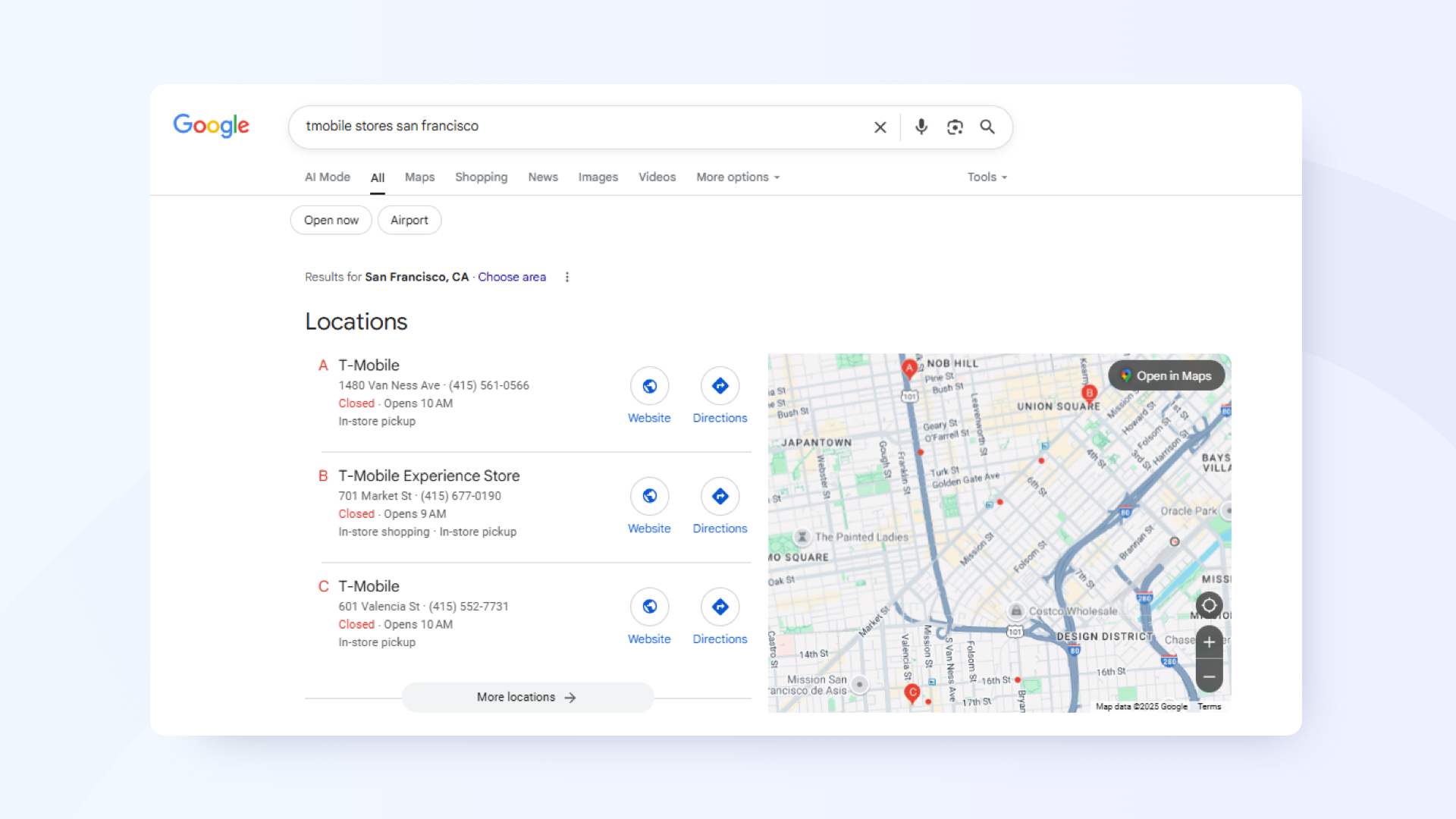
Since Google rolled out Maps 20 years ago, we’ve all become accustomed to some form of their local business listings being a prominent part of their results. Today, the norm is that Google will show a local pack (like the above) in response to basic local intent queries like “tmobile stores san francisco,” “pizza near me,” or “redwood credit union downtown”. For these types of searches, local packs continue to be the dominant response from Google.
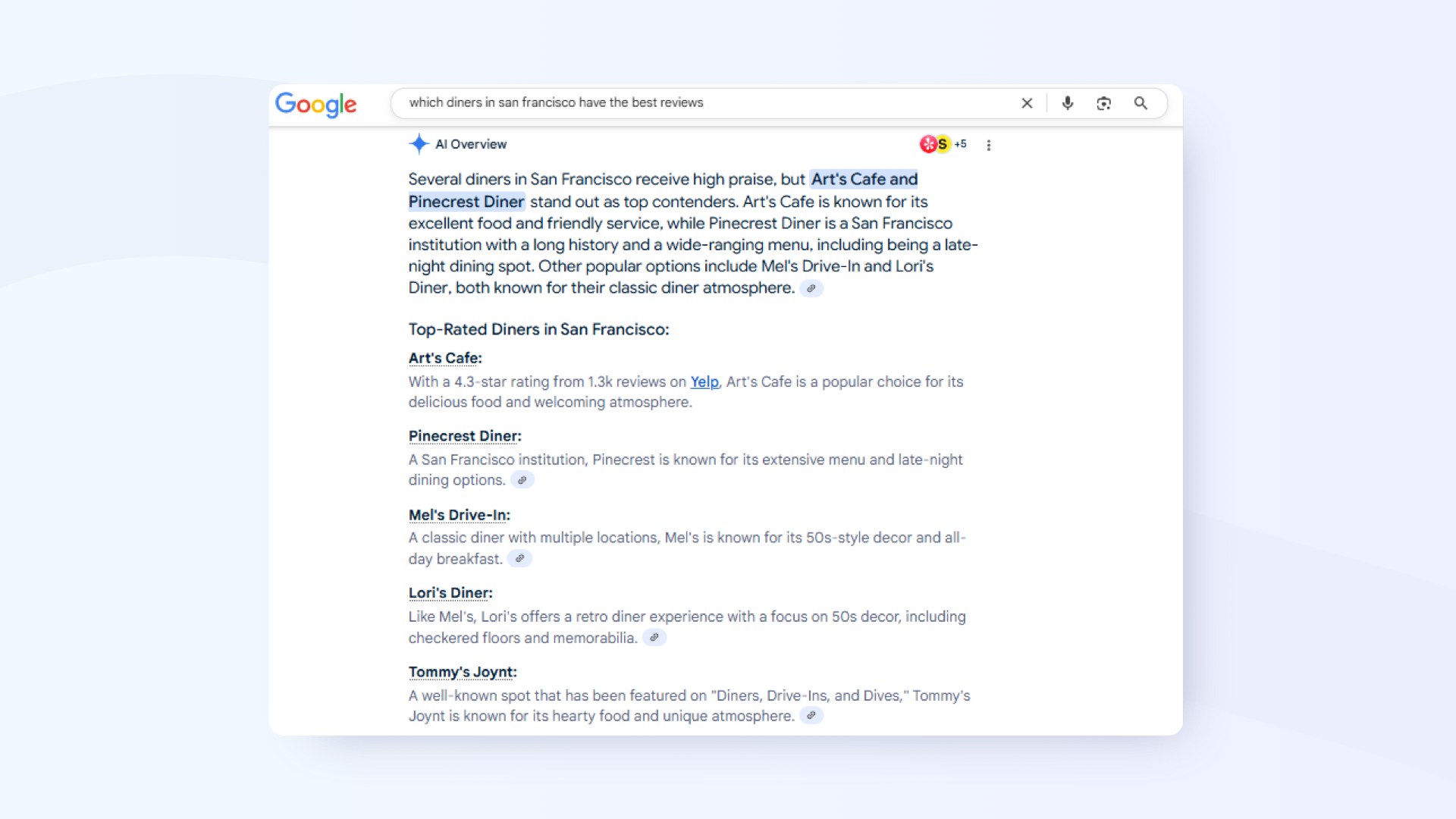
Where we are currently seeing the greatest impact of AI in Google’s local search results is in response to informational queries. Typically, queries like “which diners in San Francisco have the best reviews?” or “how much does a restaurant meal cost in San Francisco?” will now return a Google AI Overview (like the above) instead of the more familiar local pack results.
Given this, your enterprise should:
- Create Google Business Profiles for each location of your enterprise, optimizing them to the fullest extent possible, and managing them for accuracy over time to maximize your visibility in Google local packs and Maps for basic local search queries.
- Identify the informational queries that matter to your brand, study the types of content included in Google’s AI Overviews, and take the necessary steps to earn inclusion in these newer types of results.
In addition to meeting the majority of informational queries with AI Overviews, Google is now also experimenting with their conversational AI environment, AI Mode, which looks like this:
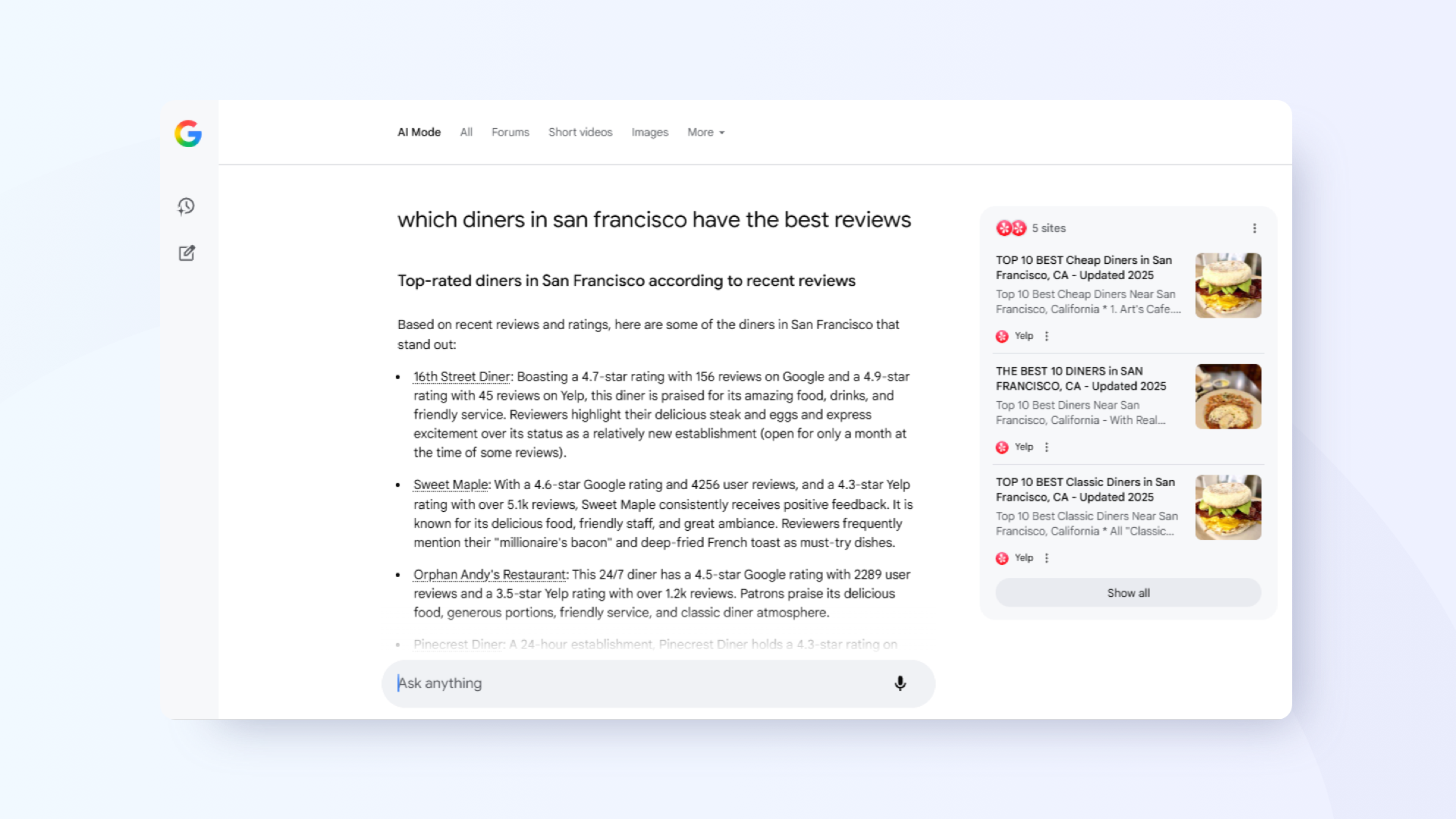
Meanwhile, Google competitor, Bing, has regained some of its lost attention in local search marketing conversations because of Microsoft’s status as an investor in OpenAI’s conversational mode, ChatGPT. Local search queries in Bing still return Bing Places packs, like this one:

But some of your customers will currently be experimenting with ChatGPT to be able to ask AI questions about local business information, instead of simply being shown a set of pre-determined local business results. The ChatGPT interface is quite similar to Google’s AI Mode, and both brands are competing for dominance in the conversational AI market:
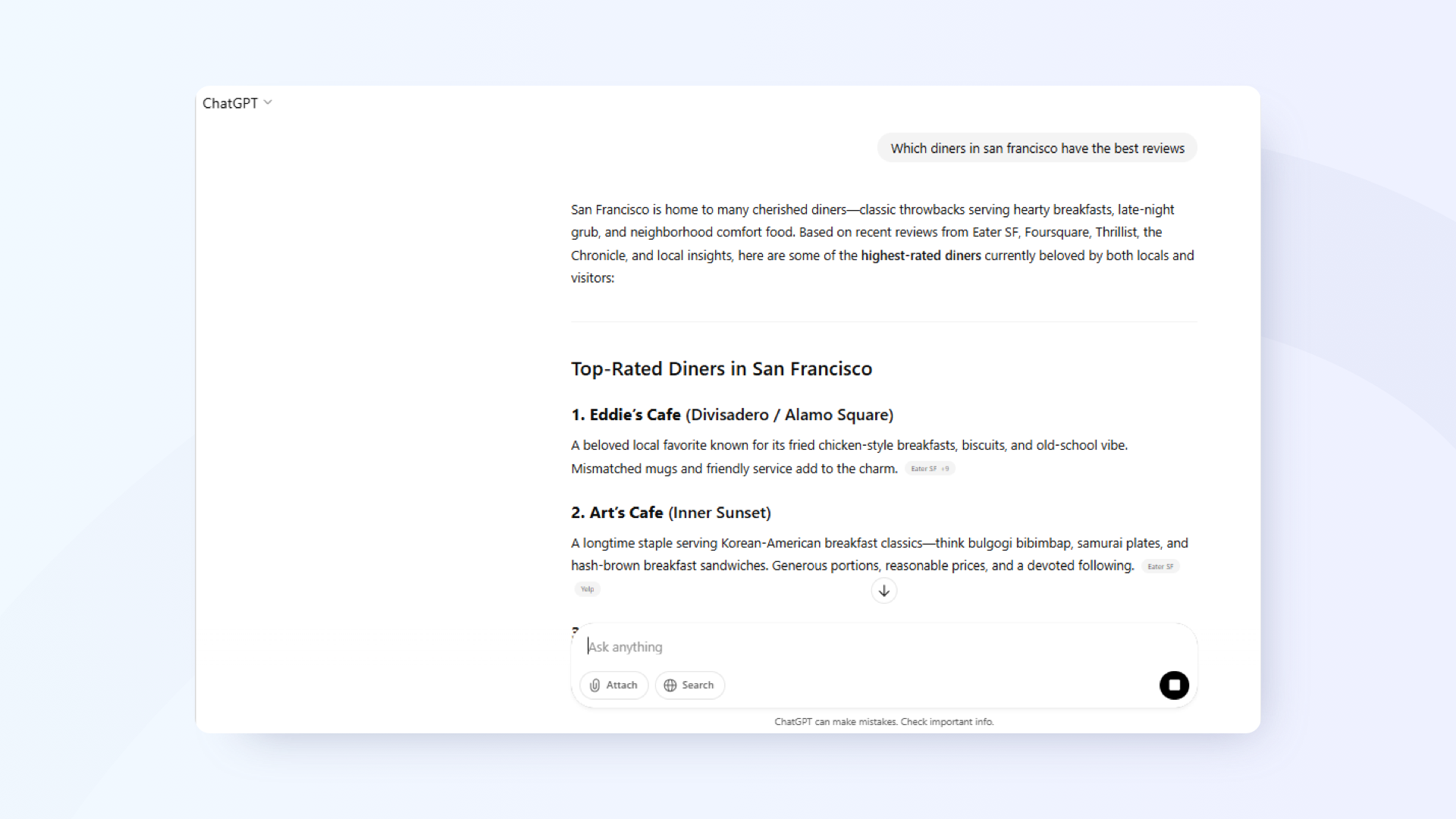
Your task: Your enterprise should be doing its own research to identify the sources that both AI Overviews/AI Mode and ChatGPT are citing in response to customer prompts that are relevant to your business. What quickly becomes apparent from this type of investigation is the major role reviews are playing as an AI training source when it comes to local businesses.
Local business review sources in AI environments
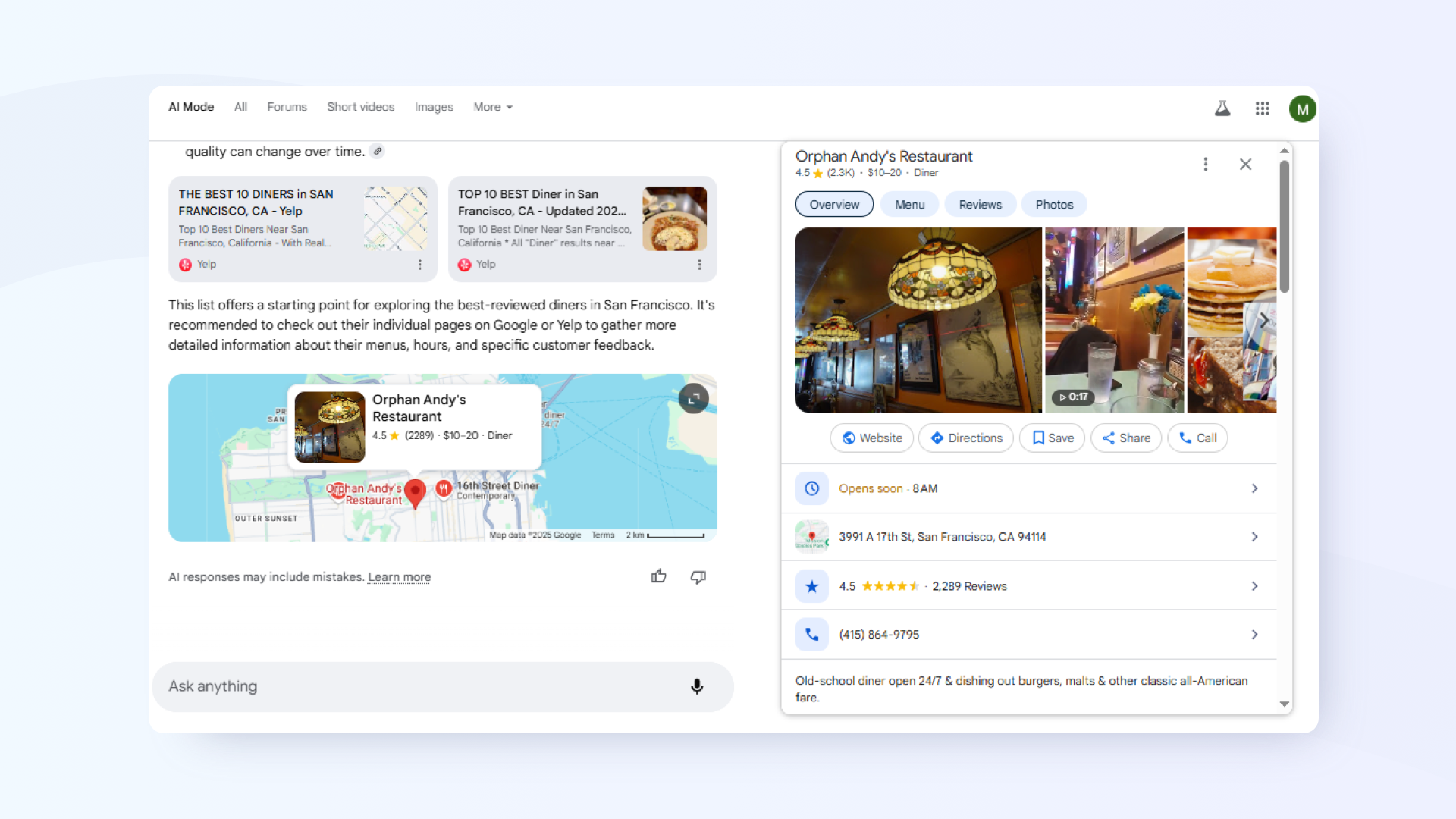
The public is using conversational AI to ask questions, compare different options, and learn more about nearby businesses. As the following screenshot shows, Google’s AI is scraping reviews from Yelp and TripAdvisor for our query about diners in San Francisco:
ChatGPT will also cite similar major review platforms when we prompt it for local restaurant information:

Depending on your industry, and the location of each of the branches you’re marketing, discover which sources of reputation content AI is citing for your enterprise. These are the sources you need to be:
- Earning a steady stream of reviews on
- Responding to reviews on to resolve complaints to defend your average star rating and customer retention
Pro tip: It can take some time to recognize where elements of AI outputs stem from. For example, it was fairly easy to spot Google AI Mode citing Yelp, but don’t overlook this different formatting within the conversation, which is directly pulling reputation information from Google Business Profiles:

Why should your enterprise care about conversational AI?
Conversational AI is a problematic product. You can prompt it to say almost anything and it is notorious for hallucinating nonsense. Further, it represents unknown legal risks to brands. As Lastmile CEO, Michael Carini, explains:
“AI is a legal nightmare. Does a company owe a customer for failing to deliver on a promise it has no idea it’s even made? Does a company have liability for missing clear signs of abuse or crimes in a customer interaction? What happens when a customer is injured due to inaccurate instructions provided by AI (anyone remember Apple maps sending drivers into lakes)? Does a company retain full ownership of content created by an AI it licensed that was trained on data that wasn’t properly licensed? … Entrusting the integrity of your brand to an unpredictable and unaccountable machine that is still in its infancy opens up an entirely new attack surface that no one is yet equipped to defend. Large brands aren’t being told this by the AI-fueled platforms they’re contracting with, and it’s a very serious concern.”
Given this, it would make sense if risk-averse local enterprises wanted to entirely opt out of AI and not appear in its results. However, the reality is successful brands have to be present wherever customers are, and we are currently in an era in which the consumer public is experimenting with conversational AI to see if it meets their needs.
Tech trends come and go quickly, but for the length of this one, there are 5 steps your enterprise should be engaged in to minimize the chances of AI making up rubbish about your business and its reputation because it lacks citable information.
1. Prioritize real-world customer service excellence and complaint resolution across your enterprise
Staff hiring and training practices must be standardized across chains and franchises so that:
- The majority of customers are having a helpful and positive initial experience with the brand
- Maximum use is being made of offline complaint escalation and resolution when customers’ initial experience is negative
Outcomes: The majority of consumers write reviews to reward excellent customer service. By satisfying your consumer base, you will not only give AI plenty of positive reviews and ratings to scrape, but you will also be earning the loyalty and referrals your enterprise needs to continue to grow its reputation.
2. Prioritize review responses, especially when complaints occur
Unless all branches of your chain or franchise are adequately staffed so that every review is receiving a response from the brand:
- You are leaving opportunity on the table to resolve complaints and win back dissatisfied customers. The majority of customers are willing to give your brand a second chance if your review response to their complaint makes things right. Many will even update their negative rating and review to reflect an improved second experience with your business.
- You are overlooking an opportunity to earn consumer loyalty. Reviews are conversational. When happy customers reach out to praise your brand for a good experience, this is the opening to a dialogue. Don’t give customers the silent treatment. Use owner responses to thank them for using their free time to publicly promote your company. Make the most of the chance to invite them to come again.
Outcomes: Average star ratings deteriorate quickly and the majority of consumers will not choose a business if its ratings on platforms like Google Business Profile and Yelp begin slipping below four stars. By resolving negative reviews and inspiring customers to update their ratings, you will be defending one of the key metrics that drives business to your doors. Conversational AI is picking up star ratings, summarizing review sentiment, and citing reviews. Every branch of your business will be better off in this environment if its review corpus features a majority of positive reviewers.
3. Prioritize resolving predictable reputation pitfalls
One of the simplest steps you can take to minimize negative reviews is to ensure that the name, address, phone number, and hours of operation are accurate across all locations of your enterprise. At Lastmile, we commonly have to engage in significant location data cleansing that has been overlooked by our incoming clients’ former local search marketing partners. If your current partner isn’t accomplishing a high degree of local business listing data accuracy:
- Your brand will receive negative reviews from customers who have been inconvenienced by arriving at wrong locations or at wrong times.
- These negative reviews will erode your average star ratings.
Outcomes: When location data accuracy is neglected at scale, enterprise reputation is at risk. AI will pick up complaints and low-star ratings, costing the brand conversions. The solution is simple: your local business listings management provider must be capable of scaling data accuracy so that the majority of consumers are encountering accurate information about your business, minimizing preventable negative reviews.
4. Prioritize active review acquisition
Though many customers enjoy volunteering their free time reviewing businesses without needing to be asked, your enterprise should experience an increased velocity and volume of reviews with a proactive approach. It’s important to know individual platform guidelines before embarking on a review acquisition campaign. For example, Google is fine with business owners asking customers for reviews, so long as no incentives are offered, but Yelp notoriously doesn’t want brands to request reviews at all. Maximize response to review requests by:
- Using a combined approach of both email and text line collection at the time of service so that the brand can ask via both methodologies
- Identifying ideal request timing – this can differ widely for different brands; in some sectors, same-day review requests yield the best returns, while in others, returns are maximized by waiting for a week or more before sending requests
- Experimenting with a variety of review prompts, including in-person requests, requests on the corporate website and location landing pages, and requests on physical assets such as store signage, menus, receipts, etc.
Outcomes: Even the best brands receive a minor percentage of complaints. Any branch of your business can experience a difficult day, and some customers are hard to please. There is a strong likelihood that AI will pick up any complaints about your business because conversational AI appears to favor evaluative and comparative information. Actively acquiring positive sentiment boosts your power to outweigh any negative sentiment your brand has accrued.
5. Prioritize review spam fighting
Anyone involved with managing the reputation of any branch of your enterprise should be fully trained in the prohibited content policies of the major review platforms so that they are equipped to recognize and report review spam. In addition to local businesses becoming the targets of negative review spam attacks, AI review generation presents a growing risk. Some experts are predicting that platforms like Google Business Profile could feature more AI-assisted reviews than human-written reviews by the end of 2026. Unfortunately, AI gives spammers the tools they need to target review platforms at scale. To defend your brand as much as possible:
- Know the guidelines of each review platform so that you understand what constitutes a violation of their review policies.
- Know the laws and regulations of your country so that you understand which reputation-oriented tactics are subject to legal consequences.
Outcomes: By reporting review violations to the relevant platforms, you will be making a strong effort to defend your brand from average star rating erosion and loss of consumer trust. If you are successful in convincing a platform to remove review spam, you will have taken away a major barrier to new customer acquisition. Theoretically, this should then also remove spam review content from the information being returned by conversational AI, but studies need to be conducted on this topic. The local search marketing industry should observe over time whether platforms like AI Mode and ChatGPT will continue to cite old data like removed spam reviews because they have been trained on it, or if removal of this content from review platforms eventually impacts what AI is displaying.
A measured approach to AI and reputation
Whether your brand views AI as a glass-half-empty and full of hassles and legal risks, or a glass-half-full of new marketing opportunities, a vital reality check is needed in the presence of so much well-funded hype from AI stakeholders. No one can accurately predict the eventual adoption rate of conversational AI in the daily lives of consumers. Google, in particular, has set a very high bar because of the success they’ve enjoyed in reshaping consumer behavior; their introduction of Google Maps led to the abandonment of offline telephone directories like Yellow Pages. Whether we will see the same sea change with AI has yet to be proven.
The good news is that enterprises who have already invested in a systematized, scaled approach to reputation management in order to make the most of platforms like Google Business Profile and Bing Places for Business will have already adopted the practices that fuel much of AI inclusion. Those who have not yet taken the full leap into online review acquisition and management should be doing so now to prevent falling behind in this experimental era of interfaces like AI Overviews, AI Mode, and ChatGPT.
It’s important to know, however, that formal consumer reviews on online review platforms are just one component of AI inclusion. Unstructured citations in the form of mentions of your brand across multiple platforms (including social media, online news sites, blogs, podcasts, video channels, etc.) are clearly being preferenced by conversational AI as sources of local business reputation information. Once your enterprise is confident that it has become adept at scaling traditional review management, your next step should be a deep dive into the creative and interesting world of unstructured citations.
Request a Demo
Drive more local sales by pairing shoppers with real-time inventory and promotions through seamless online-to-offline capabilities that help clients transact now.