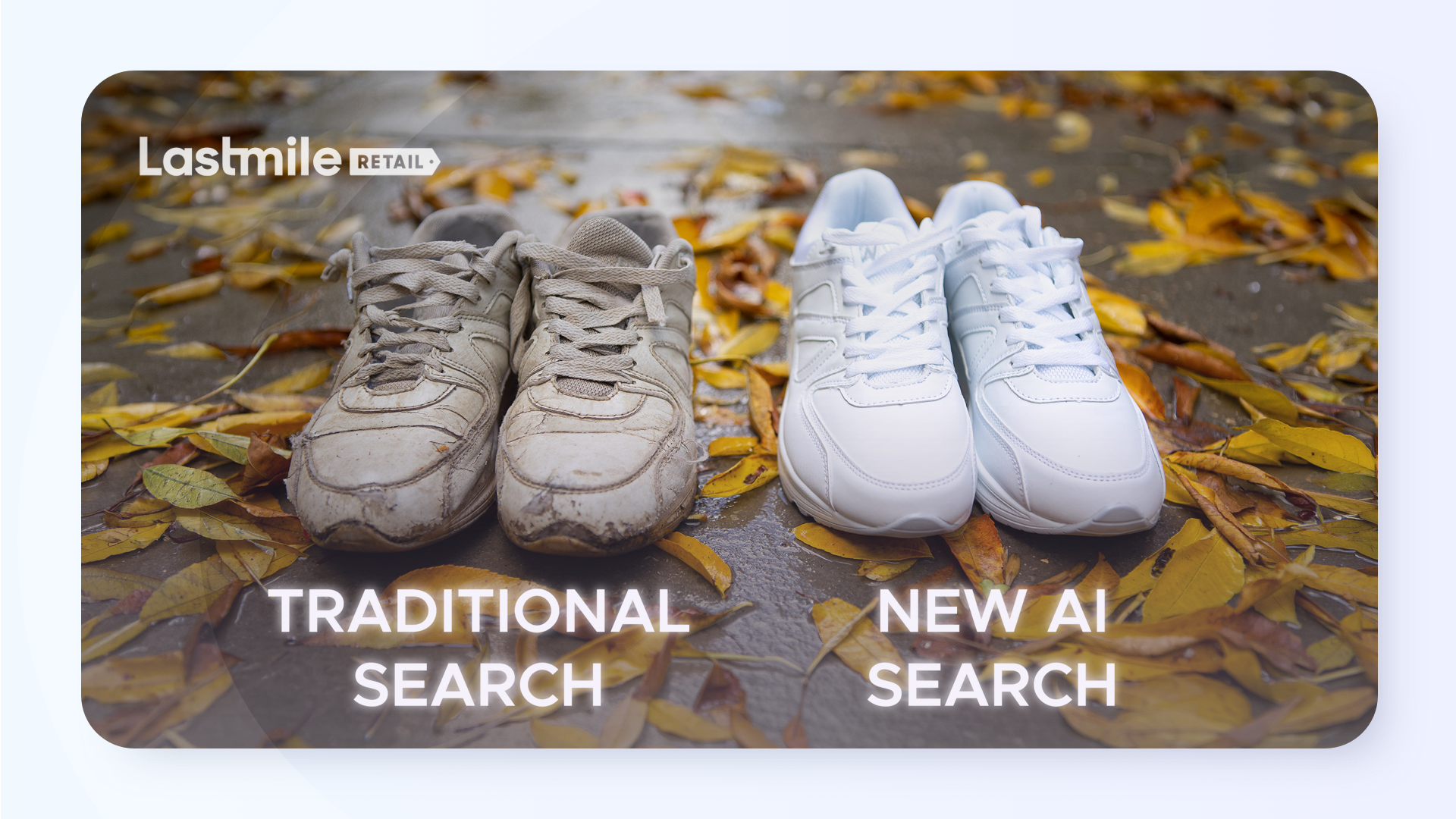
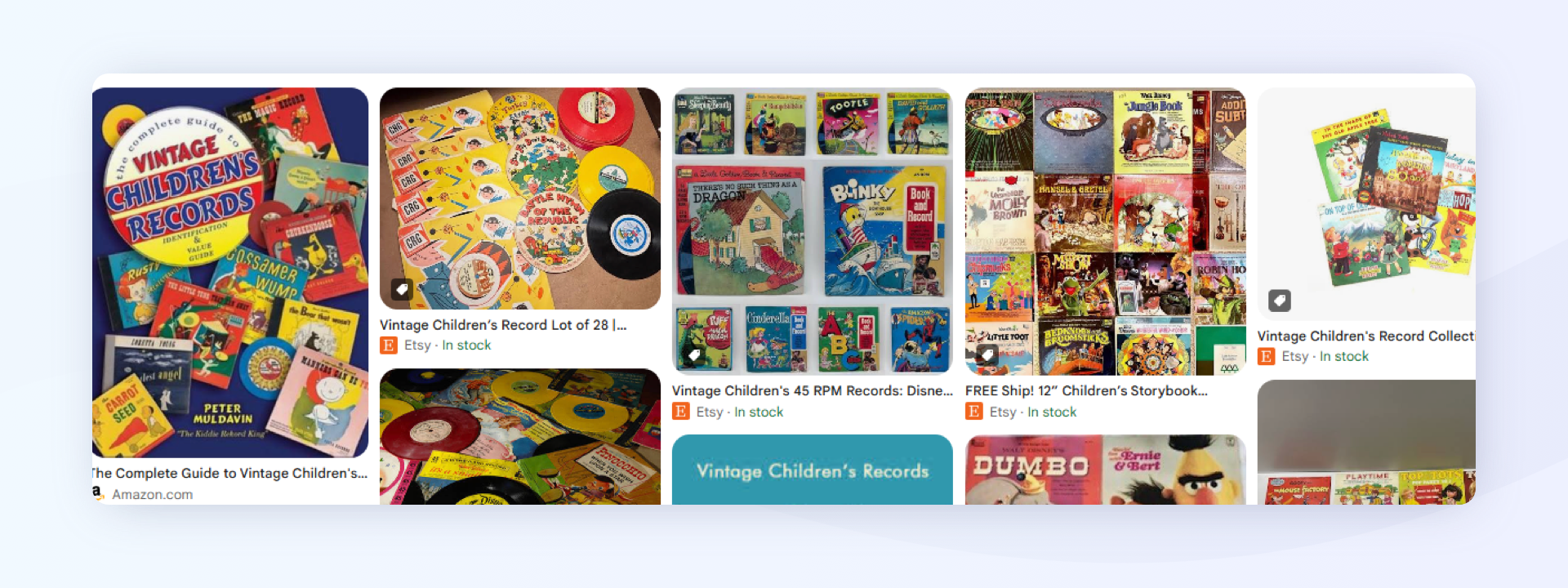
My hot take: Google’s AI Mode is a deeper information retrieval system than Google Search.
There may be no more educational exercise for local brands than to watch actual consumers trying to get what they want out of the internet. I’d like to start today’s column with a personal example.
For the past 20 years, I’ve been trying to track down a vintage LP that I had as a child. I hadn’t seen or heard this record album in decades, couldn’t remember the label that produced it, who the narrator was, or what the album cover looked like. I only knew one thing: that the LP contained three specific stories and nothing else.
Every so often, I would turn to Google and YouTube to try to locate this record, and both sources would show me a plethora of recordings similar to the one I remembered, but no matter how I tried to refine my search, the album simply wouldn’t come up in these systems.
A couple of weeks ago, it occurred to me to prompt Google AI Mode. I was utterly stunned that after years of trying in vain to track this record down, the system found the correct item within a minute or two. It was amazing to see the old record again and to be able to show it to my siblings.
Common phenomenon: I’m a bit of a nostalgia nerd, and have had the same dead-end experience with countless other searches for rare items. Maybe that’s unsurprising, but what I want to note here is that I regularly run into the same issue when using Google Search for new inventory. No matter how I try to refine my keyword-oriented search language, Google just keeps turning up irrelevant results. It feels like the search engine just doesn’t understand me and can’t help me.
Today, I want to talk to you about whether your local enterprise is leaving potential customers hanging like this or is arriving with the right help at the right time.
Hidden demand and the need for more help
About a year ago, I conducted a large consumer behavior study with reputation management brand, GatherUp, which discovered that 6/10 people want to talk to someone or something when searching for a local business. In other words, they want more help on their customer journeys.
I think it's plausible to connect the dots between these two stats.
And I think there are multiple reasons for customers seeking help beyond the traditional SERPs, including:
- Google’s search engine results pages can feel overloaded with choice, messy with too many SERP features, and hard to navigate when trying to narrow down to a particular desired item or specific information.
- Major local enterprises have made questionable choices when it comes to providing excellent consumer experiences; long phone hold times and limited on-site staff are two modern phenomena that are extremely common at the stores of large brands, and they are key hallmarks of very poor customer service.
- Poorly-trained human staff offer inadequate assistance, whether on the phone or in person, at enterprise locations; it can be extremely frustrating for customers to struggle to access human assistance, only to find that employees haven’t been trained to answer basic questions about product and service availability, brand policies, etc.
- AI-driven, automated customer service is painful; rest assured that this is not one of those articles which claims that AI is “the answer” to everything. In my experience, AI chatbots are a recipe for negative consumer impressions of brands, creating endless loops of unhelpful information and wasting customers’ time. In the last couple of months, most of the major brands I pay monthly household bills to have switched to AI-driven phone answering systems, creating similar cycles of deeply frustrating misunderstanding, misdirection, and wasted time. These “solutions” may cut costs, but they also sabotage customer experience (CX).
The combination of my 2 stats + these 4 barriers to a successful customer journey make it pretty clear why people might be turning to conversational AI like Google AI Mode or ChatGPT in hopes of getting the help they need.
In fact, if you use a tool like QueryFan.com you can see how AI tools are using the process known as query fanout to respond to a single user persona prompt; watch this video demo of all the things a customer might need to know if their hot water heater is broken:
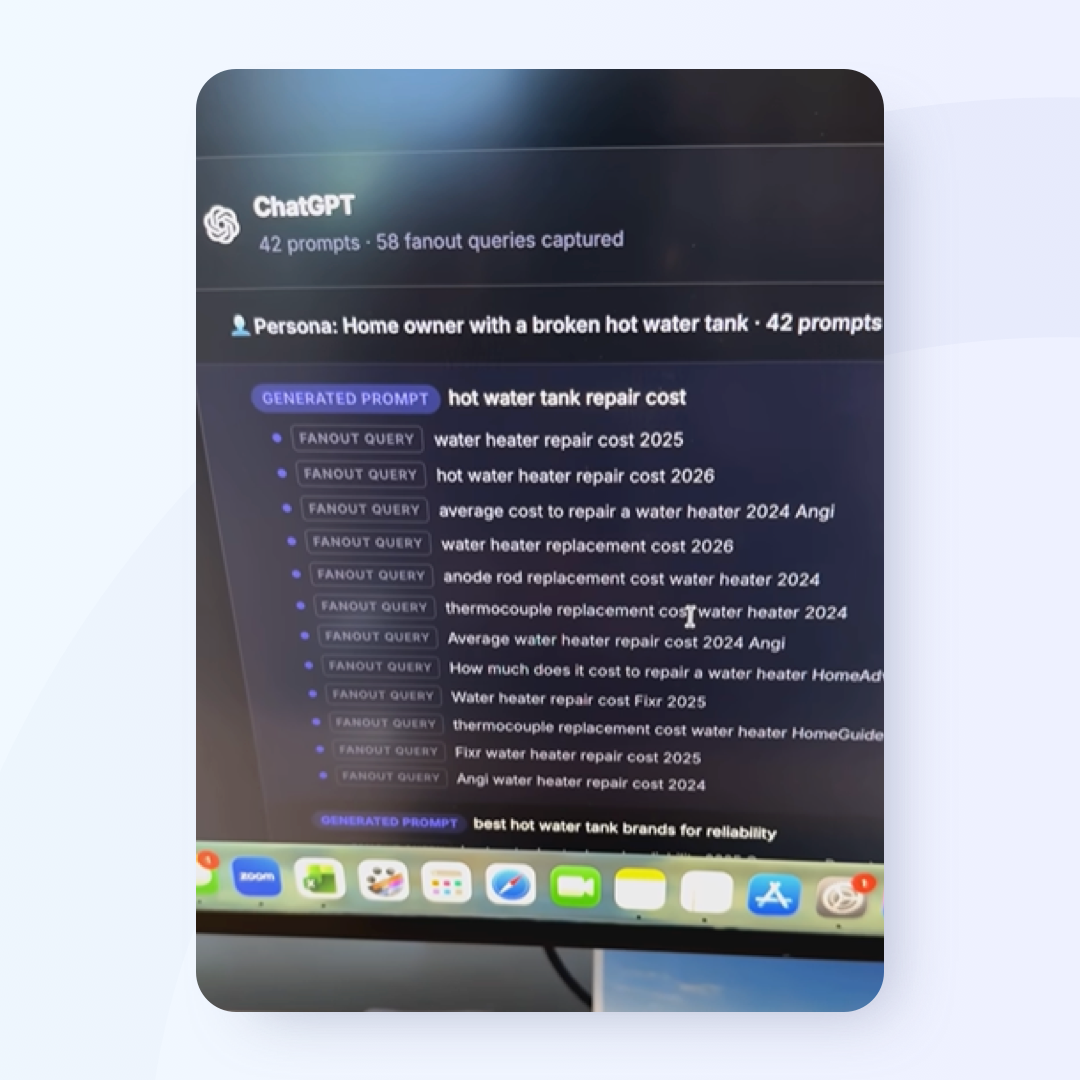
As I covered in a recent column, the public is being re-trained to ask long, complex questions of AI instead of the simple local-intent, keyword driven prompts of old (like water heater repair near me).
In a nutshell, consumers are now trying to see if Google AI Mode, ChatGPT, and similar tools can give them the help they aren’t getting from traditional search or many local brands.
Will AI fill the help gap? It’s up to you.
The logical next step in my anecdote about the vintage children’s LP should be my prompting Google AI Mode to tell me if any local music stores, second-hand stores, or other nearby vendors have this record in their inventory. But here’s where AI mimics Humpty-Dumpty and “has a great fall.” Why? Because no shop near me has got an AI-ready inventory for such an unusual piece of merchandise.
Perhaps this is no big deal in the instance of such a rare item. The clear scope of the issue only emerges when you see that major local enterprise brands are similarly unprepared to make the most of the sophistication of AI information retrieval systems. Consumers cannot be helped unless AI has what it needs to assist them in their complex, highly-customized queries.
An honest evaluation of brand AI preparedness should pose the question:
Is our content publishing strategy mimicking an undertrained employee, or a highly-experienced customer service professional?
Checklist: Hallmarks of undertraining
All of the following issues signal that human staff and AI are undertrained:
- Unsure where a business is located and where its service area extends to
- Unsure when a business is open or closed, including for regular, seasonal, and holiday hours
- Unsure about all the ways to contact and access the business, including website URLs, local business listings, social media profiles, phone numbers, text lines, email addresses, in-store, home delivery, BOPIS, etc.
- Unsure about real-time product/service availability, including which next-nearest locations have desired items when they are out-of-stock at the location nearest the consumer
- Unsure about product/service features, specs, how-tos, repairs, prices, etc.
- Unsure about the USP/UVP of the brand, why it is an expert in its field, and who cites it as an expert
- Unsure about brand policies, including customer satisfaction guarantees, returns policies, legal licensing information, accreditation, etc.
- Unsure about how consumers can make a complaint when needing help and have it escalated properly for one-on-one resolution vs. the negative outcome of low-star online reviews and ratings
A simple task
Take my checklist to Google AI Mode or ChatGPT or Google’s mobile Ask Maps feature, and start asking questions about your brand like:
- What does X brand offer?
- Is X brand open on Thanksgiving?
- Does X brand have X product in stock right now?
- What is X brand’s return policy?
- What is the reputation of X brand?
- More complex questions that feature multiple intents in a single prompt, like “Where can I get a new iphone at a store near me that is open on Thanksgiving and has a fair return policy?”
Your task will turn up one of three things:
- Your content publishing strategy is awesome – You’ve made it possible for AI to know everything about your business so that it is mimicking a highly trained customer service professional.
- Your content publishing strategy is spotty – Gaps in your work as a publisher are resulting in a mixture of correct answers, incorrect answers, and missing information when consumers use AI to try to understand your business; AI is acting like an undertrained staff member at your company.
- AI is just getting it wrong – You’re not sure whose fault it is, but AI is turning up a ton of inaccurate, outdated, misleading information about your enterprise’s locations, and you are almost certainly losing customers because of it. It could be because you haven’t published enough information. It could be because, for all the hype, conversational AI is a really inconsistent environment. All you know at this moment is that something is going wrong with information retrieval, and you need to get to the bottom of it to try and protect brand profits.
If scenario #2 or scenario #3 accurately describes your findings, it’s a guarantee that at least some of your customers are not getting the help that they hoped for from AI tools. The financial impacts of this are obvious.
And it’s up to you to experiment with whether a more robust publishing strategy can transform popular conversational AI tools into sufficient sources of help for your prospective consumer base.
Are we there yet? No.
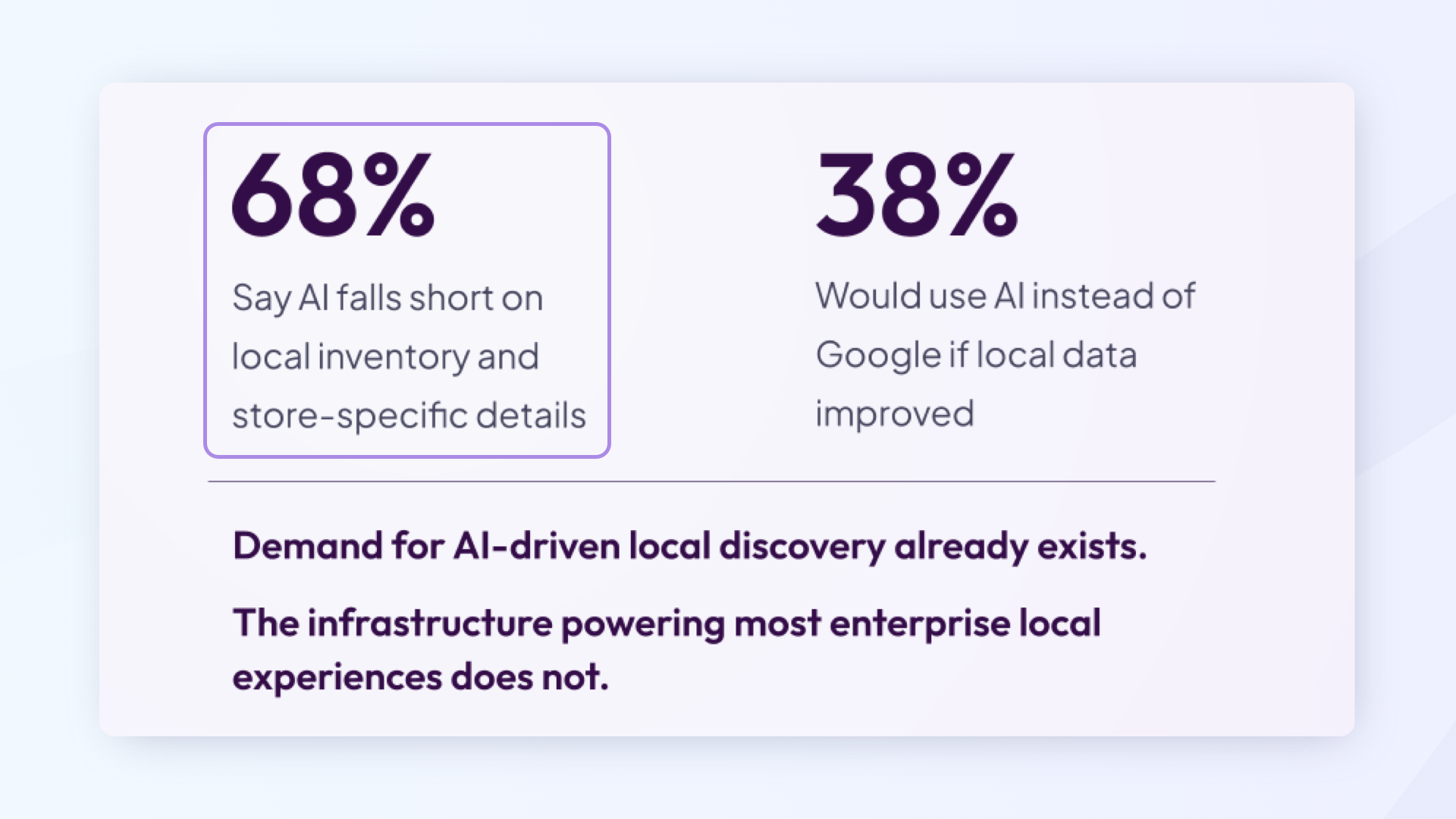
Lastmile + NearMedia’s joint study, Local Search & Shopping: How AI is Disrupting the Customer Journey, finds that 68% of US consumers feel that AI falls short when asked to provide store-specific details about inventory and other local information. 38% say they would use AI instead of traditional Google Search if its local data improved.
What we see here is a real-time glimpse of what the public is experiencing right now, using conversational AI in local contexts. With nearly 7/10 consumers expressing disappointment with AI’s ability to retrieve helpful local information, your brand needs to create an AI-ready local framework for improving CX. Here’s how Lastmile envisions that framework for major brands like T-Mobile and Hyatt:
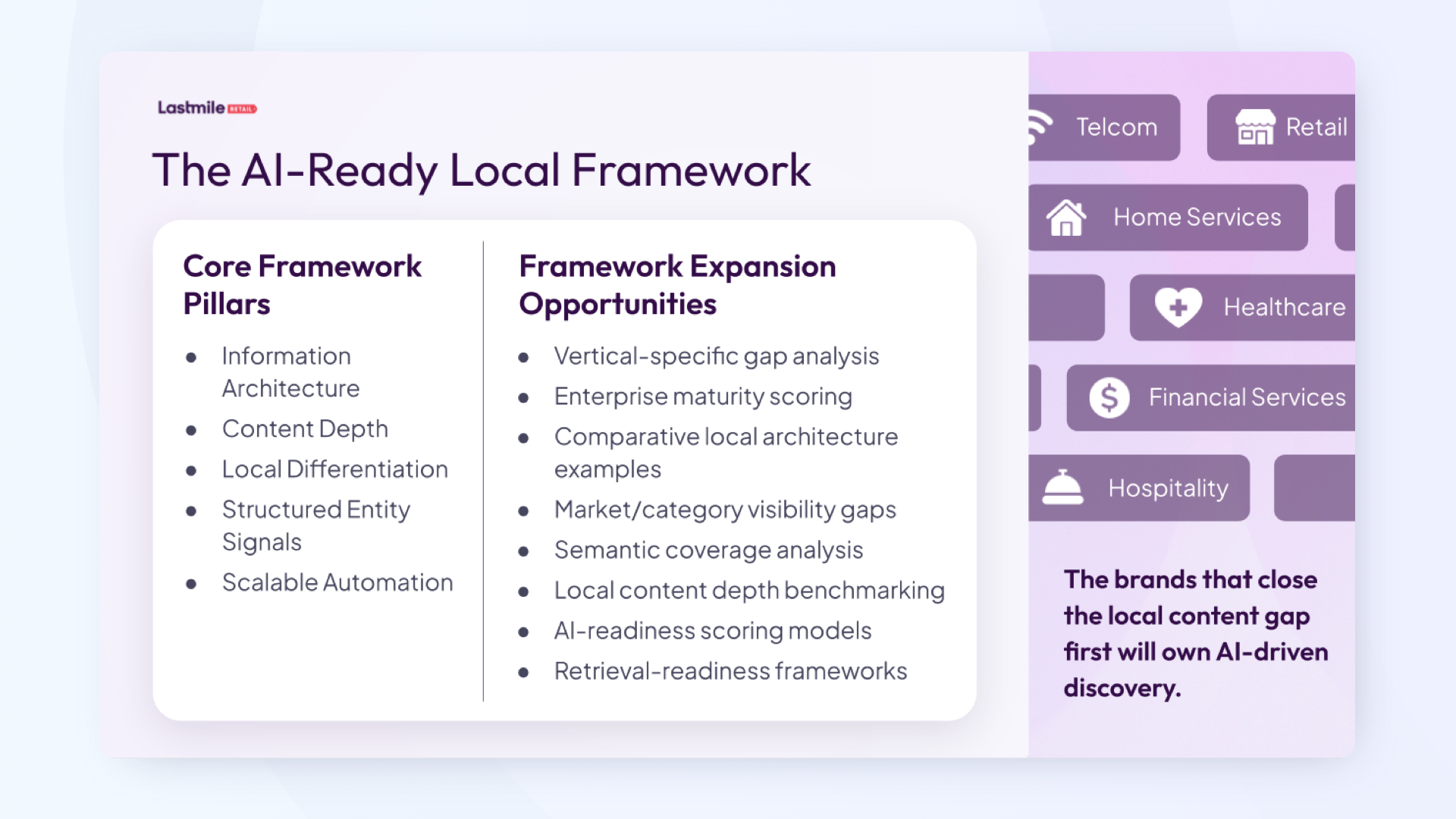
Lastmile’s approach hinges on:
- Core Framework Pillars, including information architecture, content depth, local differentiation, structured entity signals, and scalable automation.
- Framework Expansion Opportunities, including vertical-specific gap analysis, enterprise maturity scoring, comparative local architecture examples, market/category visibility gaps, semantic coverage analysis, local content depth benchmarking, AI-readiness scoring models, and retrieval-readiness frameworks.
By implementing a richer local ecosystem, Lastmile finds that your enterprise will outperform brands with thinner local architecture. In an analysis of 51k SERPs and over 2M entity citations, Lastmile compared our client, T-Mobile, to its competitors, Verizon and AT&T, with the following findings:
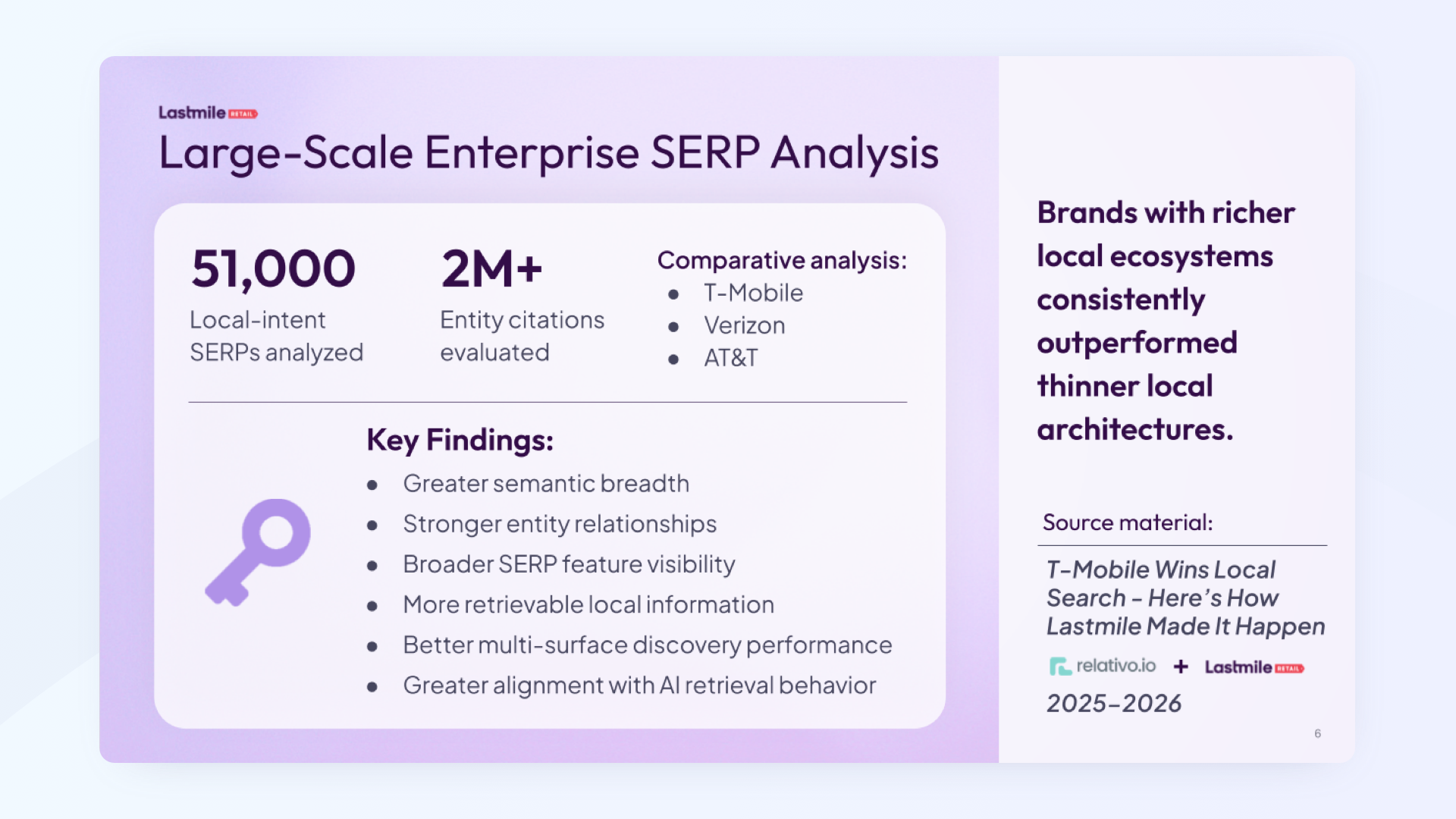
T-Mobile’s richer local ecosystem resulted in greater semantic breadth, stronger entity relationships, and broader SERP feature visibility. It also enjoyed more retrievable local information, better multi-surface discovery performance, and greater alignment with AI retrieval behavior.
Lastmile SEO Marketing Leader, Shawn Huber, concluded that:
“The brands building richer local content ecosystems today will become the most visible brands in AI-driven search tomorrow.”
Want to see more case studies like this and speak to Lastmile’s team about partnering to develop an AI-ready framework for your local enterprise brand? Schedule a meeting today.
Tactics for surfacing hidden consumer demand
My second hot take: the depth capabilities of AI tools could raise local consumer expectations of all brands.
Local customers are in a honeymoon period right now with conversational AI tools like Google AI Mode, ChatGPT, and AskMaps. They are prompting these tools to see how much help they can get from them. Opportunity is knocking for enterprises that master retrievability. Expectations for what consumers can expect of brands in terms of help, transparency, fairness, competitive pricing, and convenience should increase if AI products prove useful enough to be adopted into daily life.
The local communities surrounding locations of your business may want things they’ve never voiced in the past. Captured demand for novel goods, services, policies, and amenities can help you grow your business in ways you’ve never considered until now. Use the following checklist for discovering hidden consumer demand relevant to your organization’s business categories and locations:
- Create location-specific or regional customer surveys with open-ended questions like “what do you wish we could do for you to make us a better business?”, “is there anything you wish you knew about our business?”, “what is the worst thing about our business?”, “what is the best thing about our business?”, “what are your ideas about how our business can improve customer service?”, “what are your ideas about how our business can be of more help to the community?”, “is there a business you prefer over ours – why is that?” Task branch managers/franchisees with reading individual responses and use AI to summarize findings and discover patterns of demand.
- Transparently record customer service phone calls to capture common demand themes as well as unusual ones that could spark novel growth and fulfilment.
- Informally poll local social media to discover interest in new products, services, programs, events, policies, amenities, and other features surrounding each of your locations.
- Implement a new program for in-store staff that enables them to document both FAQs and unusual questions the business receives. On a quarterly basis, branch managers and franchisees should review these findings and use AI to discover sentiment patterns.
- Survey branch-specific local staff to request ideas for how the brand can be more helpful, based on the customer services wins/failures employees have witnessed first-hand
- When entering new markets, query AI regarding the outstanding characteristics (both positive and negative) of nearby competitors’ reputations. What do customers like/dislike about these brands? Fact-check cited sources for accuracy, and use this as business intelligence for creating a more helpful business at the new location.
- Use query fanout tools to uncover relationships between conversational AI prompts and underlying queries to discover adjacent and related consumer demand.
- Document adjacent/related consumer demand surfaced by Google SERP features like “People also ask” / “People also search for”.
Summing up: Evidence-based optimization surrounding brand helpfulness is the new normal
To make the most of AI’s deep retrieval capabilities, local enterprise brands need to get into better alignment with AI retrieval behavior. This maximizes discovery of information on the part of consumers who are currently evaluating whether to make AI tools a part of their daily lives.
To win the most customers via emergent AI interfaces, brands must meet the growing demand for more helpfulness, both online and offline. CX excellence creates the positive track record of offline transactions that translate to a detailed and persuasive online record of why your brand deserves to be chosen.
In a future column, I’ll be looking at why the consequences of failing to effectively scale local enterprise content publication have just gotten worse, but for now, I want to close with a positive thought:
Customer-centric brands can lead in the AI era because the unifying factor of AI optimization is simple helpfulness. Sincerely wanting to assist your customers is the best motivation for understanding and solving for the new AI environments. You can build up a retrievable body of evidence that your business is a trustworthy choice, one customer at a time.
See how Lastmile is doing this for our partners. Request a live demo today.
Request a Demo
Drive more local sales by pairing shoppers with real-time inventory and promotions through seamless online-to-offline capabilities that help clients transact now.