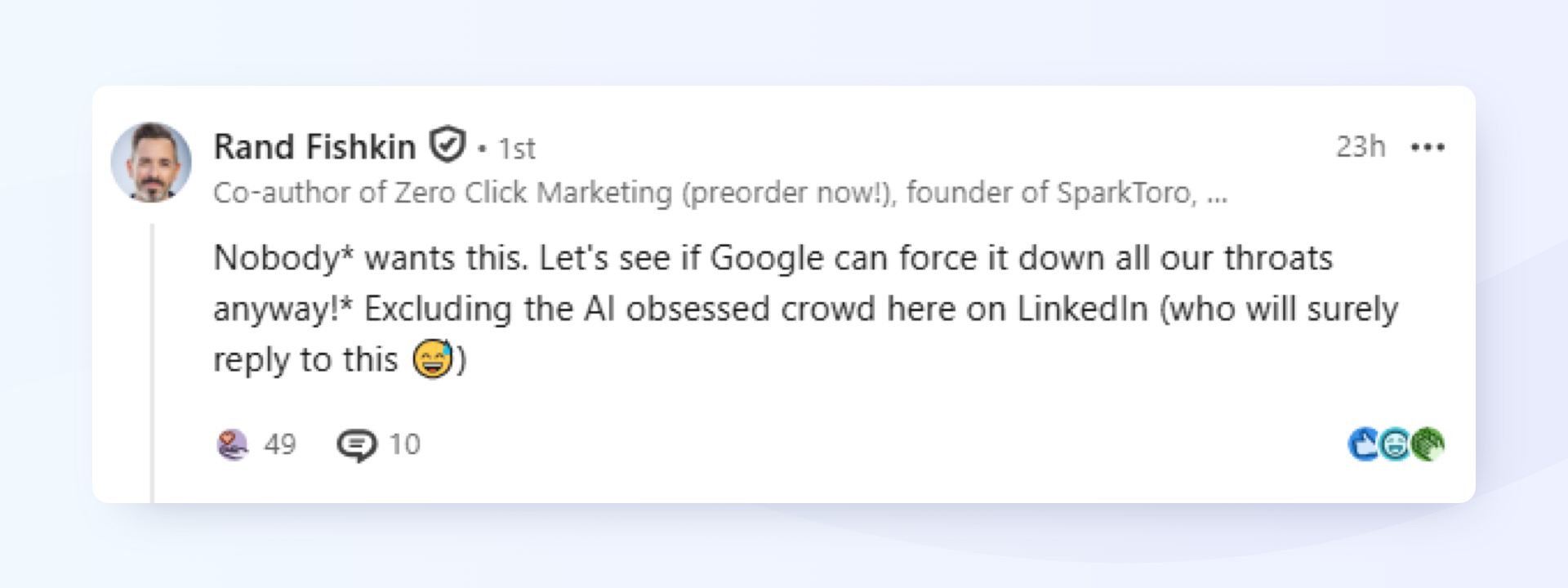
What is my respected former CEO at Moz and globally-renowned digital marketing authority, Rand Fishkin, reacting to?
This summary of Google’s new AI-powered search box, announced at Google I/O 2026 and promoted in this video:
YouTube commenters can be a notoriously tough crowd, but if you spend even 3 minutes reading the comments on this video, you’ll quickly notice the similarity they bear to Rand’s own response to Google turning its traditional search box into an AI search box:
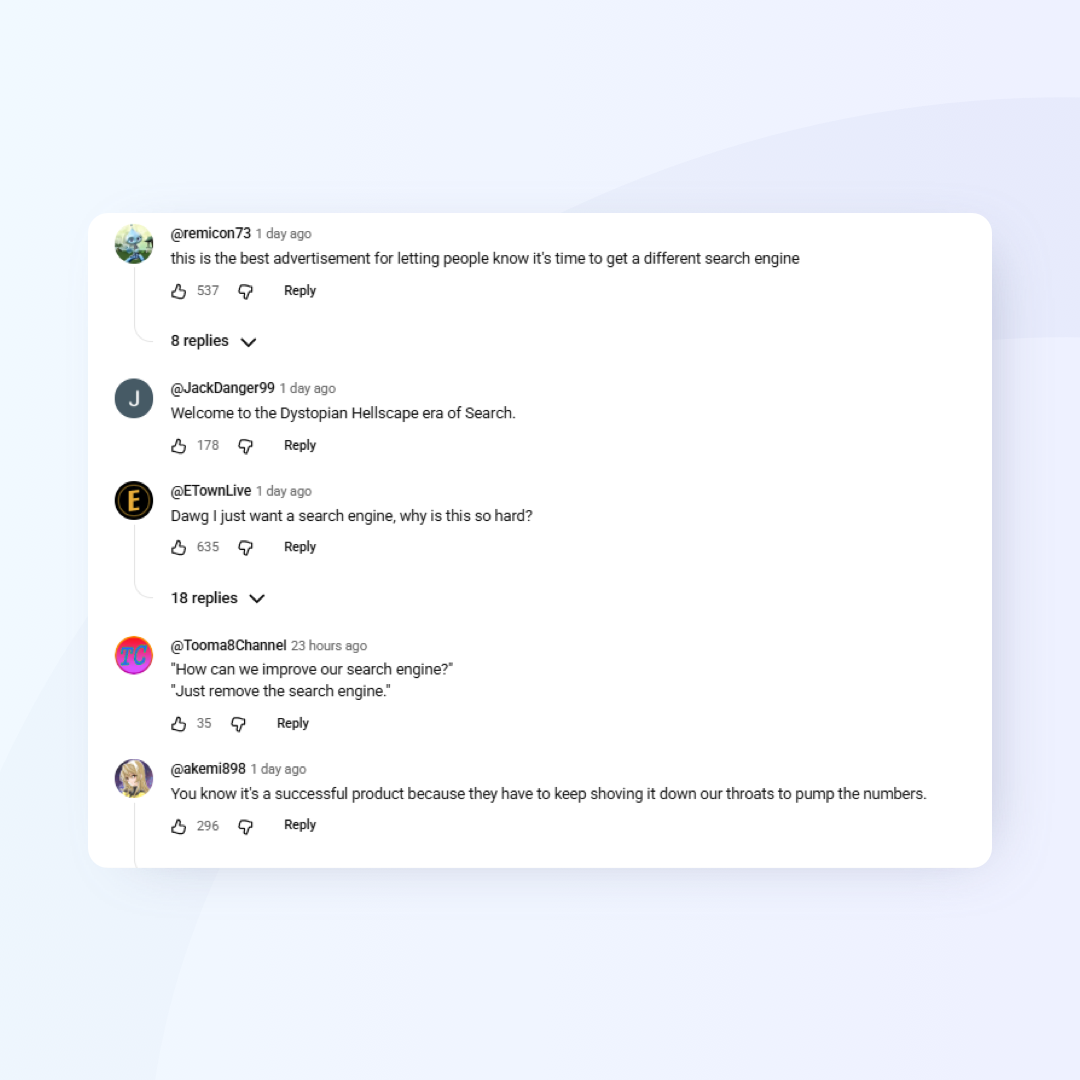
Because I’m uncomfortable with AI, I spent more than 3 minutes reading the YouTube comments, and I have a breakdown here of the core negative sentiments they contain. As a local SEO who has spent 20+ years researching consumer reviews, I’m highly conditioned to pay attention to complaints. Here’s what YouTube commenters are saying about Google’s new AI search box:
- It feels forced on the public and people don’t like that
- People are convinced that no one wants this technology, apart from stakeholders
- People want to connect directly to websites, not be stuck in Google’s random-feeling snippets
- Similarly, people don’t want Google to answer questions – they want it to direct them to authoritative sources answering those questions; people see Google as a conveyor rather than a destination and are not happy with Google trying to rebrand itself in this new way
- People suspect the video was produced by AI because it’s jumpy, frantic, and hard to watch and some people felt sick due to this when they tried to watch it
- People feel Google is navel-gazing at their slick UI and careless about the poor quality of the results of their AI products, which are routinely full of nonsense
- People want to switch to a traditional search engine, such as Ecosia or DuckDuckGo after seeing this video
- People want to turn this function off and are requesting tutorials for how to do this
- People feel that Google is unresponsive to public mistrust of AI
- People think Google is making a terrible business decision
- People want search to be separate from AI
- People are continuing to cite Google’s old code of ethics, “don’t be evil” as if attempting to remind the brand of it in contrast to public perception of the company today
- People are upset that a Depeche Mode song was used in the ad
- People are making satirical references to the lyrics of the song, “Just can’t get enough”, remarking that billionaires can’t get enough, that Google can’t get enough of people’s personal information, and that consumers have had enough of AI
These are, of course, just the personal takes of random YouTube watchers, but brands (including local enterprise brands) should always be tuning into public sentiment, and I want to especially circle back to the second line in Rand’s comment in which he remarks on the “AI-obsessed crowd” on Linkedin.
What if your local enterprise is using AI but your customers aren’t?
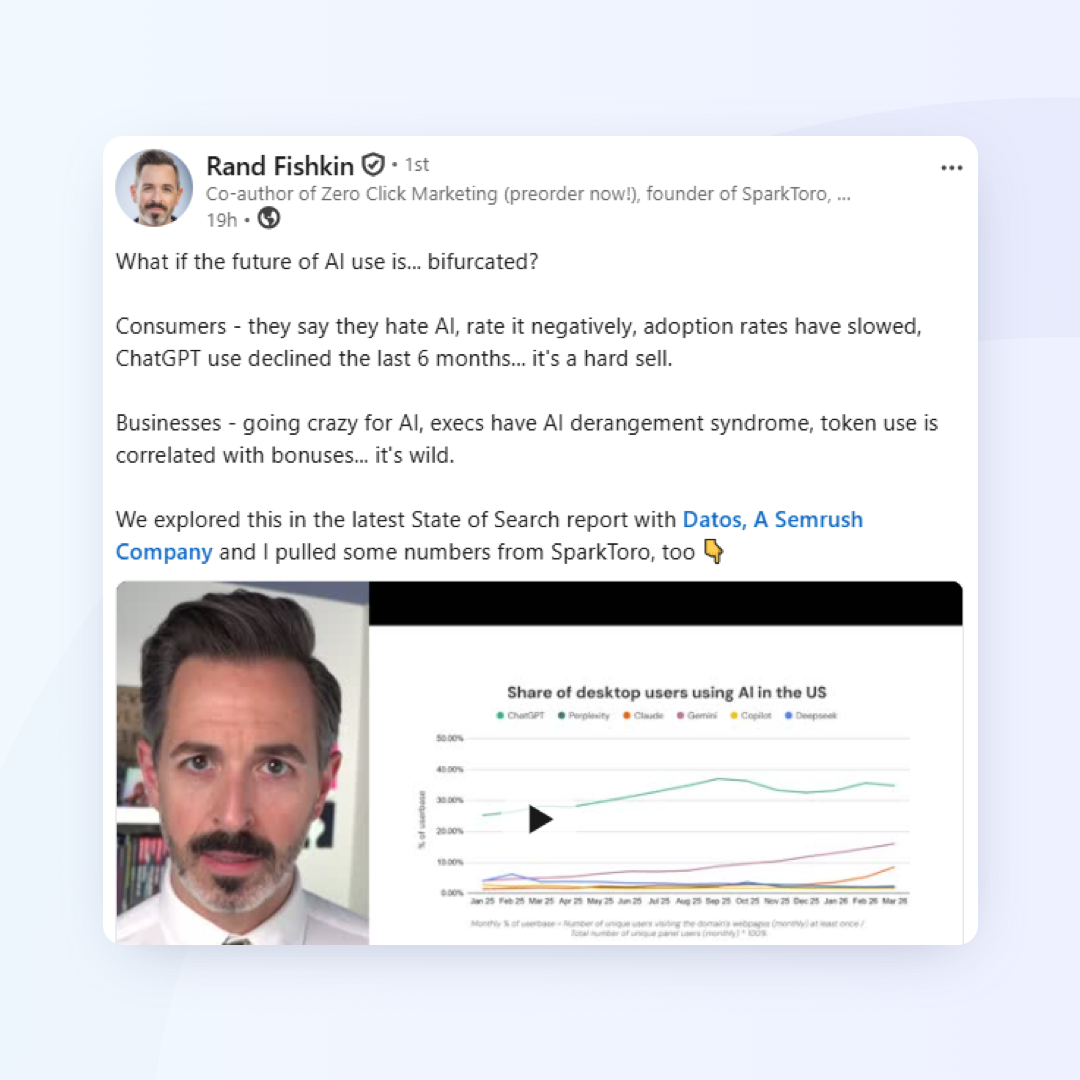
Just before I watched Google’s promo of their new AI search, I had been watching this Linkedin video in which Rand Fishkin summarizes data from the State of Search report by Semrush’s Datos, which appears to reveal a significant fracture line when it comes to AI. In brief, the data suggests that AI usage is huge with businesses, but not so much with consumers.
Will these stats change as a result of Google’s attempted makeover of themselves as an AI brand instead of a search brand and their new move with their search box, which attempts to transform all former searchers into AI prompters?
Here’s the truth: no one knows.
Marketers don’t know.
Businesses don’t know.
Google doesn’t know.
But I’m lucky enough to know a veteran marketer who wants more transparency to be brought to how little anyone knows about what will happen with AI in the future. Lastmile’s Executive Vice-President, Sebastian Pawlowski, was chatting with me recently about a major marketing conference he had attended. I am paraphrasing his remarks here:
“Everyone is trying to say they know the future of AI, but what they’re actually saying is, ‘Look, we have cool stuff.’ Brands like Google are obsessed with the cool stuff they’re showing off, and lots of marketers are basically running around saying, ‘Cool stuff, cool stuff!’ But what about customer? No one at these brands is talking about customer. Why is that? Nobody actually knows the degree to which consumers are going to adopt AI into their lives the way they did with traditional search. It’s B.S. if you hear someone claiming they know.”
With any technological development, marketers are going to rush to have a take on what’s new. That’s our job. But we’re really running into a problem with this dynamic when it comes to AI. It’s what Rand is referring to as “executive AI derangement syndrome” – brand leadership making sweeping business changes on the basis of “cool stuff” instead of consumer demand. Orgs are being restructured, departments are being deleted, individuals are losing their livelihoods because of hype instead of hard data.
Headlines seem to indicate that lots of consumers hate AI. But we have to be careful about trusting headlines, too. They can be hype. They can be written by AI, meaning they can be based on utter nonsense. The YouTube comments I’ve highlighted and summarized in this column could be an accurate read of the room, or they could have been generated by bots.
This is a crisis of truth.
If consumers hate AI, I want to know why they hate it. Do they fear surveillance? Do they dislike layers of tech being interposed between them and actual human expertise? Have they seen enough AI-generated content to realize how many errors it contains?
Look at this Google AI Mode screenshot, in which I’ve asked who the top local SEOs are the world:

Thank you very much, Google, for including me on this list, and I kind of hate to have to tell you that the data you have about me is old and inaccurate. Just like Rand, I did indeed work at Moz…years ago, now. While we’re at it, my friend Claire Carlile did work at BrightLocal sometime back, but she’s now bringing her brilliance to Whitespark.
How many times does the average consumer need to arrive at a closed restaurant that went out of business three years ago, having been told to go there by Google AI Mode, before they decide that AI can’t be trusted? I have been spending an inordinate amount of time looking at this tool and the amount of incorrect information it has about local businesses is pretty staggering.
It really doesn’t matter how “cool” the “stuff” is if what’s in the stuff is untrustworthy or unhelpful to your brand’s customers.
Getting Uncomfortably Comfortable With Mystery

Sometimes my business and personal worlds collide. I was recently honored with an award for best artwork by The Tolkien Society and my deep dive into that fascinating world of fiction and fandom is turning up a parallel that is really resonating with me in my work in the tech world. In J.R.R. Tolkien’s The Lord of the Rings, there is an enigmatic character named Tom Bombadil whose mysterious origins, nature, and identity drive fans wild. The author didn’t want his readers to obsess over questions about who Bombadil really is, but the web is filled with people trying to solve the riddle as if their lives depend on it. My own personal take is that there is no authoritative answer, and that readers of fantasy must get comfortable with the fact that fairy tales are meant to be mysterious.
Meanwhile, as I am busily absorbing tech news and developments, I am seeing so many people trying to turn the mystery of AI’s future into cold, hard facts upon which they can base business decisions. They have good cause: their livelihoods, if not their lives, may well depend on it. Perhaps.
It’s extremely uncomfortable for many humans to sit with mystery. Humanity has been seeking an answer to the meaning of life since our beginnings. No one has found an answer, and the whole topic can feel uneasy. We want answers. We want to be able to make decisions based on facts. Unfortunately, AI is also a kind of fantasy…a fairy tale its creators are trying to see adopted as reality. Will they succeed? Again, no one knows. Their vision could be a best-seller or a total flop.
Given this, here is what I suggest you do if you are in a leadership position at your brand, and are feeling forced to make some response to emergent AI technologies in an atmosphere wholly lacking in data about how consumers will react to your decisions:
- Bargain for time – Push back if your fellow leaders are hyperactively overhauling operations because tech brands are debuting new “cool stuff”. If your business has been offering hotel accommodations, home remodeling, healthcare, or hardware for the past 20 years via a set of methodologies, you do not need to throw this out overnight. You may be the smartest voice in the room if you are advising your brand to take a breather and see how AI is playing out over the next six months, year, or even a multi-year period.
- Be especially skeptical of anything that distances your brand from its customers – Be bold and challenge business peers who are insisting that customers want chatbots, AI-based phone support, and similar technologies. I am coming across brand after brand removing all signs of a way to get into direct touch with human support, trapping people in endless and unhelpful AI-driven loops. Be bold and express any doubts you have if you hear claims that this is the way of the future. It could well be the way to bankruptcy.
- Don’t ask AI. Ask your customers – There may well be specific applications of AI your unique customer base would welcome, but you can only be sure of this if you create a consumer-centric process rooted in directly speaking to individual customers at each branch of your business, recording, and analyzing their sentiments. Read Ugly Marketing is the New Beautiful in the AI Era to understand why commerce is hitting a boiling point at which brands must give customers what they want to remain profitable. There is a serious danger if your enterprise ends up in a bubble in which your leadership is basing their decisions on AI-generated information instead of real-world patron preferences. Talk to the people you serve.
Under Pressure
Are my three suggestions unhelpful? You might be thinking, “But I have to make a decision about this now!”
If what you’re feeling pressured to make an immediate decision on involves firing all of the human writers on your staff or all of your customer service reps because one of your C-Suites has heard that AI makes talent or personal contact unnecessary, then what you are dealing with is a cultural problem.
“AI is not a savior. Not if you have a bad corporate culture,” says Sebastian Pawlowski.
If the emergence of AI is causing your brand to forget that there are individual human beings behind every transaction, then something has really gone wrong at your company. The real conversation you may need to have next is not about who to fire, but how to fix an organization that has taken its eye off the customer.
Feeling too pressured and need support? You’ll find an ally in Lastmile, where “customer, customer, customer” is the basis of our decisions on how to advise our local enterprise marketing partners. We’re comfortable with the mystery of AI’s future, and are helping brands like yours navigate wisely amid uncertainty. Reach out to us for a free initial consultation.
Request a Demo
Drive more local sales by pairing shoppers with real-time inventory and promotions through seamless online-to-offline capabilities that help clients transact now.