If you’re marketing one of the largest local enterprises in the US, you almost certainly have a content problem. It’s simultaneously the elephant in the room and one of the best opportunities that’s come your way in years.
Right now, Google is putting nearly all of your customers through a behavioral training experiment. Just as the search engine taught your consumer base to turn to Google with queries like “iPhone near me” so that such behaviors became second-nature over the past two decades, they are now re-training the public to have much higher expectations of the internet, tools, and apps, thanks to AI.
The customer who used to make simple, keyword-driven, local-intent searches is now learning to communicate their needs like this:
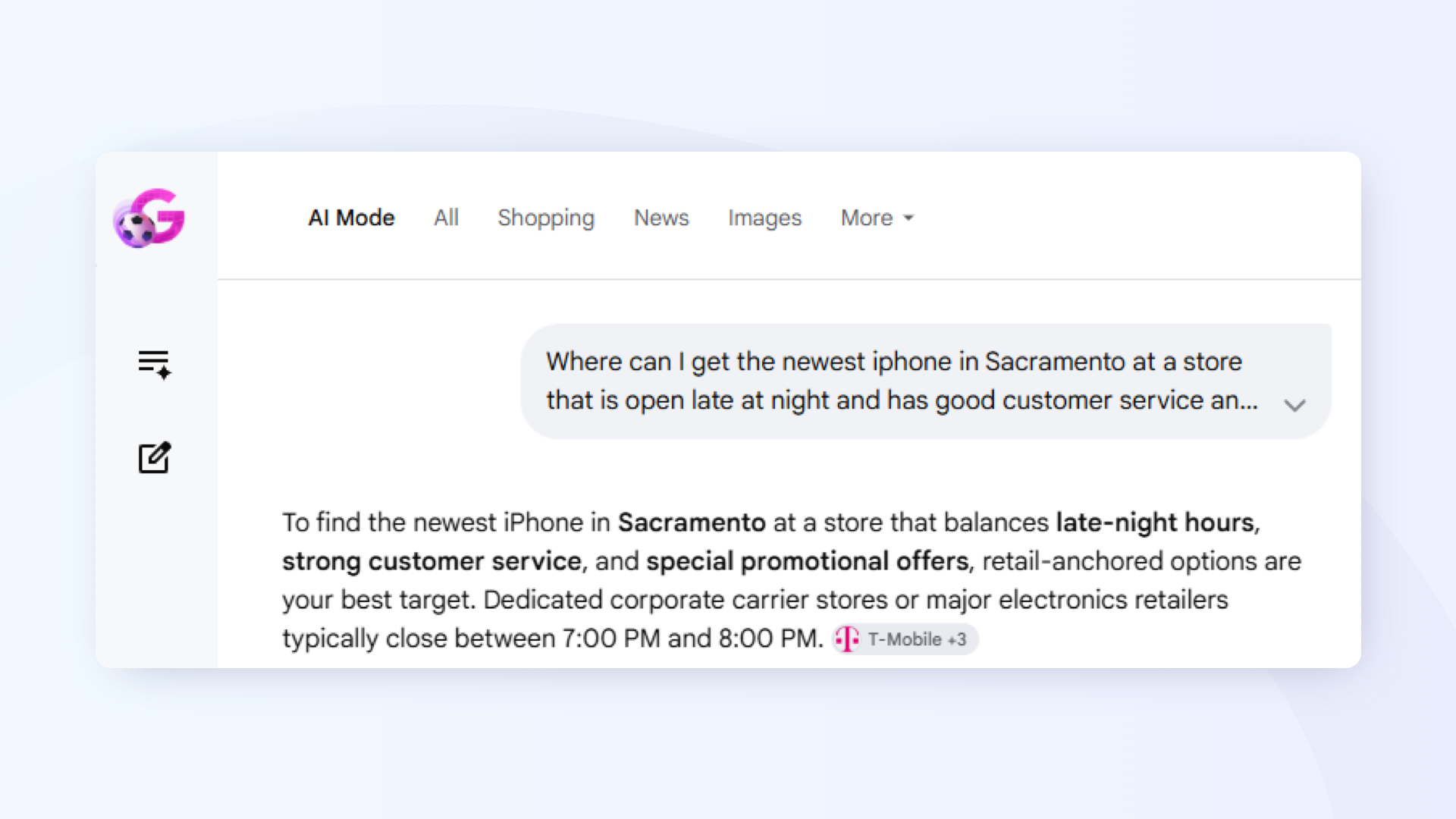
At the most recent SMX Advanced in Boston, Sebastian Pawlowski and Shawn Huber shared Lastmile’s proprietary research into the disconnect we’ve documented between local enterprise content and the new way in which consumers are being trained to utilize AI features on their journeys. Today, I want to highlight key findings for you from this timely presentation. Share this with decision-makers at your enterprise to create awareness of the local content crisis.
Current stats on how local consumers are using AI
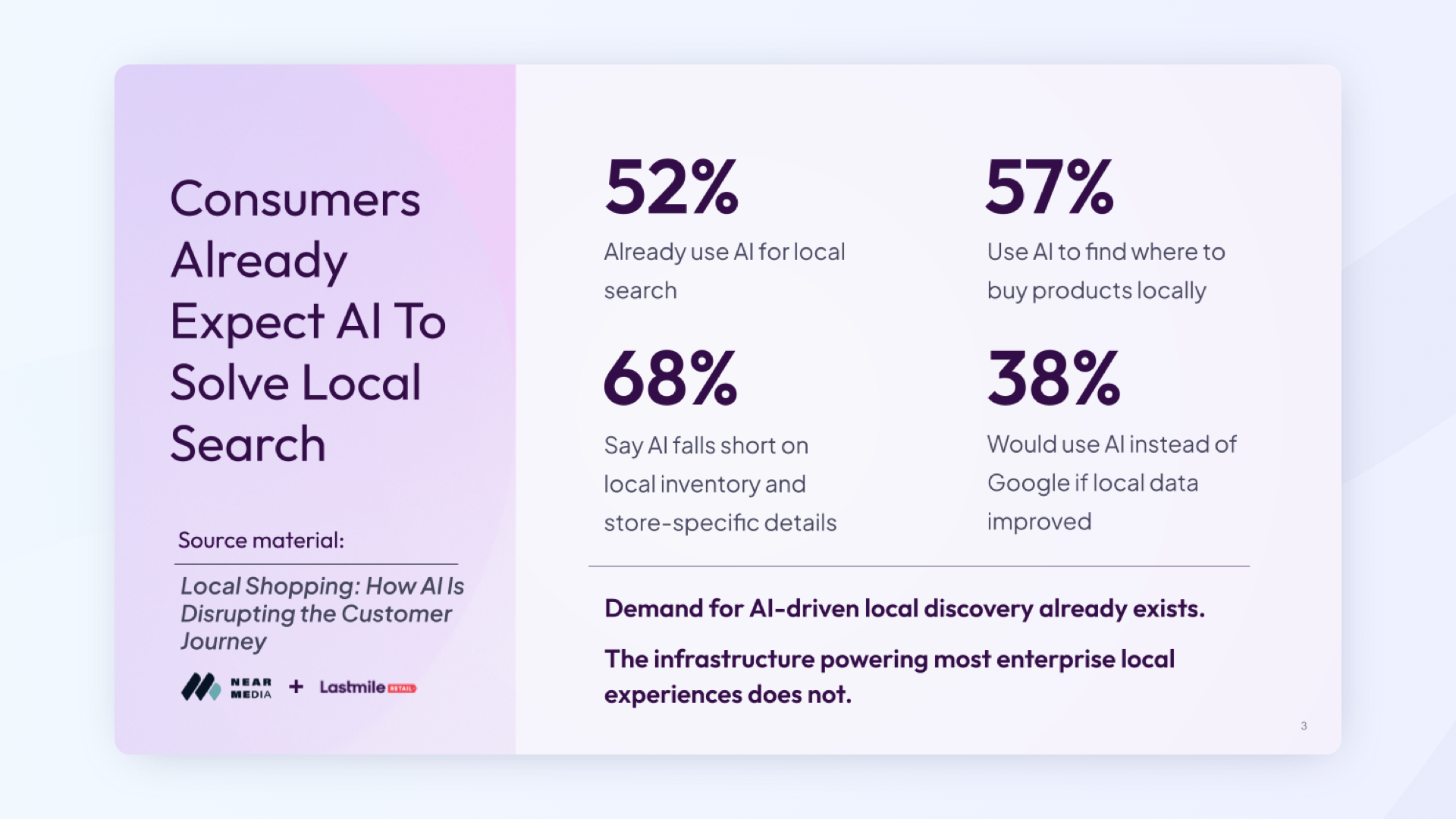
Lastmile partnered with NearMedia to research the degree to which consumers already expect AI to solve their local search needs. The joint report, Local Search & Shopping: How AI is Disrupting the Customer Journey, finds that:
- 52% of consumers already use AI for local search
- 57% of consumers use AI to find where to buy products locally
- 68% of consumers say AI falls short on local inventory and store-specific details
- 38% of consumers would use AI instead of Google if local data improved
The opportunity for your brand is that a strong demand for AI-driven local discovery already exists. Consumers are eager for more information and assistance than has been provided by traditional local search environments like Google Business Profiles and local packs.
The crisis for your brand is that the infrastructure powering the local consumer experiences you are currently offering is probably not up to the task of satisfying the desire of consumers for more help or the vast hunger of AI for specificity, detail, and context.
How search has changed
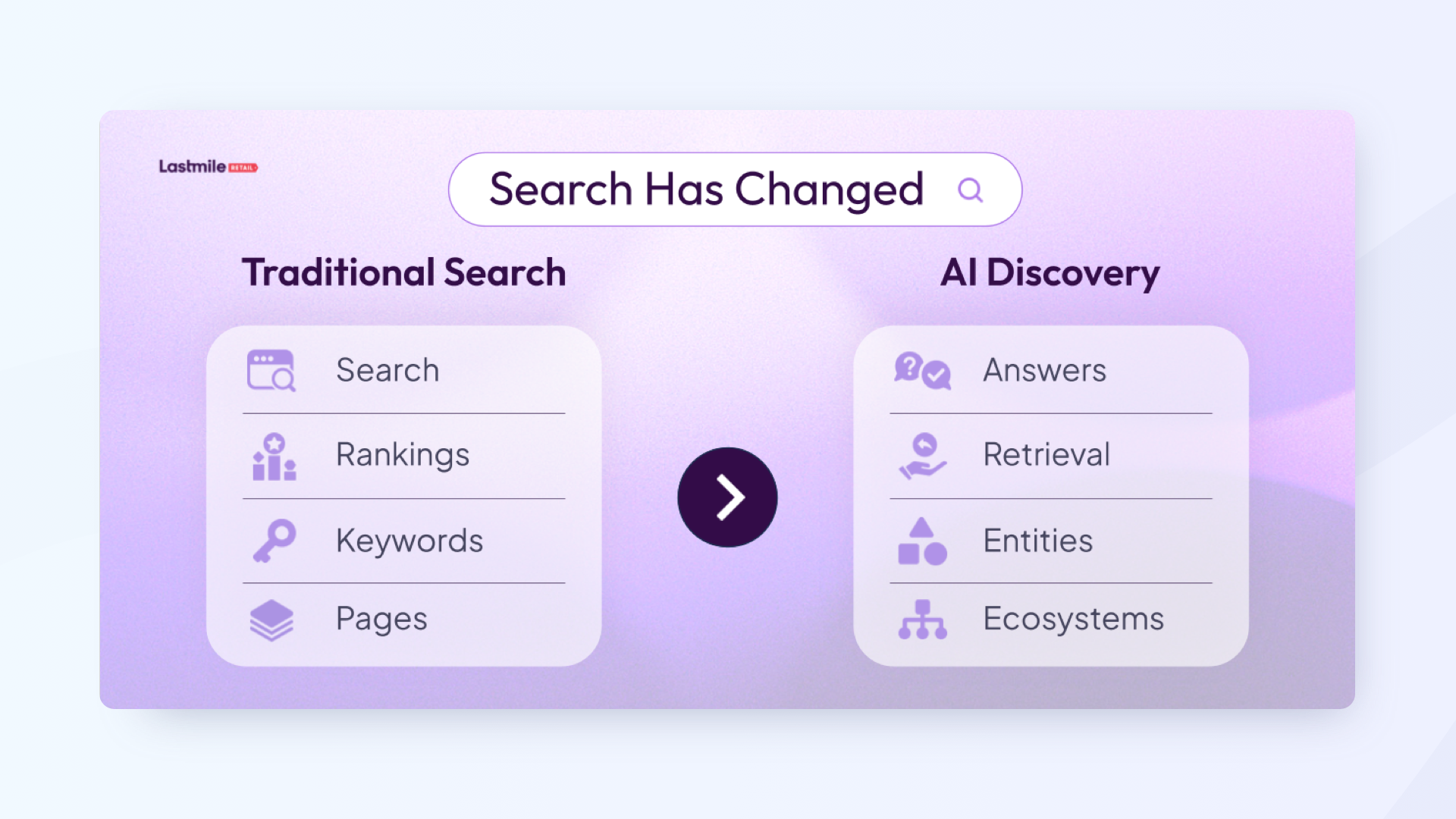
Old consumer behavioral patterns of internet usage revolved around search, search engine rankings, navigating the web via keywords and links, and landing on pages. Your enterprise has invested years in perfecting your strategy for meeting the requirements of this model.
New consumer behavioral patterns are now developing around seeking answers from AI-driven systems based on information retrieval from entities and ecosystems. To succeed in this new model, your enterprise must prove itself to be a reliable entity with a rich ecosystem of retrievable information.
Visualizing the local content gap
It’s important to understand that all local brands have been positioned at a new starting line by the emergence of local AI. There is no shame in being a beginner in 2026. Your competitors are all in the same starting lineup. However, it’s essential to get up-to-speed on new consumer behaviors as quickly as possible to defend brand reputation, visibility, and profitability.
Here is a simple method of visualizing the local content gap that has emerged for your brand (as well as nearly all of its competitors):
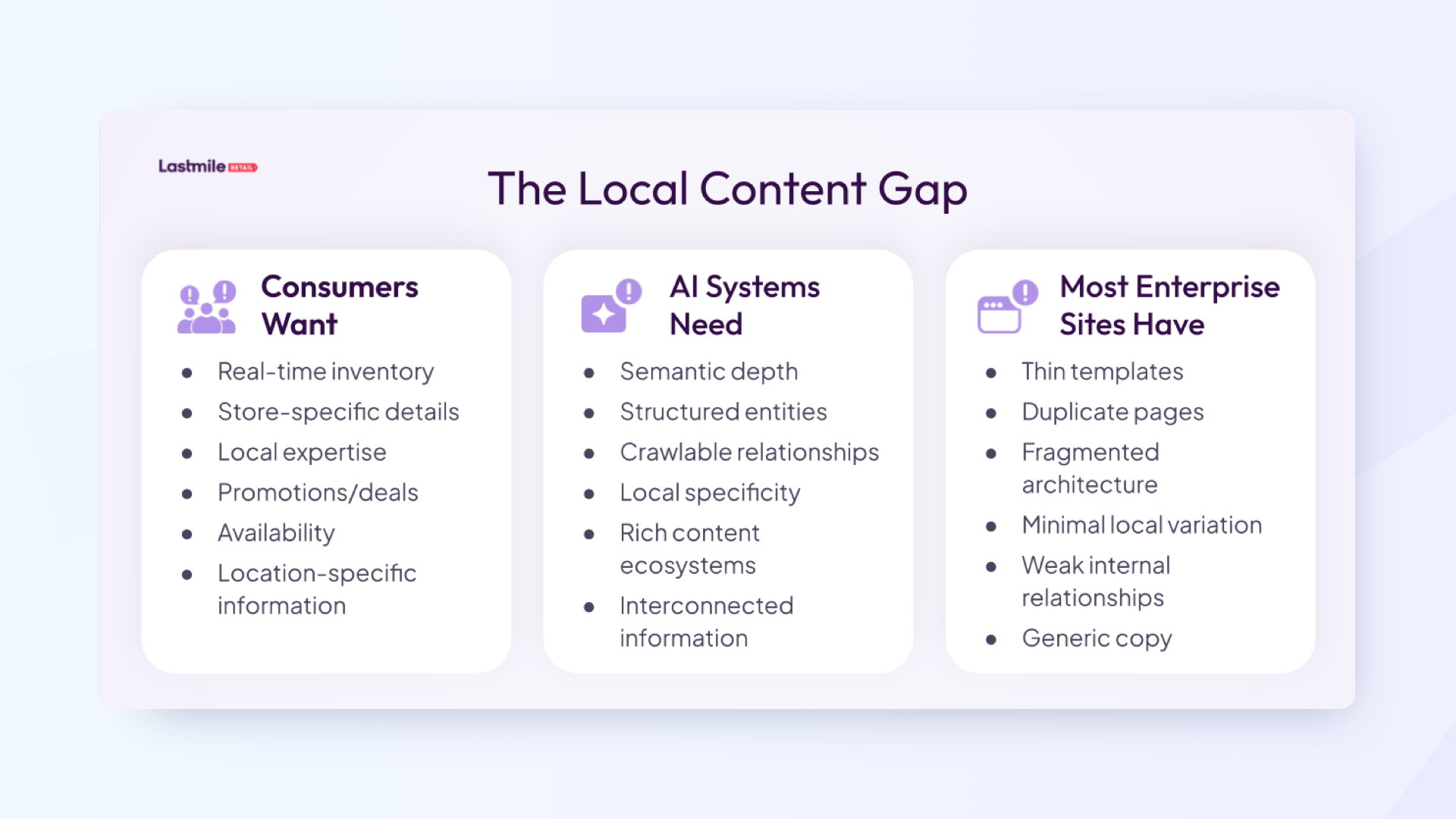
Modern consumers want real-time inventory, store-specific details, local expertise, promotions/deals, product/service availability, and location-specific information.
AI systems need semantic depth, structured entities, crawlable relationships, local specificity, rich content ecosystems, and interconnected information.
But most enterprise sites have thin content templates, duplicate pages, fragmented architecture, minimal local variation, weak internal relationships, and generic copy.
In brief, both consumer and AI demand is creating an opportunity for your brand to lead the field if you quickly identify and bridge the content gap that has come to light due to the development of artificial intelligence.
The chasm is one that your public-facing staff learned to span long ago in serving customers face-to-face. Customer service experts have first-hand experience of all the questions consumers bring with them into physical stores. This context is now translating to digital consumers because AI is making it possible for them to ask highly customized, detailed, and specific questions about local businesses.
Why most local website pages fail AI retrieval processes
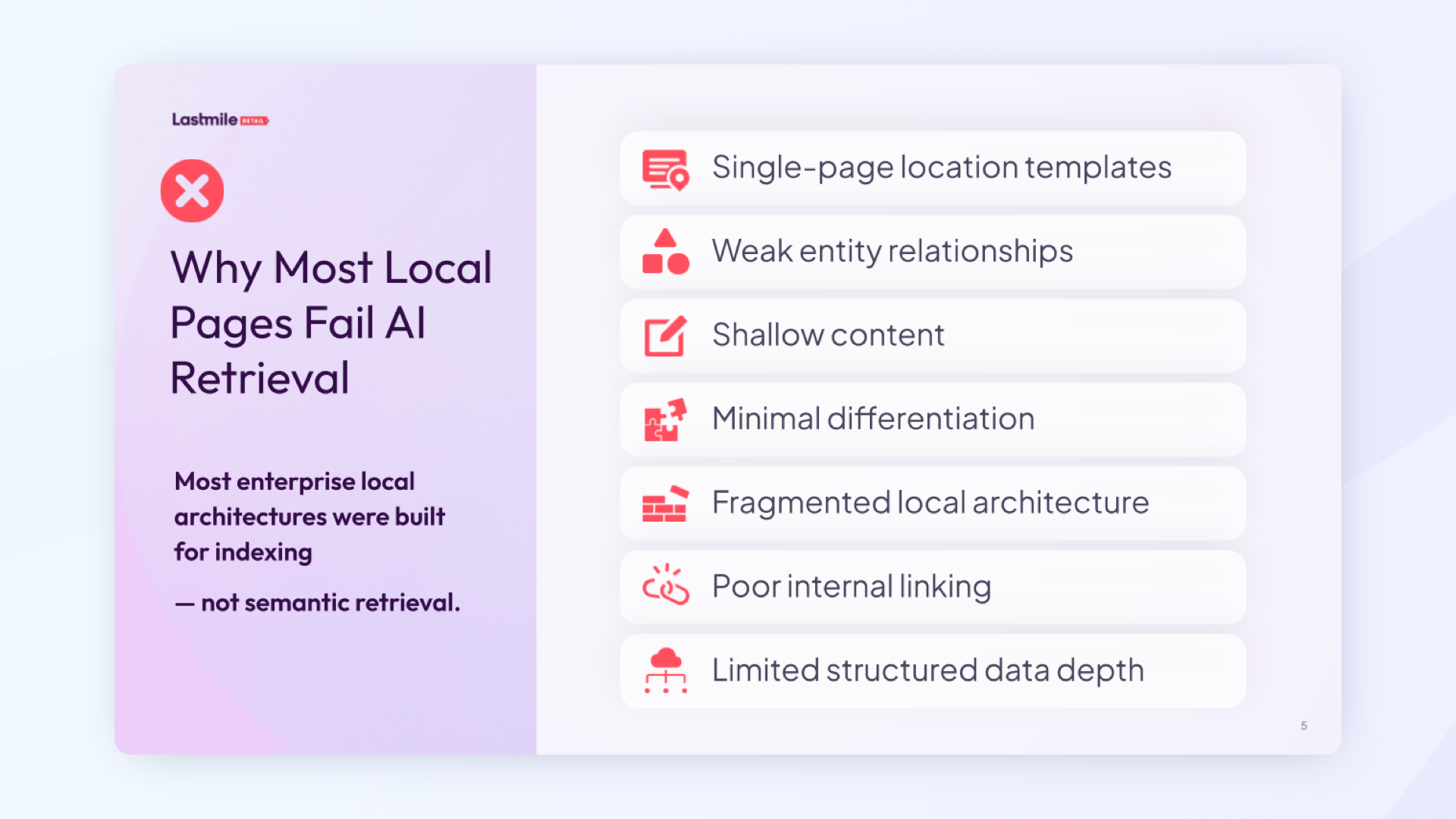
While each enterprise is unique, Lastmile has documented a clear pattern of issues present on the websites of incoming clients which, taken in sum, inhibit maximum information retrieval by AI tools.
These issues include:
- A reliance on single-location landing page templates for all locations of the enterprise; single pages typically fail to answer all possible consumer questions due to weak entity relationships and shallow content
- Minimal location differentiation; every location of an enterprise is surrounded by a distinct community with unique needs, but enterprise websites tend to take a one-size-fits-all approach
- Fragmented local architecture and poor internal linking, causing difficulties in information access by both AI and customers
- Limited structured data depth, which is increasingly problematic as early-days studies suggest that structured markup such such as Schema may improve AI visibility
The real-world results of AI retrieval failure
The obvious outcome of failing to provide the breadth and depth of information which modern consumers are learning to demand is that your brand will be invisible in AI-driven environments. This is, of course, an unacceptable scenario for any competitive local enterprise. But it is not the only dilemma you face.
When faced with a lack of authoritative information, AI tools are notorious for generating what is generously dubbed “hallucinations” but which should be more accurately termed “misinformation”. This significant problem with AI has multiple real-world consequences for both consumers and brands, including but not limited to:
- Brand misrepresentation – Under-informed AI can misinform customers about your brand’s reputation, products, services, location, contact information, hours of operation, policies, amenities, history, staff, and countless other elements.
- Consumer misdirection – Under-informed AI can waste consumers’ time and money by guiding them to make choices on the basis of misinformation instead of facts, creating negative brand impressions when under-informed customers hold businesses to blame for AI’s inaccuracies. Imagine a customer who arrives at a closed location of a business after a long drive on a busy day because AI told them it was open. Who will the customer blame for this mistake?
- Consumer harms – Trusting consumers may be over-reliant on AI information, mistaking it for official facts about businesses. AI has demonstrated little ability to distinguish legitimate businesses from fraudulent ones. The authoritative-seeming information presented by AI tools can, in fact, connect consumers to scammers who put health, safety, and personal finances at risk.
- Under-regulated liability – Imagine an AI tool providing incorrect information about safe usage of a product sold by your enterprise. Who is to blame if the customer suffers negative consequences of misuse? Insufficient regulation of AI-based environments makes liability uncomfortably murky for brands.
Given these potential outcomes, it would be reasonable to state that a lack of visibility in AI systems is actually less of a problem than being misrepresented by these tools due to inadequate information.
Fortunately, the best solution to both challenges is to publish an abundance of rich, retrievable information that is managed for ongoing accuracy to maximize consumer discoverability and minimize the potential for AI misinformation.
Your next steps for solving the local content crisis
In subsequent columns, I will be sharing how Lastmile is helping enterprises like yours become preferred sources of information retrieval for AI systems and how this drives both increased visibility and sales. For now, I highly recommend:
- Sharing this article with your teams and brand leadership to level-up education surrounding the local content crisis
- Taking a fresh look at your current website to begin identifying how many of the problems I’ve already cited are present in your core digital assets
If you’d like to access the full findings of Lastmile’s joint study with NearMedia now, download Local Search & Shopping: How AI is Disrupting the Customer Journey. Have questions about AI and your business that can’t wait? Book a free consultation with Lastmile today.
Request a Demo
Drive more local sales by pairing shoppers with real-time inventory and promotions through seamless online-to-offline capabilities that help clients transact now.