The emergence of conversational AI tools like ChatGPT, Google AI Mode, and Google Ask Maps has made it back-to-school time for all local enterprise brands. Your multi-location business needs to learn to re-see what customers are seeing and experiencing about your brand to secure visibility and avoid distortion or even invisibility in these structures.
AI-ready brands have successfully transitioned to include generative engine optimization (GEO) in their operations, instead of continuing to rely solely on search engine optimization (SEO) practices. Without making this leap, AI becomes a funhouse for customers seeking what you offer, distorting the picture of the real-world local landscape so that the public is either misinformed about your business or doesn’t know it exists at all.
Today, we’re going to focus on how to make local consumer experiences AI-ready vs. structurally invisible.
Take a seat at this table
Before you make any changes to your content publishing and marketing strategy, it’s vital that your team understands these two facts:
- Your SEO program must continue – Despite the massive build-up and buzz surrounding conversational AI technology, credible surveys like this one are revealing that just 5% of consumers are moving directly from AI tools to purchases. The majority are following up on AI tool usage by going to websites, social media, review platforms, and other experiences to further validate and research what AI has told them. Do not make the mistake of thinking that your brand no longer needs SEO.
- GEO is both an offensive and defensive dynamic – Even if only 5% of your customers are heading directly from AI to shopping carts, you must invest in this channel to proactively earn visibility while also defending your brand from misrepresentation. When AI is uncertain about facts pertaining to your brand, it will make up misinformation. This is something you need to keep to a minimum via AI-readiness in your content publishing and marketing strategy.
Check out the following table to get into the right mindset of GEO as additive to your SEO operations.
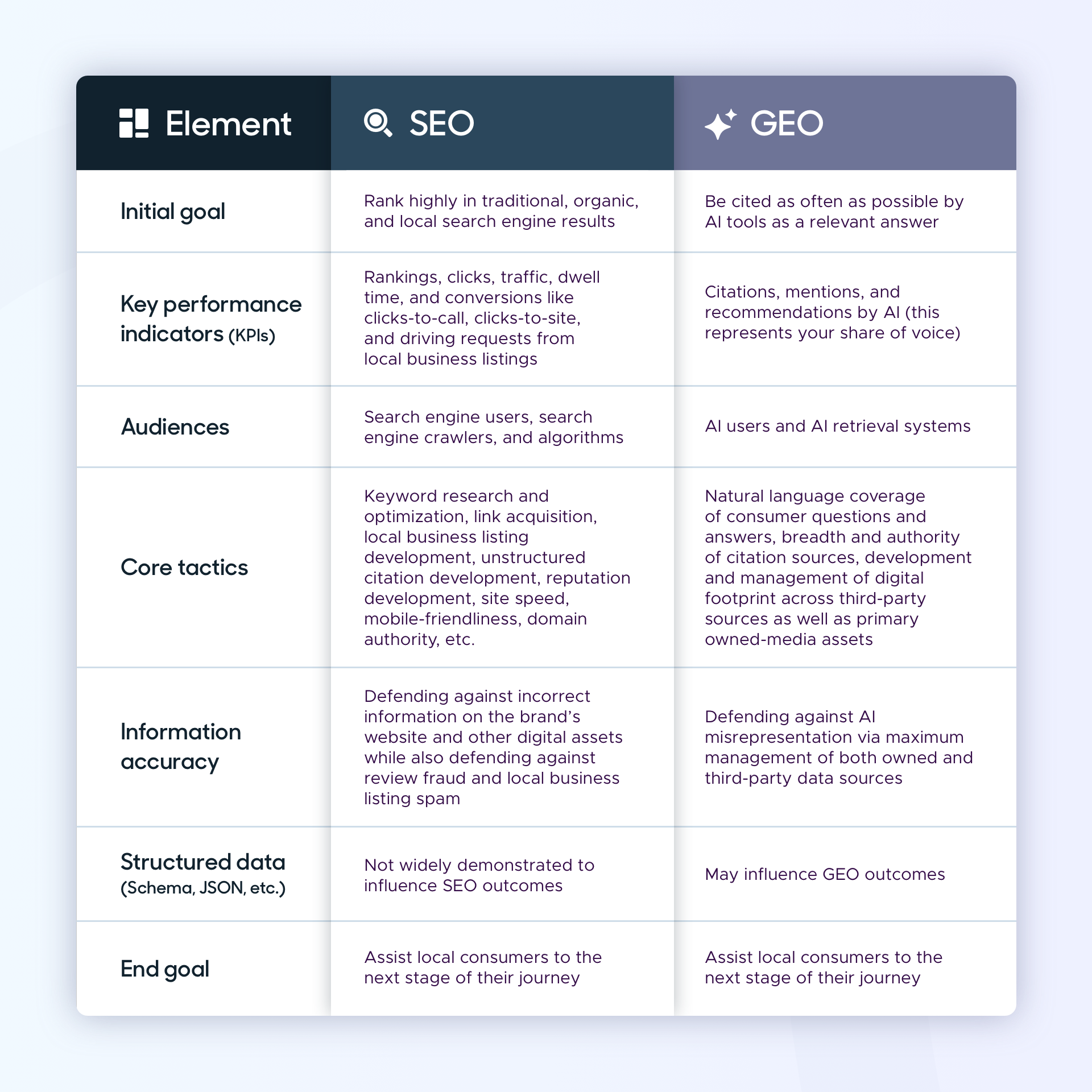
Did you notice that the end goal is identical in both columns? That’s because whether your brand has mastered SEO or is just starting to get comfortable with GEO, you are still strategizing to achieve these three goals:
- Offer better help than competitors so that you are the most visible as an online resource for customers’ consideration
- Offer a better digital experience so that it is easiest for customers to interact and transact with your brand
- Offer the most trustworthy experience so that you create a positive brand impression that earns loyalty and repeat transactions over time
The threat of invisibility and distortion in the AI era

Speaking of back-to-school time, let’s try to find out if I can find my favorite notebooks in a town I’ll be visiting this week. Hands-down, Five Star brand’s recycled notebooks are my products of choice for their good design and environmental attributes. The version shown above with the silhouette of trees on the cover is my go-to over any other notebook style or brand.
Now, let’s imagine you’re in charge of GEO for the Staples enterprise which has a branch in my target city.
Does ChatGPT know if you have the inventory I want?
We’re off to what looks like a fair start:
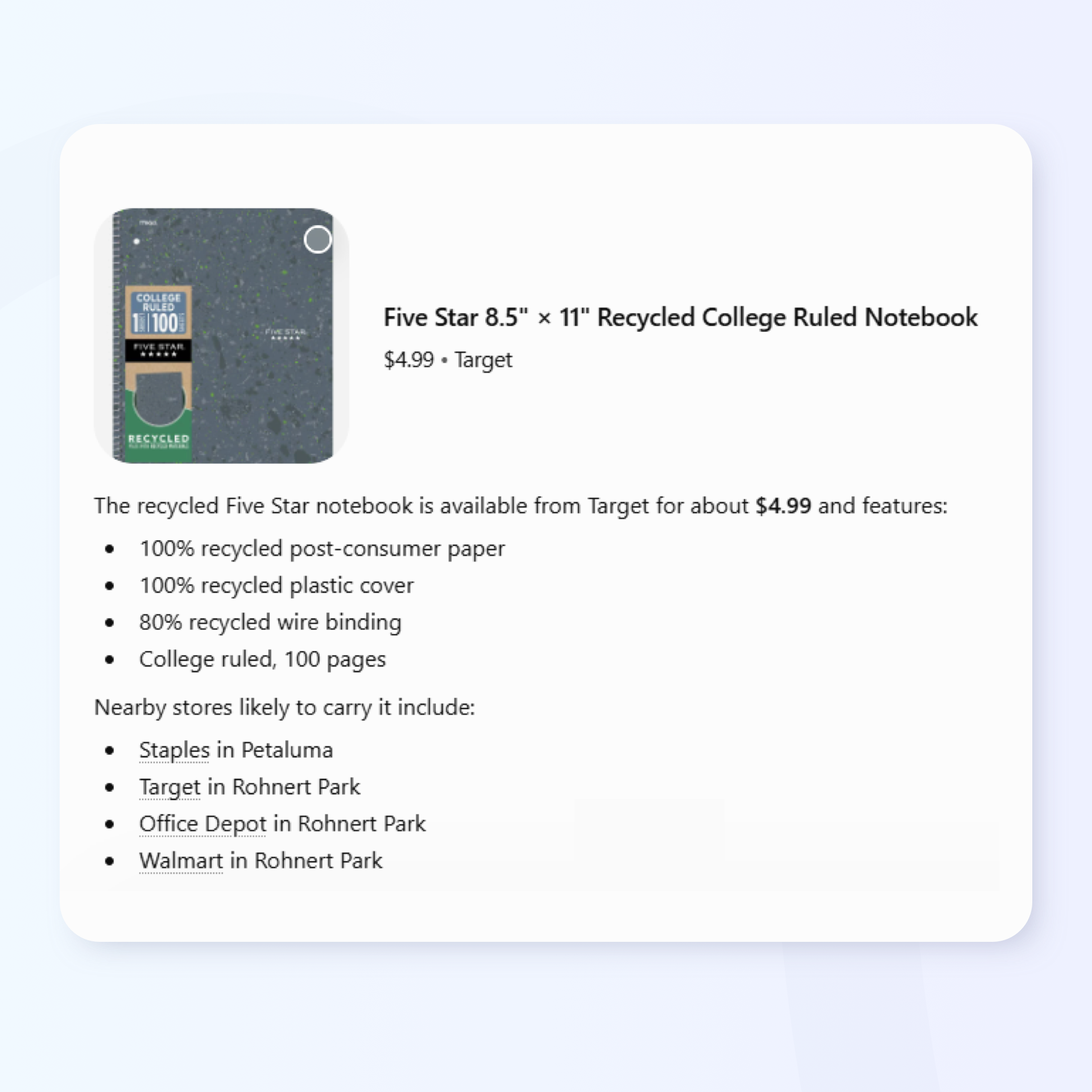
ChatGPT is preferencing Target, but at least it mentions your brand, Staples, as being a nearby store that may stock my desired notebook.
However, when I actually look closer at the notebook image, it’s not the right one. It has a mottled-colored cover. This is a different kind of Five Star notebook. So, I refine my prompt to ask about the version with the tree silhouette on the cover. Here’s ChatGPT’s response:
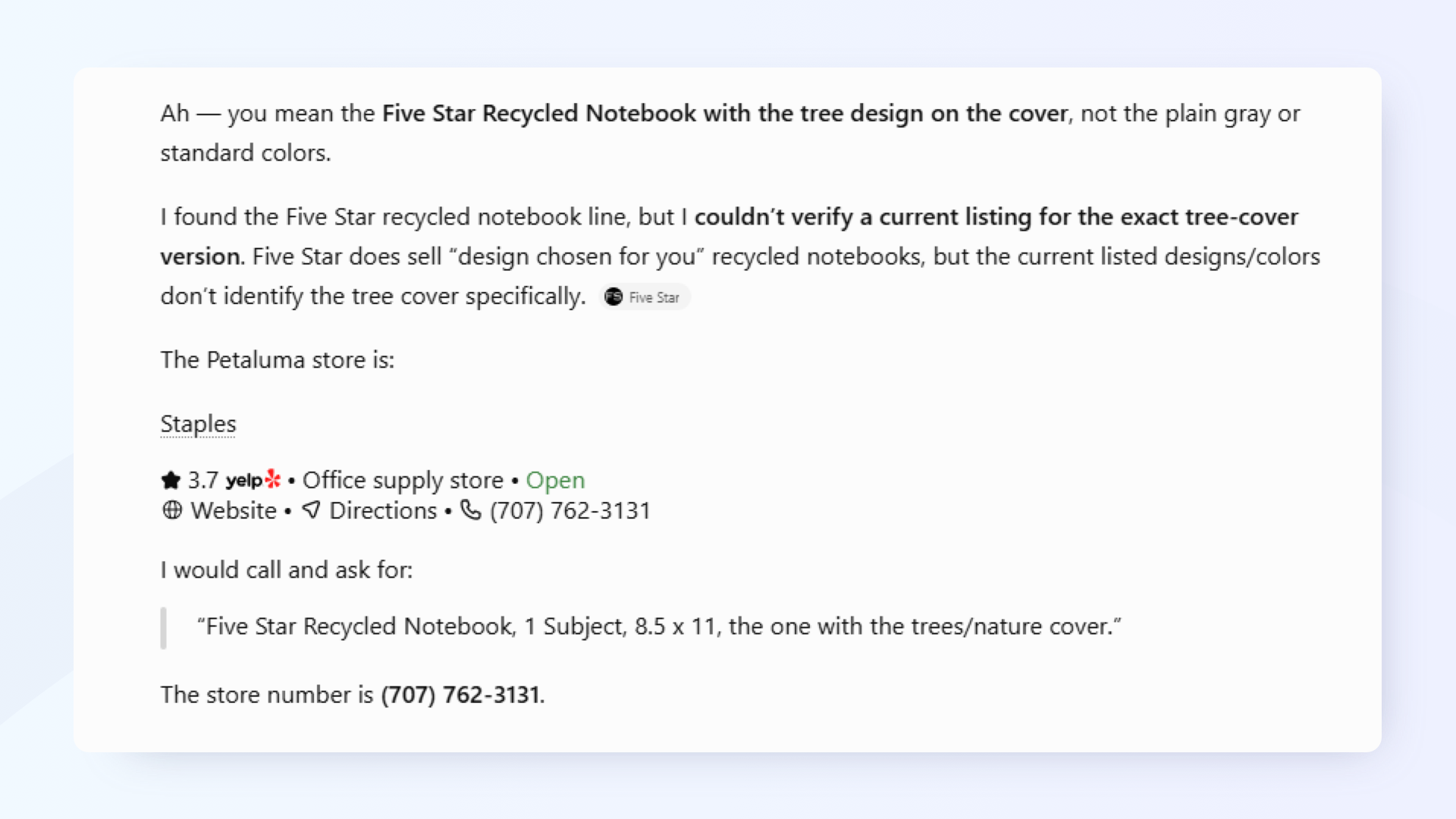
Remember when Google debuted and then shut down Google Business Profile Questions & Answers? The feature was a nice idea, but it ended up being largely filled with consumers asking questions about local businesses only to be met with random answers from the public like “I don’t know. Why don’t you call them and ask?”
The above response from ChatGPT is oddly reminiscent of this dynamic. ChatGPT isn’t sure whether your Staples branch in this city has my tree-covered notebooks and is directing me to a Yelp listing with the suggestion that I phone the location.
So I phoned the branch. The phone call took five minutes (which would not be convenient if I was in a hurry or sitting in a doctor’s office lobby or in some other circumstance in which I didn’t have time for a phone call), but the helpful employee did an inventory check and confirmed this this location has my tree-covered notebooks in stock.
What’s the problem? ChatGPT could not give me this information. If AI stakeholders are pinning their hopes on the pitch of “never-before-seen” convenience, we’ve had a failure here. I shouldn’t have to pick up the phone in this space-age era, right? How is this any better than my going back to school well-supplied in 1985 by picking up the nearest phone book and curly-corded dial phone to ask this same question of a local store?
Staples inventory is structurally invisible in my chat, and therefore, I’m left with a distorted view of product availability in the local commercial landscape.
Why doesn’t ChatGPT know Staples has these notebooks? Because try as I might, paging through all available pages of inventory, I cannot find these items on the Staples website:
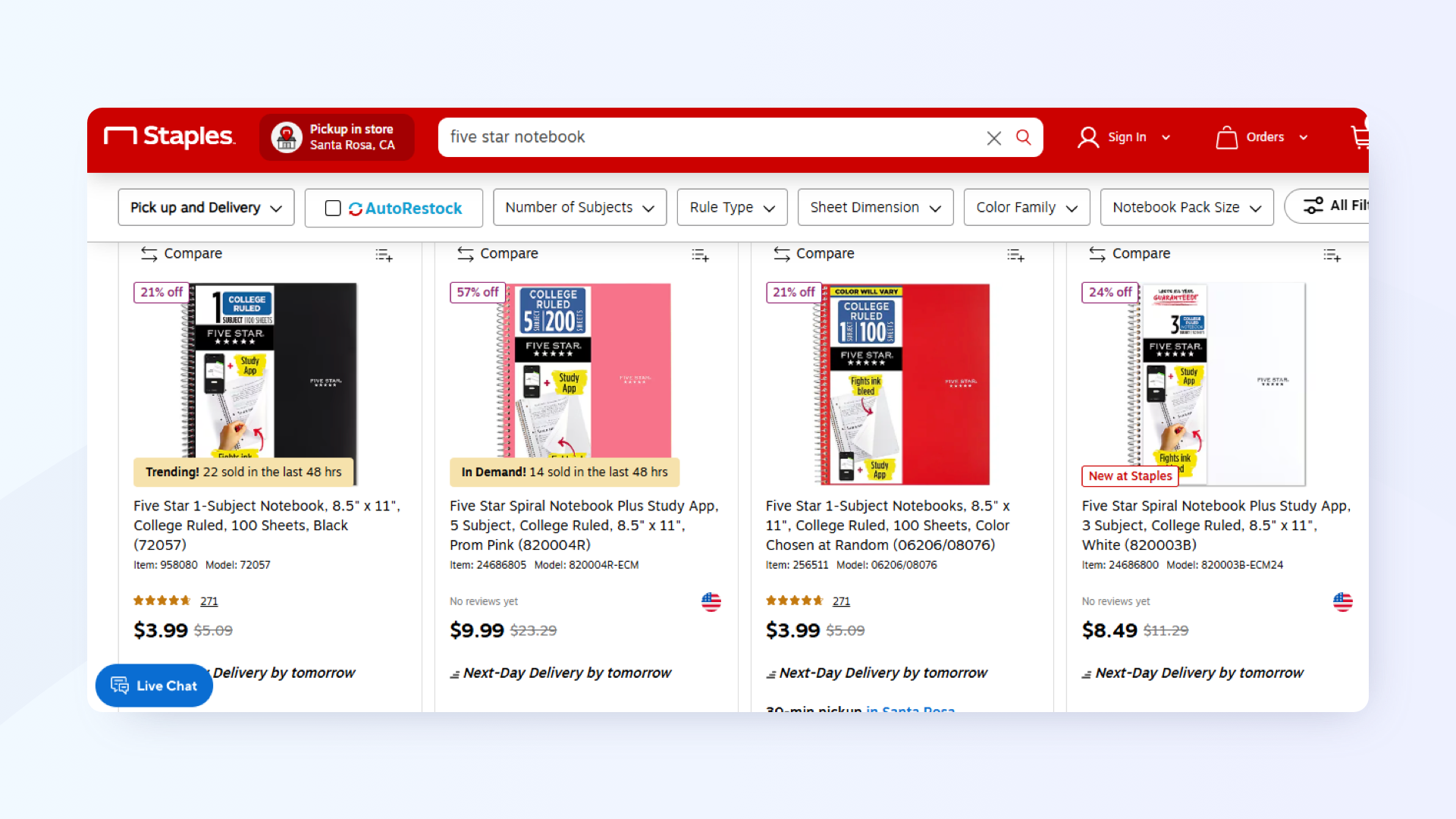
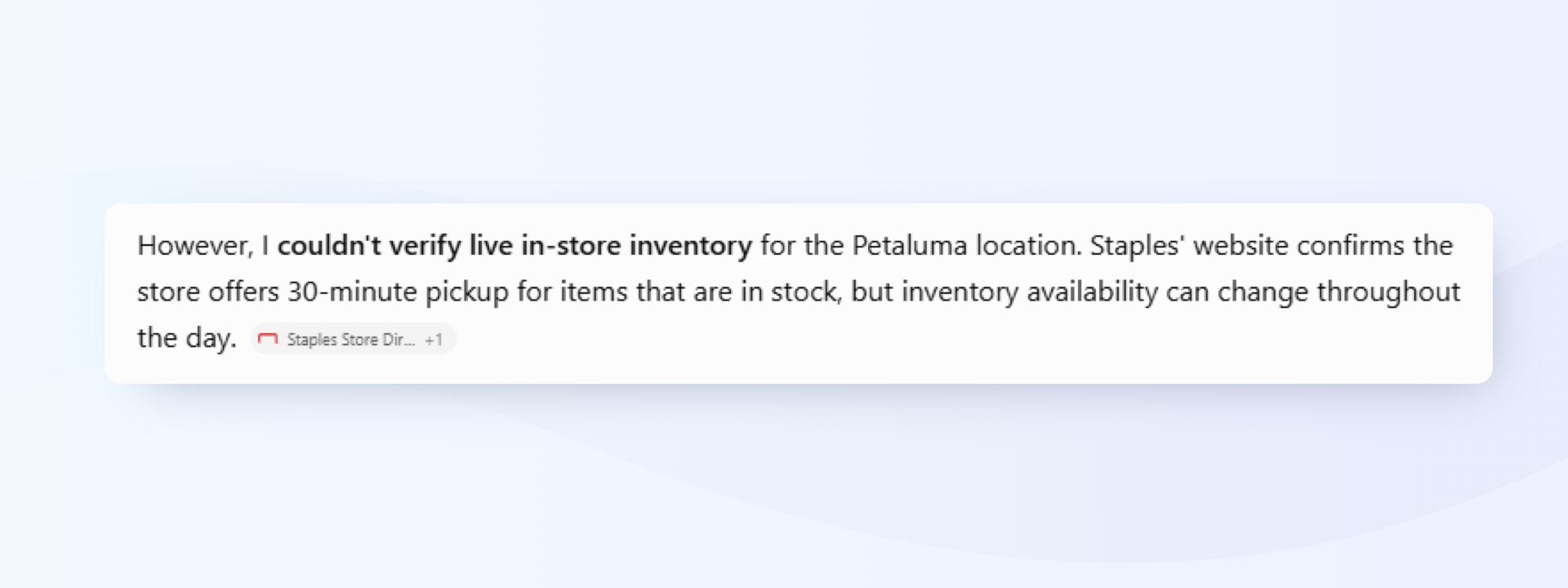
So it isn’t actually the AI tool’s fault. Staples is stocking an item that is somehow being left off of their website, and you can apply this problem to literally anything any kind of local business vends. If AI can’t find it, it’s as if the product doesn’t exist for AI users. This response from ChatGPT gives us a huge clue to the massive “answer gap” that is emerging in the AI era:
Just for the sake of thoroughness, I went back to ChatGPT’s initial recommendation that Target had Five Star brand notebooks (though the example they showed was the speckled one.) I gave them a call for an inventory check, but, sadly, no one would answer the phone. This is a failure of a different kind: a customer service failure. Target’s opportunity to beat out Staples just disappeared, despite being the #1 answer to my query, because they are not adequately staffing their phones.
What is the common thread running through both scenarios? Neither brand is fully envisioning the modern customer journey. You can’t be visible in AI tools unless you are putting in the work. You can’t benefit from AI visibility unless you’re ready to serve in the real world. It’s like watching money go right down the drain for both major local enterprises.
What could Staples do to achieve priority visibility for this product in AI tools?
You can apply this checklist to any SKU your local enterprise vends:
- Create a real-time local inventory listing on your website for the product and be sure this connects to your location landing page/microsite ecosystem for all applicable branches. (Don’t know what a microsite is? Ask Lastmile.)
- Be sure the product page includes clear visual media, including photography and video media, and that it features all relevant details about the item.
- Be sure the product page answers all FAQs consumers could possibly have about the product, using natural human language.
- Mark the item up with product Schema, because early days research suggests it may actually improve AI visibility.
- Publicize your product via your social media channels: take photos of people using the product, film video demonstrations, run a contest to get the public to showcase how they use the product, etc.
- Earn unstructured citations about your local branch carrying the product; can you donate it to schools, teams, or other organizations for third-party mentions, or donate a percentage of sales to valued local causes to earn news coverage or other PR?
- Opt-into all available Google productization programs. This could include Google Business Profile products, Google In-store products, and Google Merchant Center, creating multiple references to the fact that your brand stocks this item at specific locations.
- Put next-nearest location inventory availability at website visitors’ disposal so that they are directed to a nearby store when an item is out of stock at the location nearest them. (Not sure how to do this? Again, ask Lastmile.)
- Keep all data sources continuously updated with accurate information, including inventory information, store location information, hours of operation, available fulfillment options (in-store, BOPIS, curbside, home delivery, etc.) to avoid negative brand impressions due to consumer disappointment.
- Launch a review acquisition campaign with templated language designed to ask customers to review this item. Periodically re-run this campaign across your locations to ensure you have recent sentiment on the topic.
- Be at the finish line by adequately staffing phones, live chats, social media accounts, email, and store premises to finalize transactions. It’s now more important than ever that every stage of your operation generates positive online mentions and reviews for each of your locations, as these are exactly the types of content being retrieved and cited by conversational AI.
I want to add here that I am not specifically calling out Staples or any other multi-location enterprise. The notebook narrative I’ve shared here is one I am repeatedly experiencing with multiple brands in the AI scenario.
There’s no gainsaying that my checklist represents a ton of effort to successfully vend a single item. You may not choose to make this investment for every single SKU, limiting full campaigns to most popular or profitable products. Inevitably, questions of scale are going to be on the table at every all-hands meeting you hold over the next few years.
You’ve taken a first step today in looking at this real-world example of AI-readiness vs. structural invisibility. Need a partner to take the rest of the journey with you? Lastmile works solely with major local enterprises, offering white-glove marketing services. Book a free initial consultation with us, and we’ll respond promptly to set up a live demo of how we are helping our enterprise partners transition into the AI era by putting customer experience first.
Request a Demo
Drive more local sales by pairing shoppers with real-time inventory and promotions through seamless online-to-offline capabilities that help clients transact now.