The rise of conversational AI tools like Google’s Ask Maps, AI Overviews, and AI Mode is a clarion call to zoom in on the finest details about your enterprise’s locations. Why? Because consumers are learning to expect answers to every conceivable question about your brand in these emergent environments.
A good answer is like the next stepping stone on the customer journey towards a transaction. A poor or absent answer is a break in the path, inviting the potential patron to head in another direction and wind up with your competitors.
I know of few topics about which customers are more passionate than being able to answer the call of nature in business settings in reasonable comfort. Ask nearly any group about public bathrooms at local businesses and almost everyone will respond with an animated story of their good and bad experiences. Bathrooms are of universal interest to all human beings.
But here’s the problem. My own research indicates that this is a layer of information that is sorely lacking details and attribution in AI tools. Today we’re going to look at how your brand can assess, address, and resolve this significant problem, earning a valuable reputation for truly caring for customer comfort. Small details have never mattered more!
Why bathroom data is a big deal
I have friends and relatives who tell me that they have a mental map of every decent bathroom in their town, on their commute routes, or in cities they regularly visit. This is a sentiment they express to me with pride. They know they’ve amassed valuable information through practical experience. Pretty much everybody prizes sanitary bathrooms and is disgusted when janitorial practices at public facilities fall short.
Beyond meeting general norms for restroom cleanliness, your brand should practice a persona-like approach to understanding why some prospective customers are especially keen on access to trustworthy bathrooms. Consider the following examples:
1. Accessibility needs

Patrons with different needs have to know if your bathrooms comply with the Americans With Disabilities Act or the guidelines of other nations. Beyond matters of wheelchair accessibility in toilet stalls, other considerations could include Braille signage and the accessibility of sinks and vending machines.
2. Medical needs
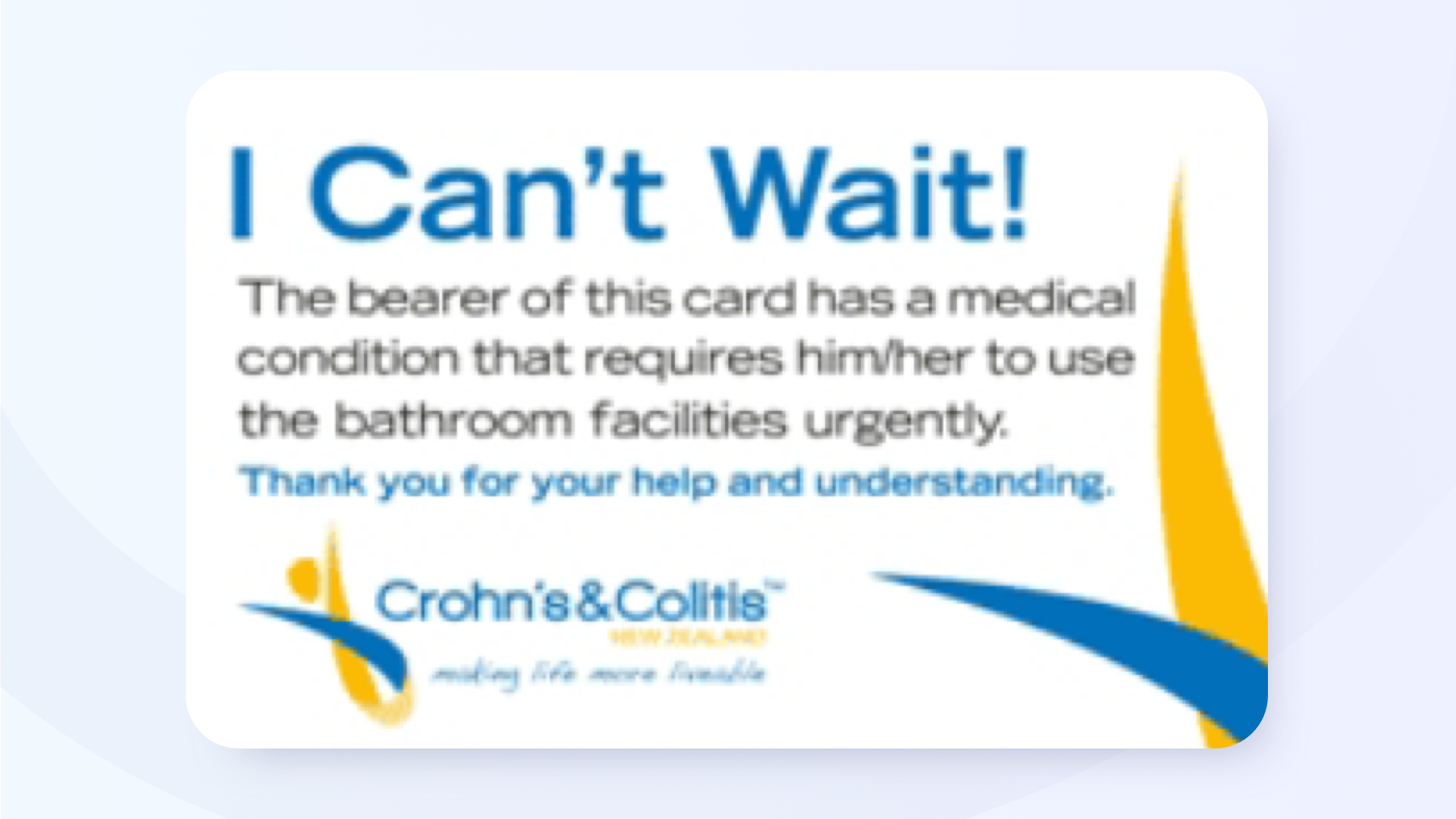
Multiple US states and many nations have passed some version of a “Can’t Wait” Act, providing cards like the above to individuals coping with medical conditions that require urgent access to bathrooms. These cards are meant to signal to staff and people in line that the bearer should be given fastest access to available restroom facilities. There are a host of medical conditions that affect people of all ages that require urgent bathroom visits.
3. Childcare needs
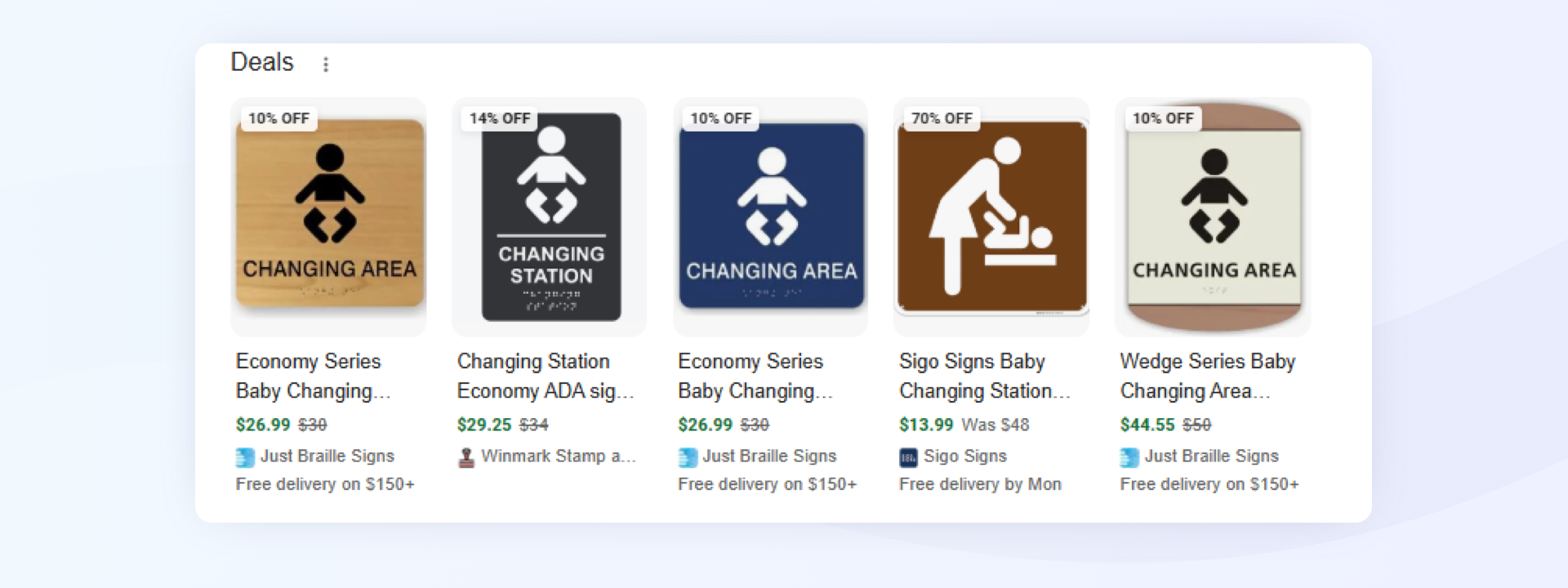
Anyone caring for an infant knows the value of changing stations in public restrooms and this includes differently-abled parents and guardians who need accessible changing tables for the babies in their care.
4. Gender-based needs
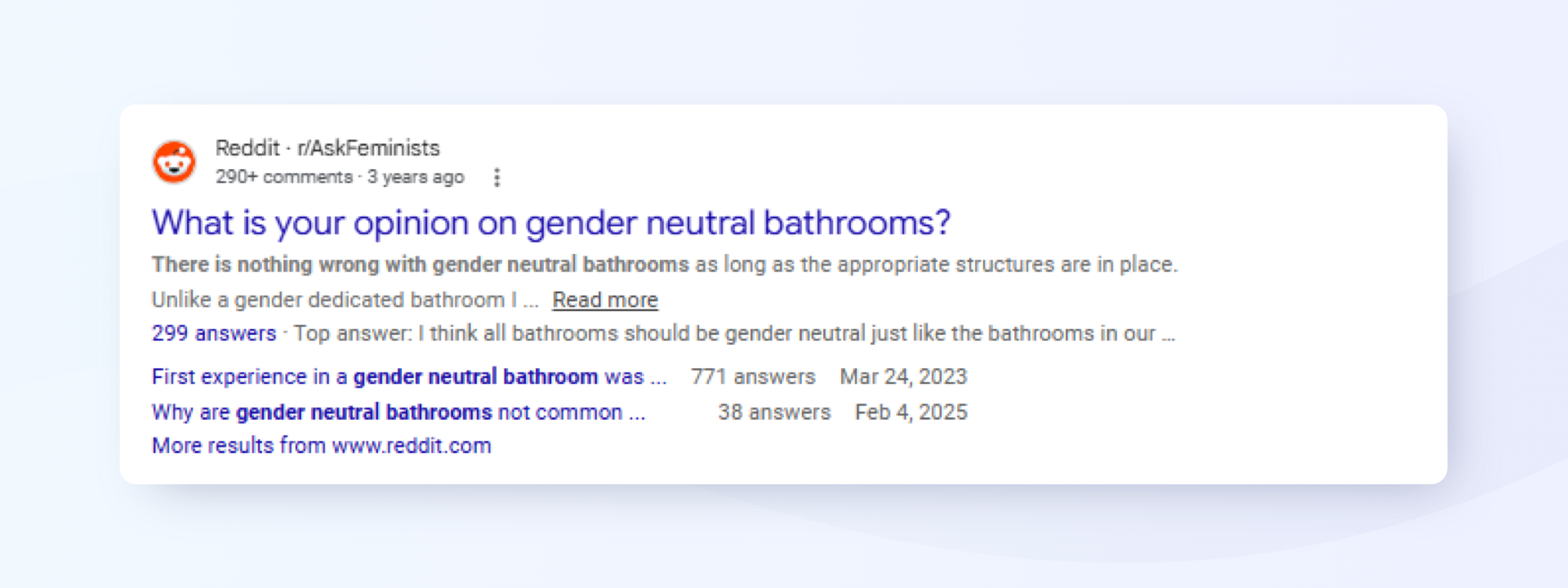
Gender-neutral bathrooms have been a subject of public discourse in recent years, and it’s a topic that every brand needs to address with appropriate onsite public facilities. Some US states and nations have specific legal codes and guidelines regarding gender and restrooms, and commercial architects offer a variety of plans for designing acceptable bathroom units.
5. Travelers’ needs
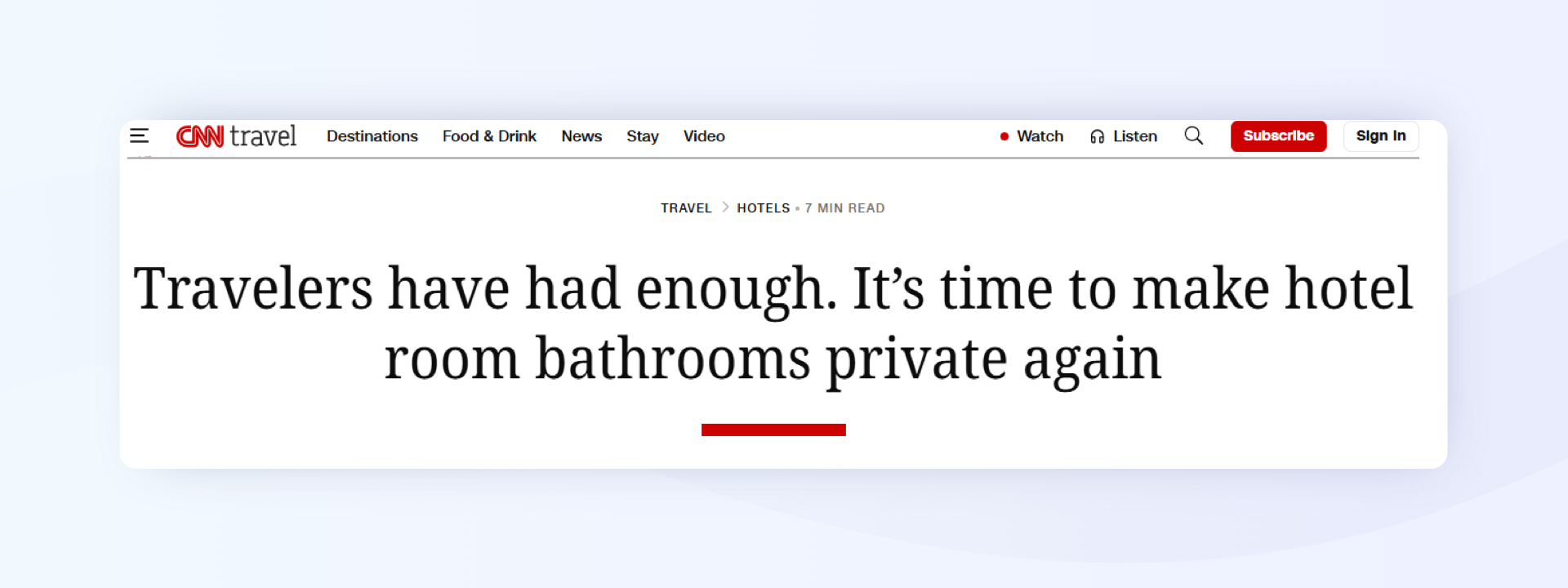
It may seem obvious that hotels, B&Bs, and other lodging destinations need to be clear about whether rooms feature en suite bathrooms or only offer shared facilities, but as this CNN article suggests, bad bathroom-related decisions in the hospitality sector can drive guests away. In this particular instance, the reporter is documenting design trends such as bathrooms without doors or with glass walls, sparking social media backlash from people who prefer private restroom arrangements.
Different subsets of your consumer base are eager for reliable data about how your locations meet the above needs.
What AI doesn’t know about your bathrooms could hurt you
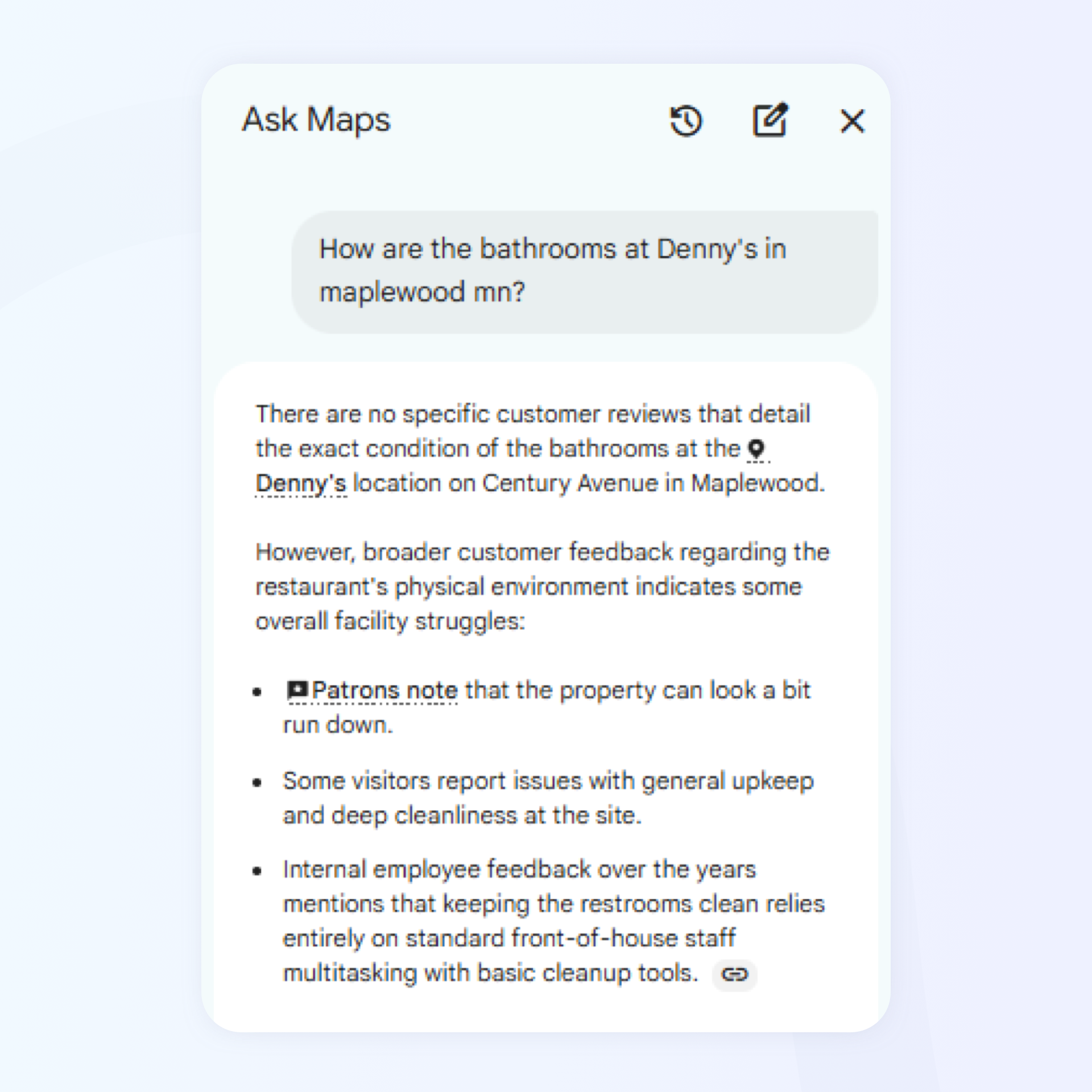
Imagine a multi-generational family on a road trip through Minnesota. The father of the family has Crohn’s disease, the mother uses a wheelchair, they have a ten-month-old baby, and the grandparent requires a gender-neutral restroom. It’s late at night, and they are looking at Google’s Ask Maps feature to understand their options for getting dinner at a familiar chain restaurant with appropriate bathroom facilities. Unfortunately, a lack of detailed information about the restrooms at this Denny’s in Maplewood means that the travelers have no idea whether the diner will meet their needs.
Ask Maps can only tell the family that there are no reviews mentioning bathrooms at this location, that there is a public record of the facility looking run-down, that some visitors (and note there is no attribution for this) report problems with cleanliness and that there are employee reports on Indeed.com of potentially problematic janitorial practices. This is not enough information to provide a trustworthy next stepping stone on these customers’ journeys.
If a competitor has taken the time to provide more detailed information across a variety of platforms about how their restrooms meet a variety of specific customer needs, they are far better positioned to win the transaction.
The top takeaway here for your local enterprise is that a lack of evidence about your public restrooms could be costing you sales. In search after search, I’ve found that:
- AI tools lack sufficient data to give cited responses to bathroom-related prompts, even for very large brands
- AI is apparently making up information that may or may not be accurate, due to this lack of evidence
A symptom of a larger problem
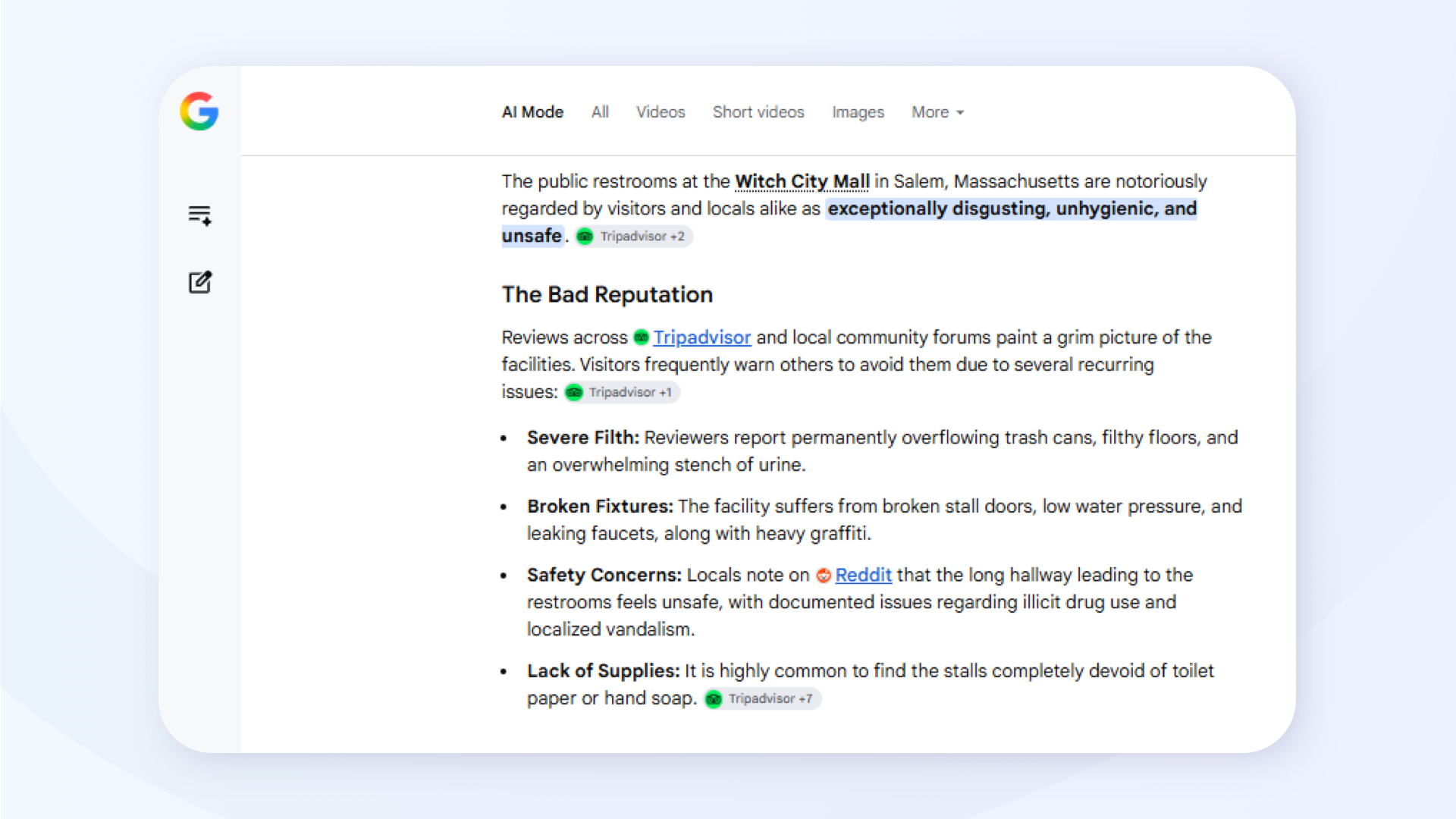
When I think of struggling business models, shopping malls spring quickly to mind. While some of these once-flourishing destinations are striving to re-invent themselves, statistics suggest that some 1600 US malls have permanently shut down over the past few decades. Contributing factors are numerous, but Google AI Mode highlights one particular narrative that is easily overlooked: inadequate janitorial practices in mall restrooms create a terrible experience for the customers of every chain store location on the property. You cannot expect the public to patronize a shopping environment known for bathrooms with:
- Severe filth
- Broken fixtures
- Safety concerns
- Lack of supplies
Note the way in which AI is becoming the public record-keeper for all such reputation-based evidence.
This scenario begs the question: how could any enterprise in this economy be overlooking something as basic and essential as offering and documenting the positive attributes of their restrooms when every single one of their customers will need to use these facilities at some point in time?
I would suggest that the answer to this puzzle is an overall lack of customer-centrism. Something I’ve found to be so refreshing about working with Lastmile is that their informal, internal slogan is “customer, customer, customer”. They see it as a primary responsibility to teach the large enterprises they partner with to put customer needs at the core of marketing.
Poor customer experiences aren’t confined to bad bathrooms. There is a growing sense that the largest brands are getting worse and worse at serving the public.
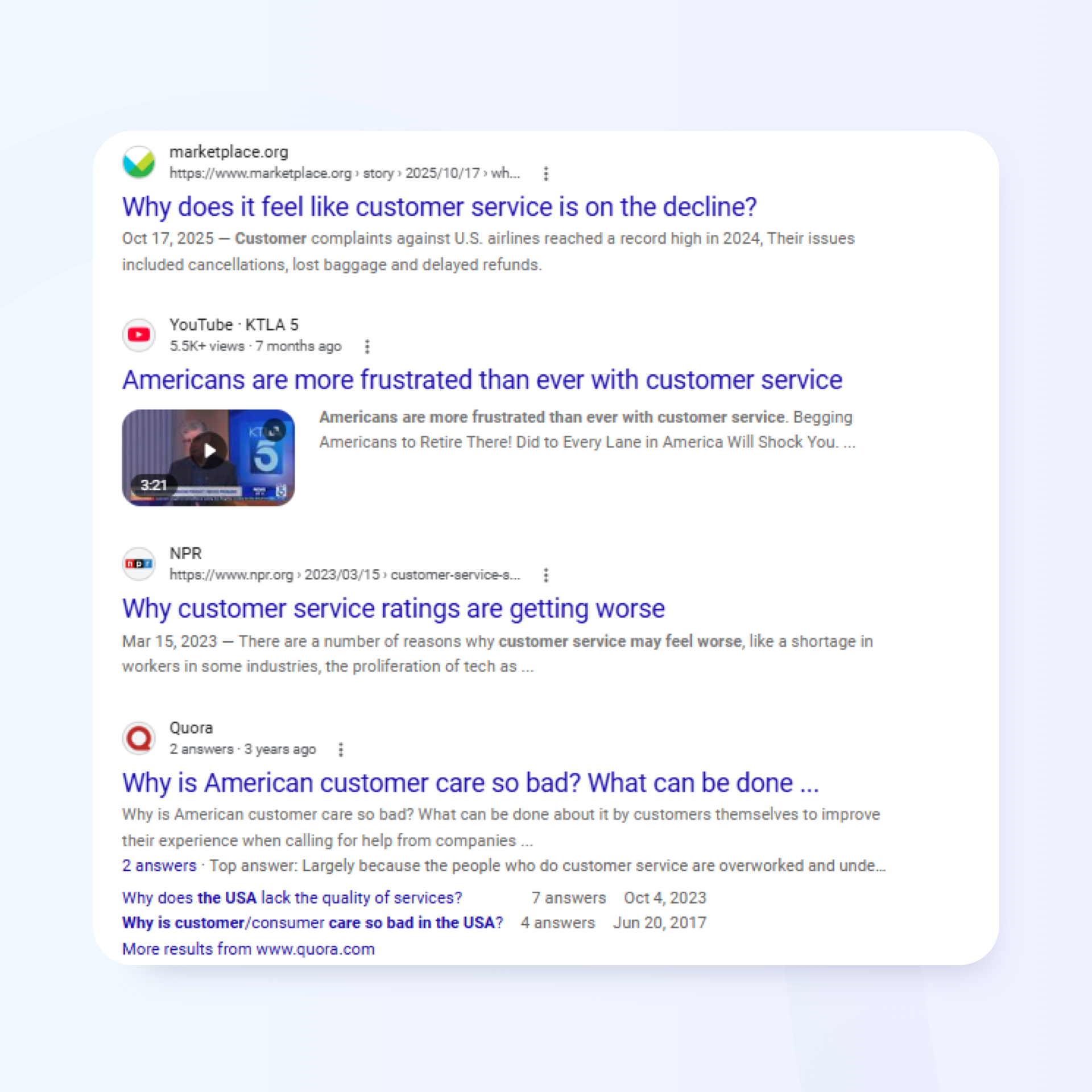
- The incidence of customer service problems has more than doubled since 1976
- AI chatbots and automated customer service systems are not a replacement for skilled customer service staff
When the largeness of an enterprise misleads it into thinking that customer service failures create acceptable losses, the brand is headed for trouble. A lack of care for patron comfort and satisfaction is no longer a private, one-on-one incident. It’s a matter of public record that tools like Ask Maps put at the fingertips of every prospective customer:
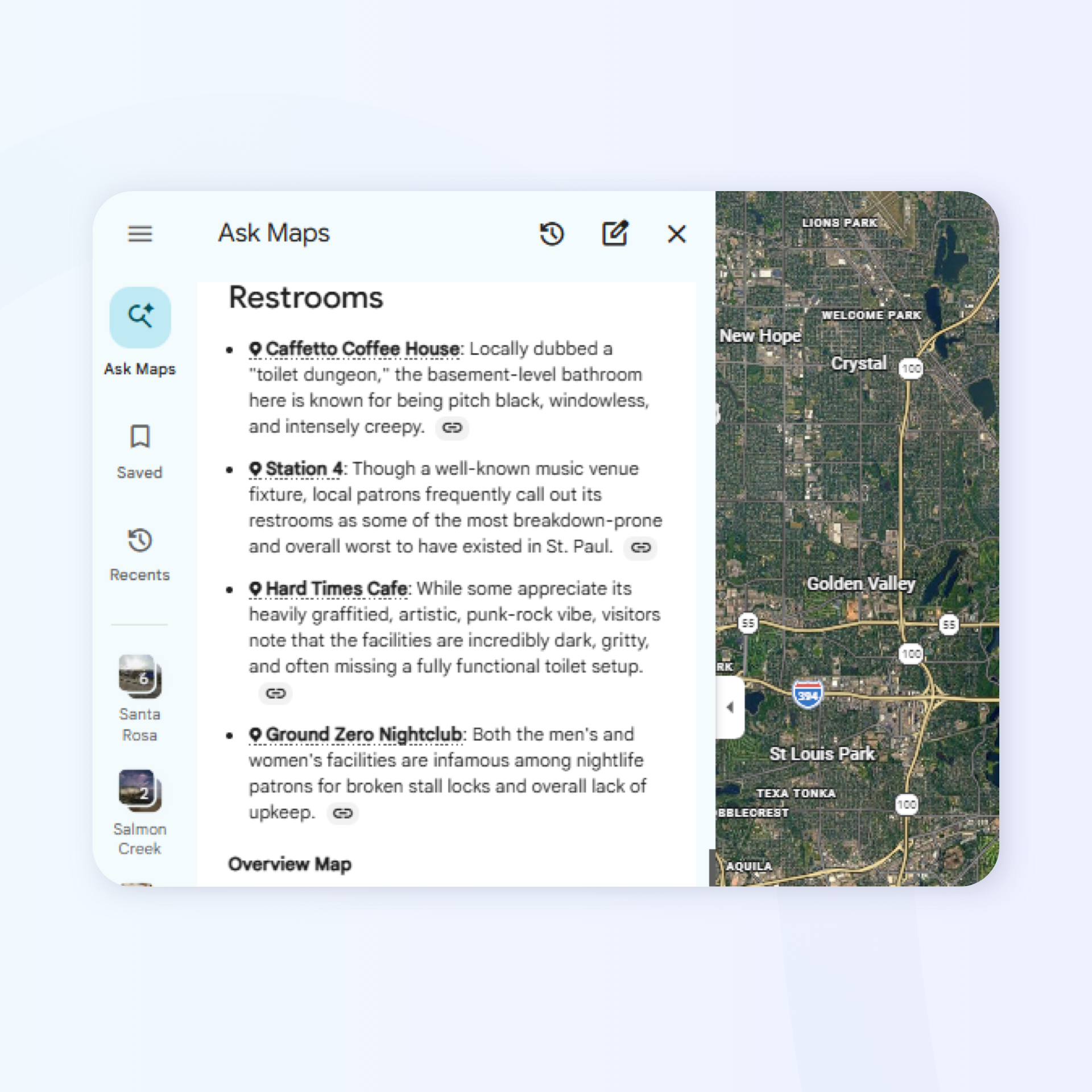
Every decision maker at your brand should take a look at the above screenshot and ask two very simple questions:
- Would I want to spend time or money at these places?
- Would customers?
These questions apply to so many aspects of a business. A scenario that springs instantly to mind is that of auto repair businesses. Single car owners frequently lack a convenient way to get home after dropping off a car for something like tire repair, rotation, or replacement. The customer may have to wait on-site several hours, and these facilities often lack:
- Public restrooms
- Cleanly waiting rooms
- Outdoor seating
I can recall many times when I was stranded at these types of local businesses with the choice of either sitting in an uncomfortable indoor setting that reeked of tire rubber or sitting on an unshaded parking lot curb in the hot sun. Headaches and heat prostration are not anyone’s idea of good customer service. As a result of such experiences, I learned to choose auto garages that have one or more of these hallmarks of care for patron comfort:
- Reasonably comfortable outdoor seating
- A clean public restroom
- A shuttle service that takes customers home and picks them up again when their vehicle is ready
- A car pick-up and return service so that the customer isn’t obliged to wait at the business at all
Other signs of good customer service for many local brands include:
- Having real-time location-based inventory on the company website
- Revealing next-nearest location where a product is available when it’s out of stock at the branch near me
- Maintaining local business listings so that core location and hours of operation details are always accurate and complete
- Courteous and problem-solving owner responses to reviews
- Adequate staffing
- Abundant online visual documentation of real-world premises and amenities
- Well-trained human phone staff with quick response times
- Documentation of all fulfillment options, including BOPIS, home delivery, shipping, etc
Better bathroom habits as an AI-ready marketing practice
Use the following checklist to begin building up your body of evidence for the bathroom facilities at each of your locations so that AI tools drive consumer trust and sales for your brand:
- Build a new feature into each location’s microsite or landing page, offering a full text description, image and video content of restrooms, including a map of where bathrooms are located on the premises
- Be sure this content specifies how the bathrooms meet ADA, medical, childcare, and gender-based needs
- Fully describe your janitorial policy, including how often restrooms are cleaned and what patrons should do if they encounter a dirty bathroom or one lacking in supplies
- If bathrooms offer special features like vending machines or attendants, be sure to mention these amenities
- Include a brief summary of bathroom availability and cleanliness in your Google Business Profile description
- Select Google Business Profile attributes such as “wheelchair accessible restrooms” to further signal the availability of your facilities
- Create a new review request template that asks a subset of your customers to specifically review your restroom facilities, if possible, across a variety of platforms such as Google Business Profile and TripAdvisor
- Upload bathroom photography and video footage to the image/video section of your Google Business Profile
- Create a series of social media posts showcasing how care for customer comfort includes offering inviting and cleanly restroom facilities to your patrons
- Query Ask Maps about bathrooms in your city, and see if it is turning up third-party citation sources like HoneyPot; reviews on these bathroom-rating sites will give you a sense of the competitive landscape as well as of how your own locations are scoring
- Be sure you are backing up all of the above activities with professional-standard facilities and janitorial practices at each of your locations
Next steps: a no-job-too-small mindset
If a feature of your business matters to customers, it should matter to brand leadership, company marketers, and on-site staff. No enterprise is too big to care about the small details that create initial consumer experiences which foster:
- Repeat sales
- Referrals
- Positive reviews and ratings
- A positive and detailed AI footprint
Your next all-hands meeting would be the perfect opportunity to launch a bathroom initiative at scale, codifying standards of cleanliness and accessibility, and training branch managers and franchisees to document the welcoming aspects of location-level facilities as a core marketing practice.
Some consumer needs and journeys are very challenging to identify and assist, but everybody needs bathrooms. This should be an easy win for your brand.
Request a Demo
Drive more local sales by pairing shoppers with real-time inventory and promotions through seamless online-to-offline capabilities that help clients transact now.