
Natural historian Sir David Attenborough turned 100 this year, and a lesson I’ve learned from his peerless nature programs is that hummingbirds and flowers have often evolved in tandem to serve one another. The shape of the beak and the blossom work together. It’s a relationship worth highlighting for everyone at your local enterprise brand who is trying to strategize around the ways in which AI discovery is changing requirements for visibility, relevance, and trust.
Customers requirements have always been specific, but the internet wasn’t up to the task
In the analogy I’m making, your brand needs to shape the flower of AI to fit the hungry beak of the customer who is sipping from tools like ChatGPT and Google AI Mode, searching for help. If the way you’ve shaped your offering doesn’t fit, the customer will flit off elsewhere to something that better suits their specialized needs.
It’s specificity that is setting the AI era apart from the previous epoch of traditional search. Humans haven’t changed. There were people 20 years ago needing to find something like an unscented, vegan, coconut-free shampoo due to allergies and health concerns. Solutions to such specific requirements could be very hard to find in the keyword-driven internet.
AI opens the potential for discovery of specific solutions. Customers can now be far more detailed about the uniqueness of their needs, and your brand must respond with a full answer, rather than the shorthand approximation of an answer that was the norm when SEO was so heavily focused on keyword optimization.
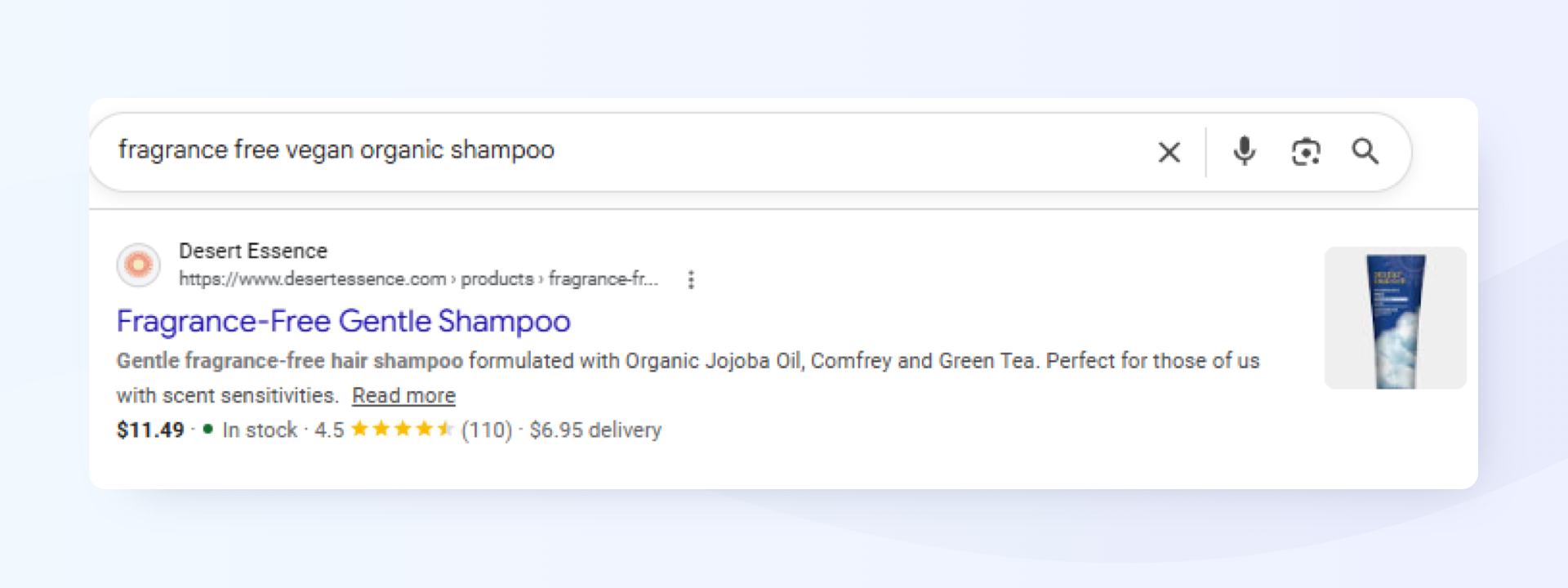
The customer who once searched for a keyword-oriented phrase for “fragrance free vegan organic shampoo” used to be stuck with this type of typical Google search entry, with a title tag, a brief meta description, and a few other elements:
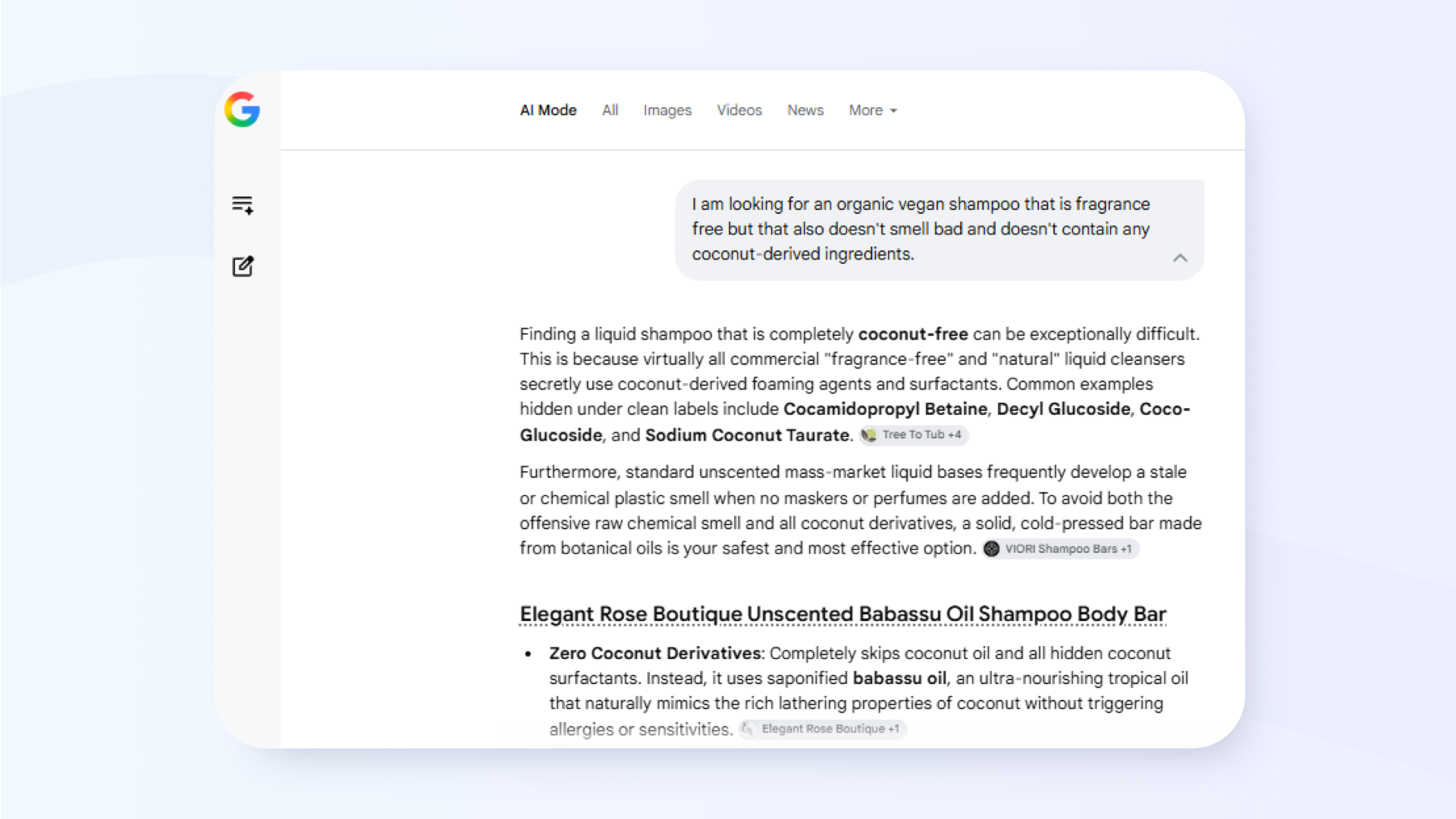
Now, AI has opened up the possibility of this same customer being highly specific about their needs and receiving far more information in reply:
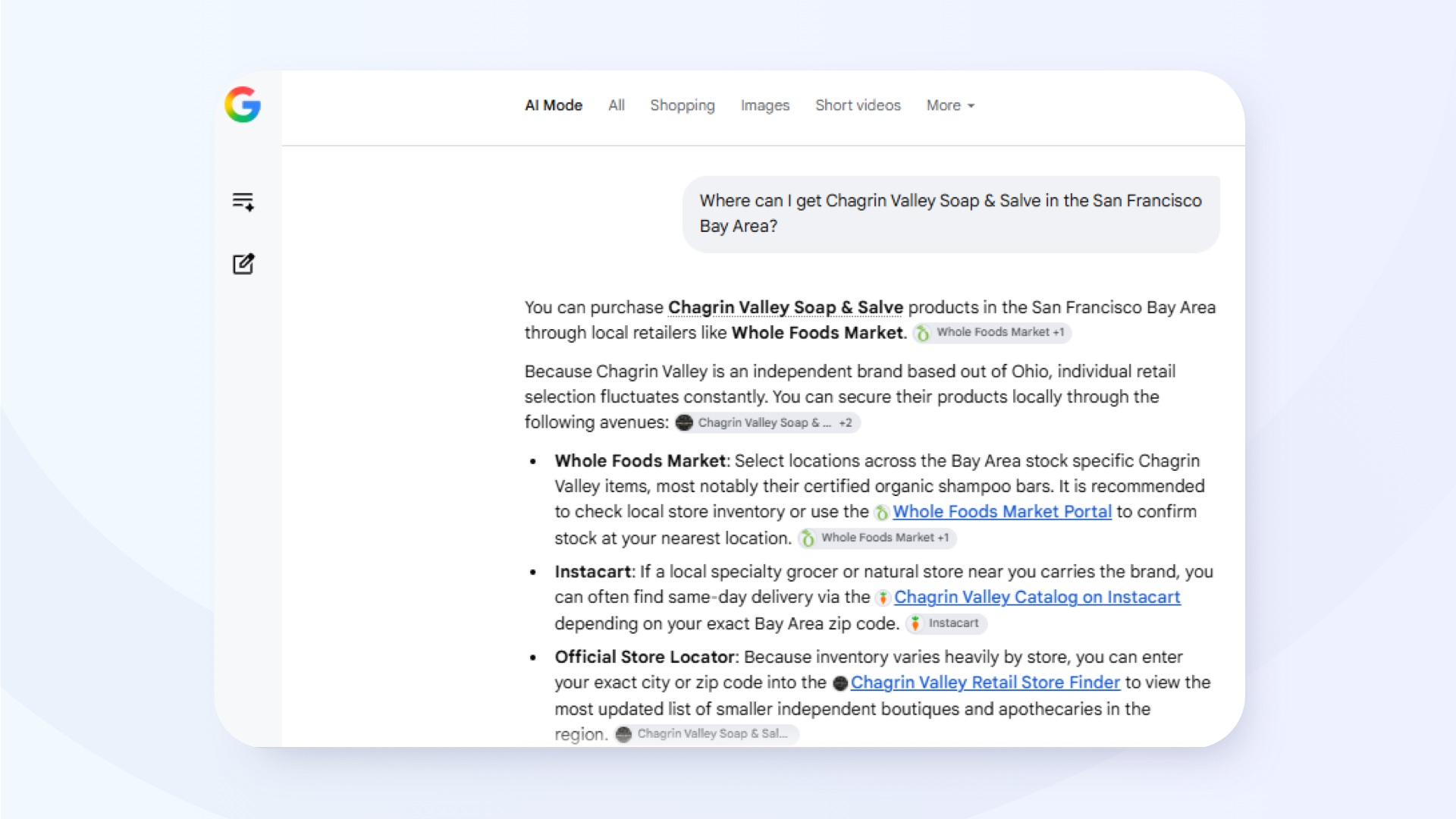
If this type of conversational exchange enables the consumer to locate the ideal solution to their needs, they can follow up with this type of query, with AI retaining the context of their past prompts:
If you are marketing a major grocery enterprise like Whole Foods or a multi-location beauty supply chain or franchise, shaping AI results to fit such specific needs can result in bringing high-intent customers right to your doors. Facilitating specificity in AI results will make your brand:
- Visible – In any given town or city, AI has a limited number of local options to show local consumers. If you’ve put in the work to promote your inventory on your website for each branch of your business, you will be well ahead of nearby competitors who are failing to make location-specific products visible to AI retrieval systems and the public.
- Relevant – By fully describing each product and taking the time to answer FAQs about it in your website content, you will be signaling why attributes of any inventory item are a relevant match for highly-specific consumer intents.
- Trustworthy – You can go beyond simply listing and describing products and services your enterprise offers to proving why both your inventory and your brand deserve to be trusted. Trust signals include third-party citations, consumer reviews, hands-on product testing, image and video media of products and services being utilized, expert commentary, statistics, studies, comparison charts, and consumer guarantees.
Customers have always wanted all of the above, but traditional search typically couldn’t fulfill complex needs. AI is different because it has the potential to be:
- Shaped by your customer to more fully understand a huge array of personal criteria
- Shaped by your brand to showcase all of the ways in which you and your offerings meet that criteria
Back in time: from proxy keywords to conversation

My example query about shampoo is like the preface to a long novel. A couple of decades ago, many SEO and marketing brands became fascinated with the concept of building user personae for their clients, as a kind of approximation of average customers. For just a moment, let’s think about a real person, an actual potential customer of yours who:
- Has had a breakthrough moment in their life looking at the long list of ingredients on most standard bottles of shampoo, and has suddenly asked themselves, “Why am I putting all these weird things and chemicals on my head every day?”
- Went through an extensive and expensive set of allergy testing with their healthcare provider who identified coconut products as an allergen that was causing them scalp irritation and sinus congestion
- Found out that so many shampoos contain some coconut-derived ingredient under fancy names like coco-glucoside, cocamidopropyl betaine, or sodium coco-sulfate
- Realized that they are experiencing migraines from contact with perfumes and have taken steps to find fragrance-free cleaning products for doing dishes and laundry, but can’t easily find a good product for hair-care
- Has made the commitment to eating organic and wants to live up to this standard in their health and beauty care, too, because they are concerned about personal and environmental well-being
- Went vegan ten years ago and spends more time than the average consumer trying to find the right products that match their requirements because of this
What we’re seeing here is a set of life experiences, choices, and events that bring a customer to the internet, looking for solutions to their needs.
These are the kinds of stories your brand needs to be able to tell itself about its customers..
This is how to make the move from a period in which “vegan organic shampoo” was a keyword-driven label standing in for a whole spectrum of life experiences to a place in which both you and your audience believe that further communication is possible. The point of this further communication is a truer fulfillment of real human beings’ diverse intents by businesses that are committed to offering meaningful help.
Knowing your customer has always been vital, but in many ways, traditional search put distance between brands and their patrons. Instead of calling or visiting locations to talk with expert human staff, search encouraged consumers to substitute keywords, title tags, meta descriptions, and links for useful one-on-one conversations. Conversational AI tools like Google AI Mode and ChatGPT may feel futuristic, but they are actually having the effect of winding the clock backward to when people communicated in natural, human language. This realization should be informing everything your local enterprise is publishing online.
Is AI genuinely up to the task of facilitating conversation?
Opinions on this hot topic are diverse, but what will count at the end of the day is whether customers are convinced that it’s worth it to chat with AI because:
- Solutions to their needs are visible in AI tools
- Answers provided by these tools are relevant to the conversation instead of being generated slop that doesn’t make sense to real humans
- The accuracy of AI’s side of the conversation is trustworthy
Ongoing studies are suggesting that only a minor percentage of consumers are currently moving directly from an AI conversation to a transaction. Most are then going elsewhere to validate what they are being shown by AI. And this is what brings me back to the hummingbird and the flower.
A misshapen blossom simply isn’t going to fit the customer’s needs. Two key components can cause AI to fail at the task of being trustworthy:
- Inherent problems in the technology that result in hallucinations (misinformation)
- A lack of data being provided by digital publishers like your local enterprise, leading AI to make up answers instead of basing them on retrievable facts
It’s this second point that holds out the most hope for your enterprise winning in the AI era because you have so much power to “shape the flower”. Your publishing standards will dictate whether AI accurately cites your content as a relevant, trustworthy answer much of the time, or whether it misrepresents your local enterprise to the public.
Meeting the new requirements for visibility, relevance, and trust at local enterprise scale
Do a health check right now of your publishing strategy with this checklist:
- We are actively gathering and analyzing consumer FAQs drawn from in-person interactions of staff and customers across our locations
- We are utilizing surveys, polls, behavioral tracking studies, and in-person interviews with customers to be better informed about their personal stories across our locations
- We are interviewing the members of local staff who have lived the longest in the communities we serve to better understand nuances of culture, language, and concerns in each town or city
- We are evaluating each product and service we offer for how it meets real-life scenarios experienced by real customers
- We are basing store location, product, and service content on the above information on our website, our social media profiles, and our local business listings
- We are investing more than formerly in third-party validation of our brand, products, services, and reputation
- We are investing more than formerly in making real-time location-specific inventory accessible on our site
- We are exploring new methodologies for tracking full consumer journeys to the best of our ability in the AI era, despite the blanks it tends to create along paths to purchase
Next steps
How many of the boxes were you able to check with confidence?
All of them? You’re way ahead of the game.
About half of them? You’re moving in the right direction, and a strategic partnership with a customer-centric enterprise marketing partner could take you to the finish line.
Less than half of them? You’ve got to move now to avoid being left out of the AI conversations your customers are having.
Lastmile works solely with some of the world’s best-known local enterprises like Hyatt and T-Mobile. Read our philosophy about helping our partners’ customers every step of the way and then reach out to book a meaningful conversation with our team. We’re learning so much about shaping success in the AI era and we’d be glad to share our knowledge with your organization.
Request a Demo
Drive more local sales by pairing shoppers with real-time inventory and promotions through seamless online-to-offline capabilities that help clients transact now.