Is anybody thinking about the customer anymore?
It’s the middle of October and I just saw the first Christmas billboard in my community, advertising eggnog, which sounds incredibly unappetizing in the midst of the fall heat wave we always have here. But, yes, we’ve entered Q4 and I am wondering which brand will follow on the heels of McDonald’s this year in producing an asset that is so offputting to customers that it has to be pulled:
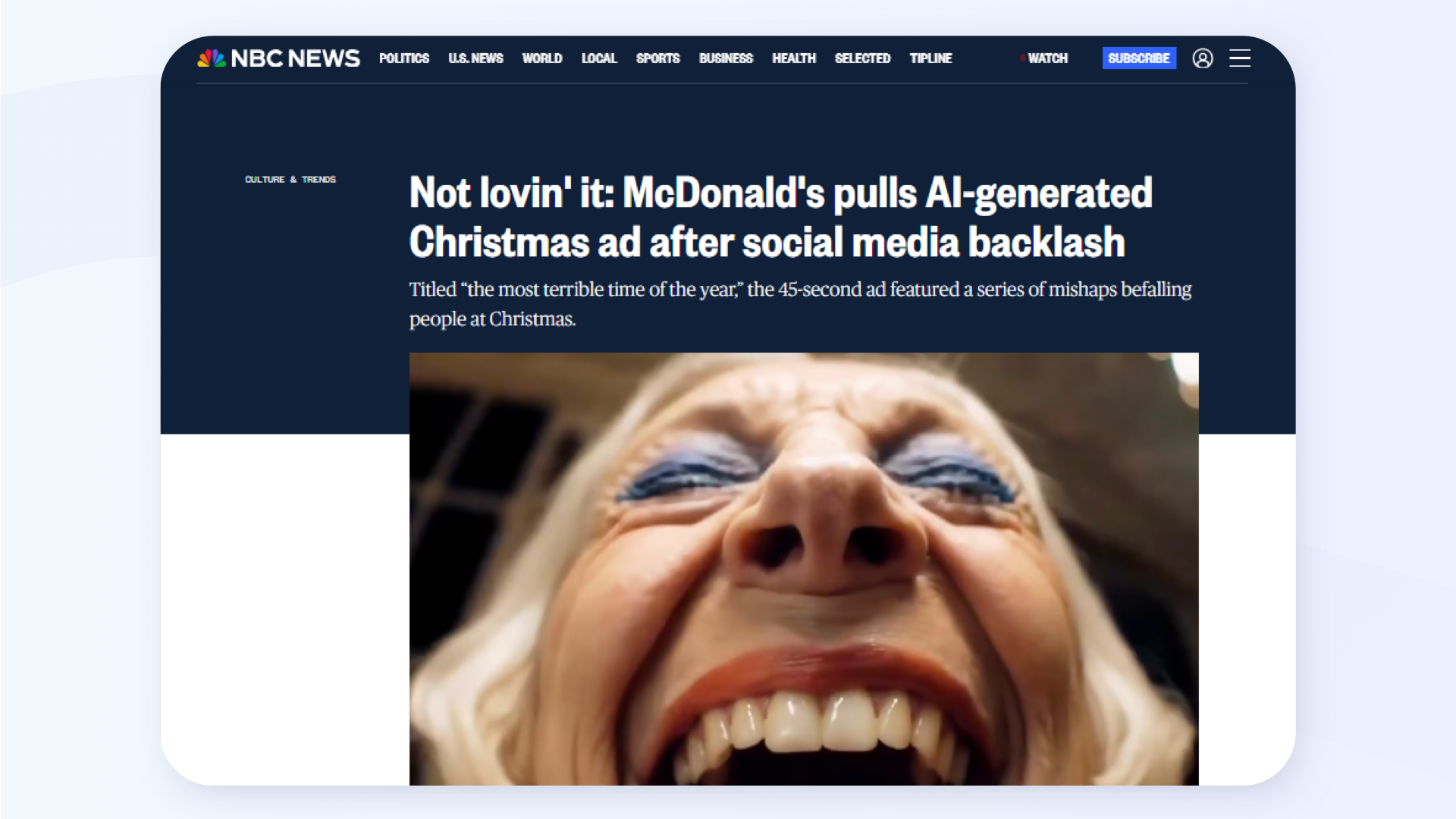
While actual customers were deeply offended by an ad that appeared to wish ill luck and disaster on them when they are trying to experience peace and joy at the close of the year, Reddit captured quite a different reaction in a thread titled AI Bro loses it after McDonald’s AI commercial is taken down. It contained this screenshot:
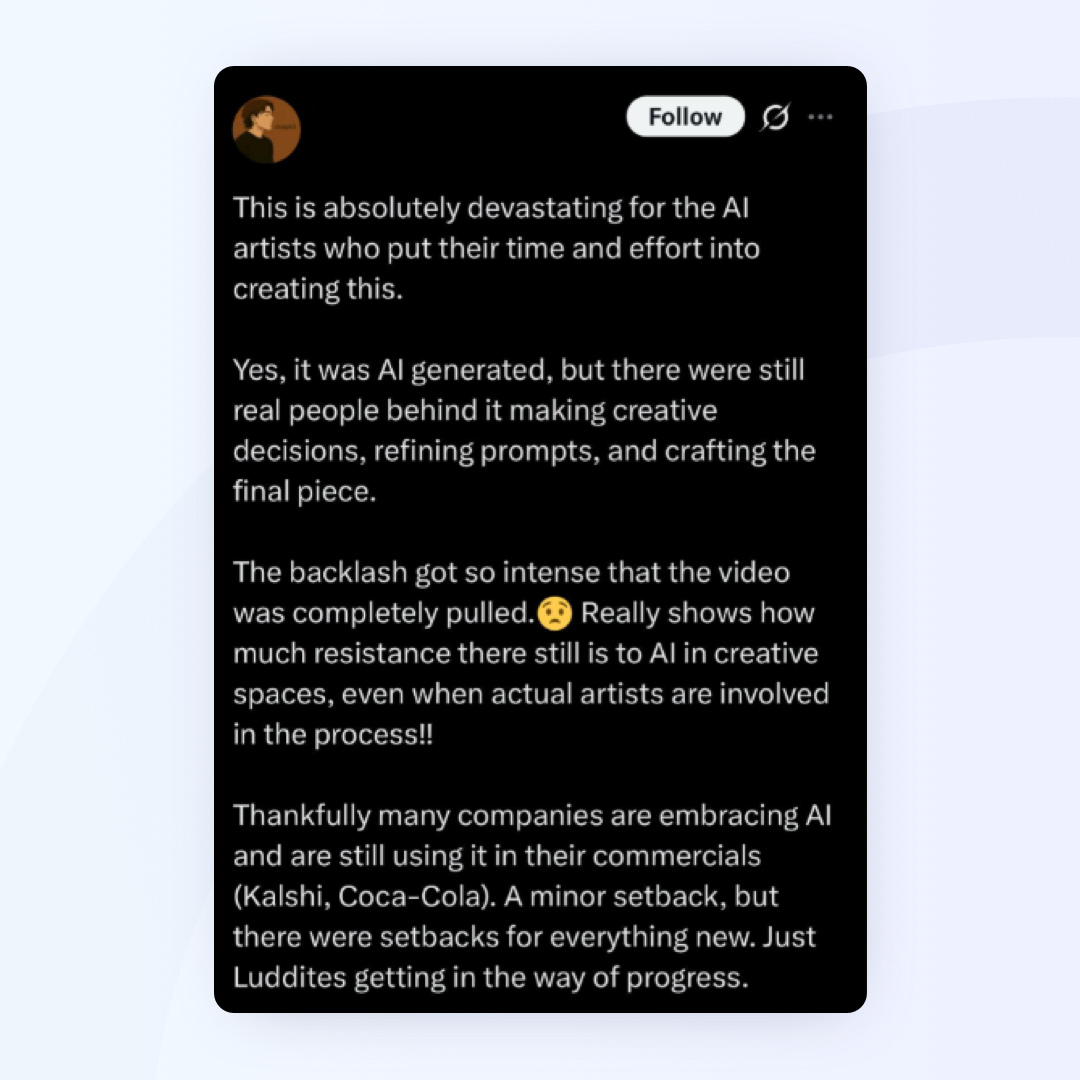
To be clear, this is not an X post from a McDonald’s representative. It’s from a user with the pseudonym @ChrisGPT whose profile describes them as “AI Insider” and a reporter for such publications as Axios, the New York Times, and TechCrunch. After all, you wouldn’t expect an official McDonald’s rep to refer to its customer base as “Just Luddites getting in the way of progress”, right?
According to McDonald’s official statement to the BBC, the ad was meant to
“...reflect the stressful moments that can occur during the holidays…This moment serves as an important learning as we explore the effective use of AI."
As for the ad agency, Sweetshop, that produced the commercial, its CEO, Melanie Bridge offered this defense:
“I don’t see this spot as a novelty or a cute seasonal experiment…To me, it’s evidence of something much bigger: that when craft and technology meet with intention, they can create work that feels genuinely cinematic. So no – AI didn’t make this film. We did.”
The whole spectacle was so bizarre that it had publishers like Futurism questioning whether McDonald’s had forced its Netherlands division to be a guinea pig and speculating about how C-suites are currently strategizing how to wear society down to accept AI-produced content. Who knows?
But what unifies the ad, the brand, the agency, AI apologists, and official statements?
It’s the utter lack of awareness of the customer.
Read the statements again. Who in them is caring about human customers?
In so many ways, the backlash against the use of AI for the ad ought to be the side story here. The main issue is that the brand and the agency thought it was a great idea to depict its prospective patrons having a miserable time during the festive season.
Agencies and brands can try to pass this behavior off as excitingly innovative, but if they stray so far from reality that they think content depicting customers suffering harm at the holidays is acceptable, then they’ve abandoned the other side of the cash register. And there’s really no excuse for it.
Wandering the aisles of fragmentation
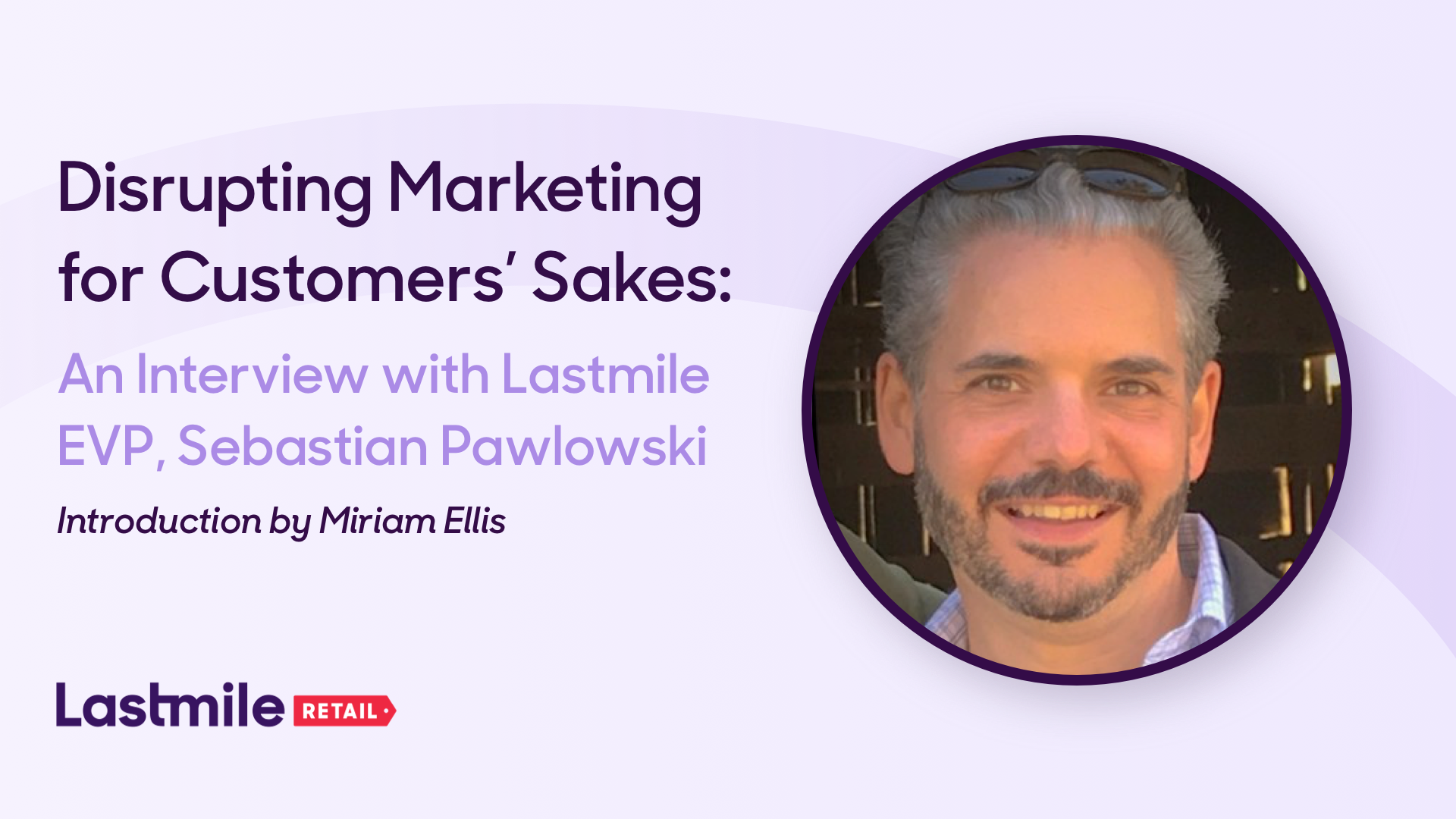
“We’re so fragmented in brand marketing, and we’re trying to fix it with AI. You go to an industry conference, and people from different departments will actually tell you that they’re not interested in revenue, or in anything that falls outside their division. But your whole brand should be accountable to the same bottom line. Everyone should be accountable to customer experience.” – Sebastian Pawlowski, Executive VP, Lastmile
I can guarantee it: there was some staff member at McDonald’s or its ad agency who knew that TV commercial would upset the public. They either spoke up and were ignored, or they stayed silent out of fear or some other motive. There are bright people in your org right now who get that it’s a terrible idea to promote heavy, overly-rich eggnog to a community experiencing 100-degree weather.
I worry about the smart people, because they are now up against two different levels of fragmentation.
Level 1: Departmental disconnection from consumers
Any internal team or third-party partner that is walled-off from your customer base is incapable of making consumer-centric decisions. Other priorities, like tech fads, or efficiencies, or ego, become substitutes for what should be the core purpose of the brand: serving the customer.
This disconnect explains phenomena like:
- Brands willingly shedding customers rather than ditching chatbots
- CEOs continuously making headlines by disturbing the public they are supposed to be serving
- Employees regularly turning to sites like Reddit to ask how many of their peers are working for brands with terrible product, toxic culture, disdain for customers, and systemic dysfunction
- Ad agencies proudly taking credit for commercials customers call “gross” and "inappropriate"
In each of these instances (and so many others), it’s clear that a customer-centric unified vision is absent. Practices, policies, culture, and messaging fail to put the customer first, as if profitability is of little concern.
Level 2: AI splintering CX like never before
Customers who were already feeling the effects of brands’ failure to focus on them are now having the near-out-of-body experience of AI summaries of nearby enterprises. Look how ChatGPT sums up the reputations of these well-known chains and franchises:
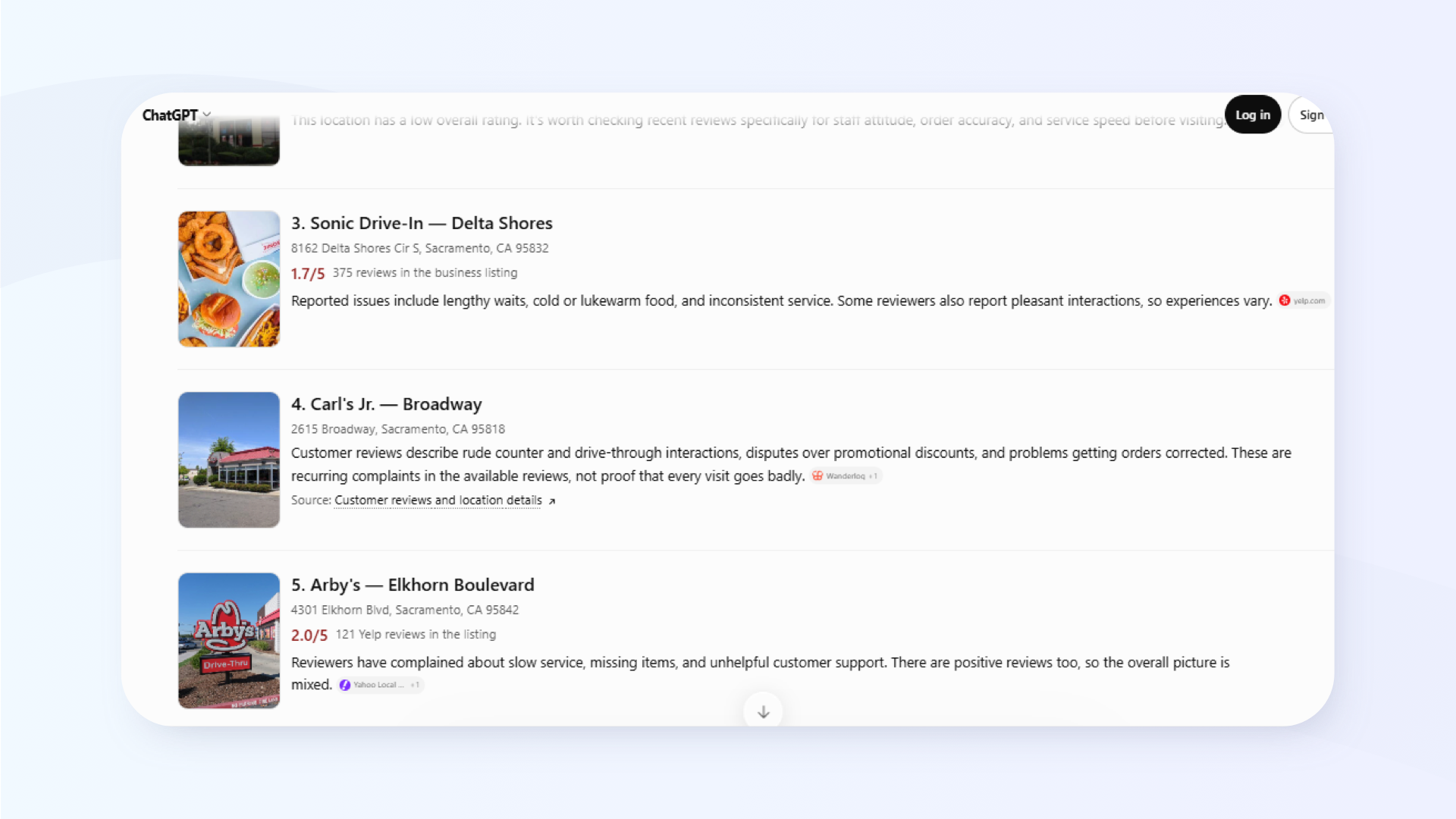
There are complaints on all three counts about long wait times, food quality, and poor service, coupled with vague AI-speak like “experiences vary”, “not proof that every visit goes bad”, and “the overall picture is mixed”.
What, exactly, is the customer to make of your brand if AI is describing your locations this way? These statements don’t stem from your CEO, your ad agency, your SEO team, your sales reps, or your customer service department. They aren’t even entirely stemming from your customers. They’re being put through a kind of meat grinder that pulls from random sources (this single, small data set includes content from Yelp, Wanderlog, Yahoo Local, Google Maps, and other platforms), and then mashes together a kind of burger of mimicked human language. Unless your org really doesn’t care about profitability, then this is a serious problem.
What we’re seeing in the AI era is the result of brands failing to commit to their customers, and this leaving patrons wandering strange aisles of random messaging instead of knowing they will be treated well by any company they choose. Few founders launch a bad business on purpose, but too many allow other priorities to shove CX to one side of the mission, instead of vigorously defending its position at the very center of the brand’s existence.
Back to the register and the bottom line
What does it really mean to step into your customer’s shoes?
Right now, I’m imagining an American family whose day hasn’t been the greatest. Their oven broke this morning and they’re worried about how long it will take to get fixed, what it will cost, and what they will do about dinner. The eldest child in the family had to hurry home from school to remind their live-in grandparent to take their medication, but his bike got a flat tire, causing him to arrive late and feel a lot of stress. One parent had to get leave from work to take the youngest child to an eye appointment and found out a lot of the upsetting problems she’s been having with schoolwork stem from her needing glasses. The other parent is worried every day at work because there are rumors that layoffs are coming. Imagine this is your family, and you need to provide a quick, affordable dinner for everybody tonight.
So, you choose a highly-advertised brand and walk into this location with the goal of feeding your loved ones:
That night, multiple members of your family feel sick after eating the meal you brought home from this famous brand, and the next day, an employee video showing the unsanitary conditions of the restaurant goes viral. Would the CEO have let their family eat there? Probably not.
That’s the problem. Employees on the ground may know what’s going on behind the counter, and some may even try to protect the public by shooing them away from a brand that demonstrably doesn’t care about the people it serves, but what about the rest of your org?
- Do your ad execs know they are promoting a business with filthy kitchens?
- Does your HR department know they are hiring people to work in unsanitary conditions?
- Do your engineers trust the software they’re using to monitor customer satisfaction, or do they know it’s highly flawed?
- Have you fired human staff and replaced them with AI tech that has no capacity to feel personal responsibility for community welfare?
- Is your founder paying attention to falling profits and being advised by shareholders to paper over them with more AI instead of a renewed commitment to customer service?
No new technology is a triumph if it is putting a greater distance between a business and the people it serves. The entire narrative of service is at risk of being lost to internal disconnection and increasingly-fragmented consumer journeys. Can this course be corrected? Possibly, if brand leadership is willing to:
- Become a customer of the business and experience its faults with the goal of correcting them
- Call a massive all-hands that includes every level of employee, franchisee, and all third-party marketing partners to implement the highest-possible customer service standards at every point of the journey
- Resolve internal divisions between departments via dialogue that unifies all teams under the single banner of improved customer service
- Engage directly with customers to ask what would make their experience better, earn their loyalty, earn their referrals, and then provide exactly that
- Refuse to turn over the controls to AI in as many instances as possible because the business plans to grow forward by keeping existing customers happy and earning repeat business from new ones instead of leaving the local community to wander the aisles of ChatGPT or Google AI Mode
I know it’s not realistic to ask low-level employees to take this stance. They have too little say in how most brands operate, despite the fact that they frequently possess a unique knowledge of customer needs. This is a call to the C-suites and it has a time limit on it.
Because it isn’t just that any major enterprise should be ashamed to run a dirty kitchen. It’s that those splintered conversational AI aisles can so readily lead a whole town or city away from your brand to one with a better reputational summary. This really is the bottom line.
Lastmile gets this. I was recently talking with Sebastian Pawlowski about a marketing conference he had attended not long ago. He spoke with a lot of fellow attendees and presenters there about the lack of cohesive company vision and how this is deteriorating customer experience.
“I wanted to talk about the thing we’ve always called the ‘marketing funnel’ and how we can better qualify and assist the customer journey, and what is getting in the way of this. It’s clear that departments are acting in isolation. They’ve been trained not to speak to one another about customer. When I said this, no one disagreed with me.”
If your current brand vision is resulting in offending customers with insensitive media and terrible on-site service, it’s well past time for something new.
Request a Demo
Drive more local sales by pairing shoppers with real-time inventory and promotions through seamless online-to-offline capabilities that help clients transact now.