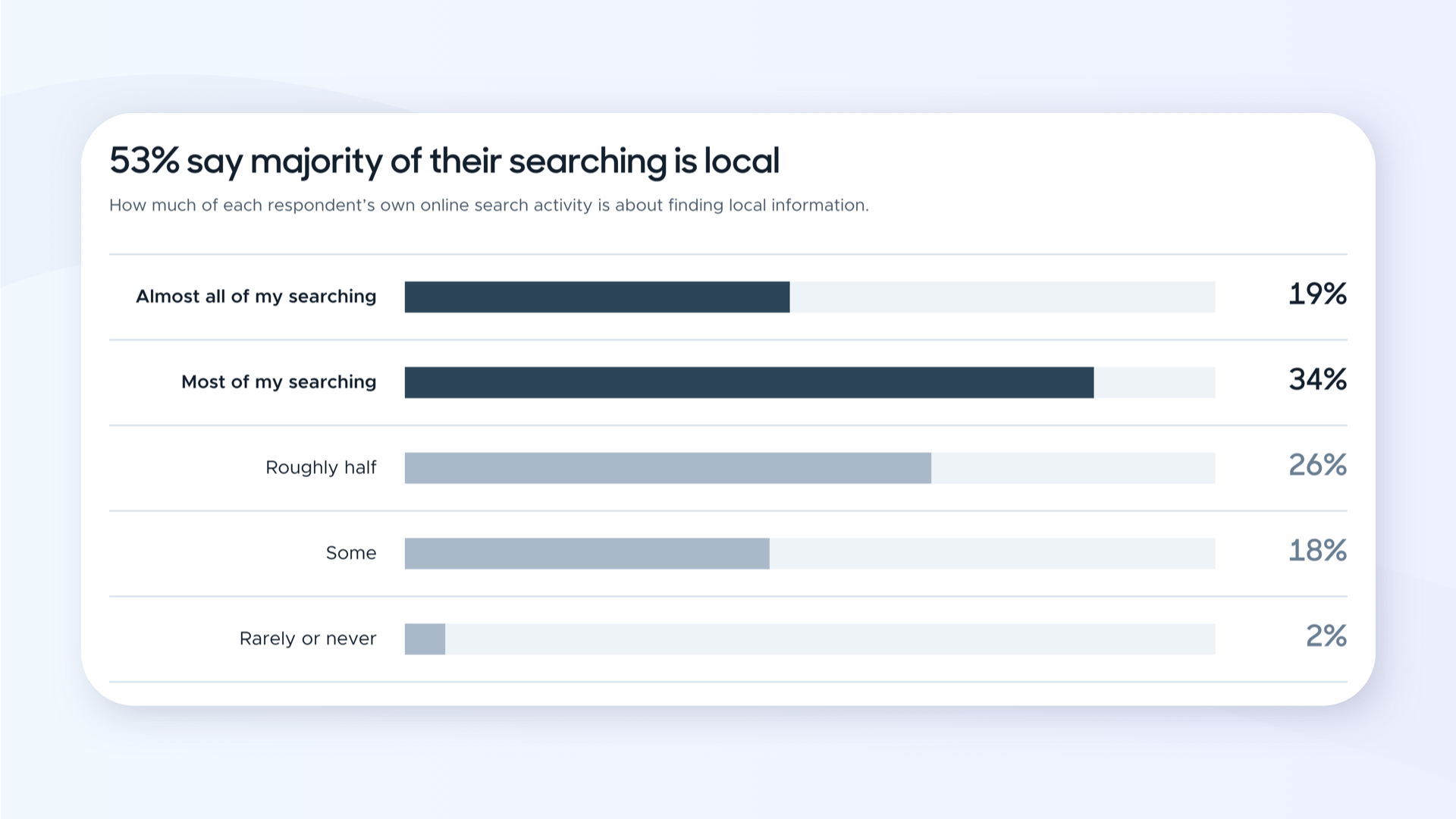
You might not know it from the itineraries of most SEO conferences or the strategy sessions happening at most multi-location enterprises, but ongoing consumer behavioral research by Lastmile in partnership with NearMedia finds that a stunning 53% of the public says that almost all or most of their searches are local. An additional 26% state that roughly half of their searches have a local intent, and 18% say that some do.
Taken altogether, this is 98% of the consumer public going online to find local providers of goods, services, and experiences at least some of the time, making it both a truly dominant usage of the internet and a local enterprise’s dream come true.
The odd thing is that statistics like these get so little press and are often so poorly reflected in what marketers and decision-makers at major brands talk about. And because this kind of data isn’t top-of-mind, tracking local consumer behavior is also frequently treated as an afterthought.
There is opportunity to be had by brands and agencies that heavily localize their approach to both offline and online marketing.
Breaking biases and assumptions
Biases may contribute to this lack of attention to local search. Even brilliant companies may still not have made the transition to thinking of themselves as local businesses, despite having dozens, hundreds, or thousands of physical stores or service areas. They may conceive of themselves as a world class brand, but not as an integral part of real-world communities from Portland, Maine to Portland, Oregon.
Assumptions can also obscure the view. For example, major brands not fully tracking local consumer journeys may be operating from unfounded ideas like, “Only older people use the Internet that way” or “We don’t need to worry about localizing because young people are using AI now.”
Lastmile’s research offers practical data, with the goal of better understanding the needs of this massive local audience:
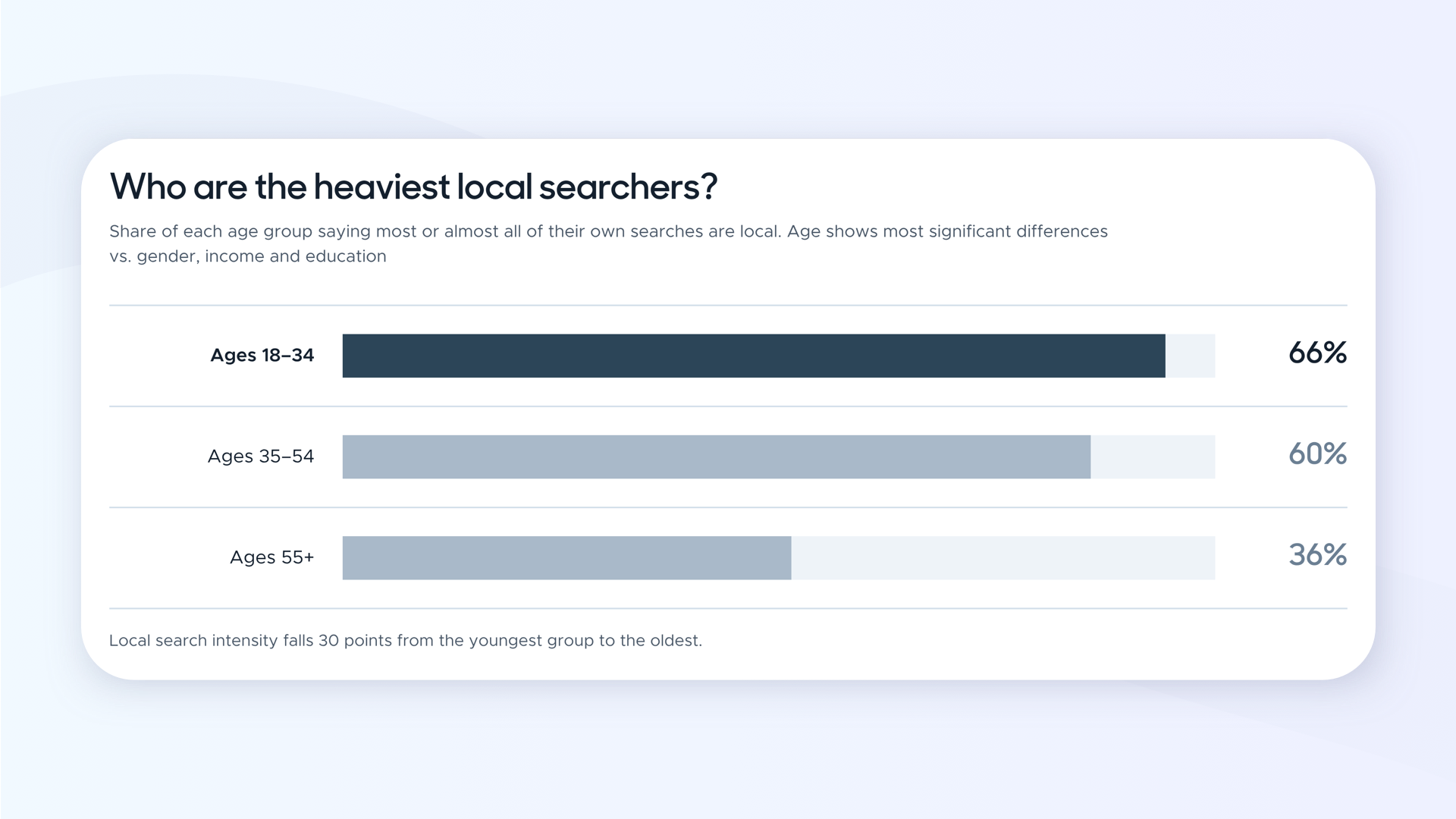
In surveying the respondents for whom “most” or “almost all” searches are local, Lastmile finds that young people (ages 18-34) are the dominant group. 66% are heavy users of search to navigate their options in local towns and cities. Consumers aged 35-54 come in just behind, at 60%.
It is actually consumers aged 55-and-over who are the least engaged in local searching, with only 36% stating that “most” or “almost all” of their searching activity falls within this category. This is an interesting data point when you consider that MapQuest–one of the first commercial online mapping solutions–launched in 1996. People at younger end of our oldest age group would have been in their mid-20s at that time, and have certainly had opportunity since then to develop strong local searching habits, but it could be that these more seasoned consumers continue to rely more on other research methodologies, such as getting recommendations from friends and family, before making local transactions. Even so, it’s not negligible that for ⅓ of this group, local search is their dominant search activity.
The takeaway for brands and marketers is that, regardless of the age of your core audience, a profound amount of their searches have a local intent. Tracking data must be implemented to replace biases and assumptions so that enterprises can re-envision themselves as resources within unique and specific geographic communities.
Is AI making local search obsolete?
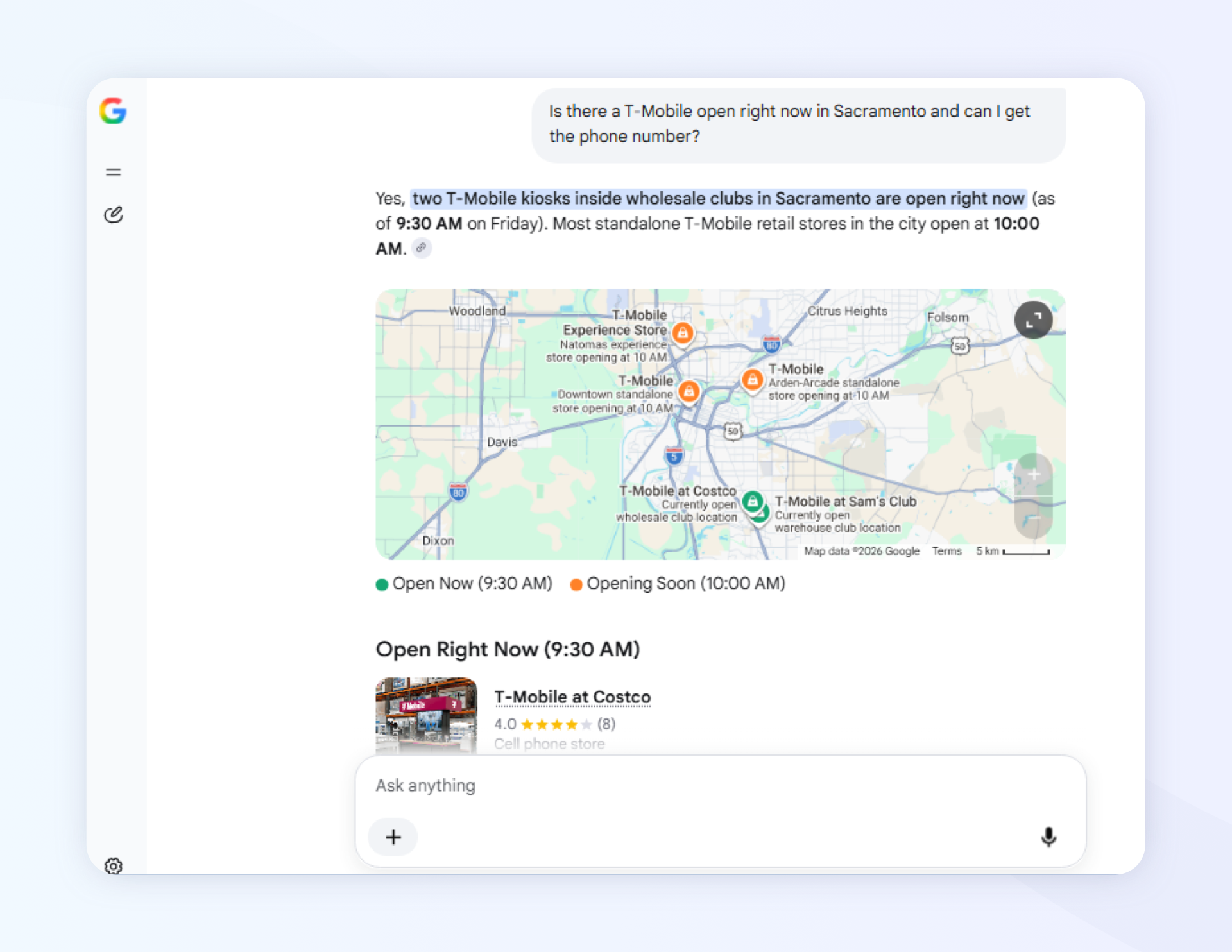
Just the opposite! Conversational AI models like ChatGPT and Google AI Mode are directly dependent on local business data to answer local-intent consumer questions:
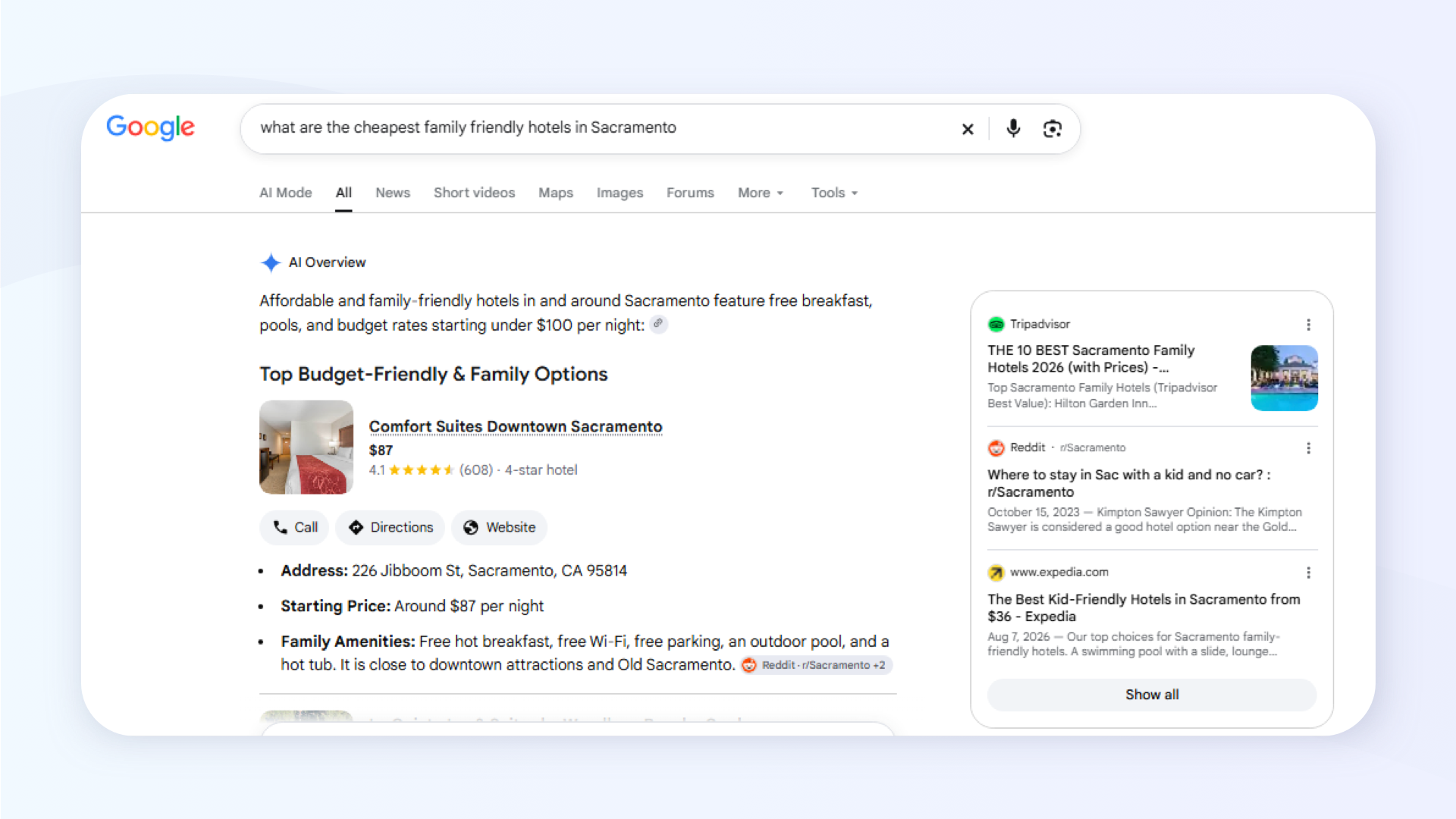
Inline search results features like Google’s AI Overviews also depend on local data sources:
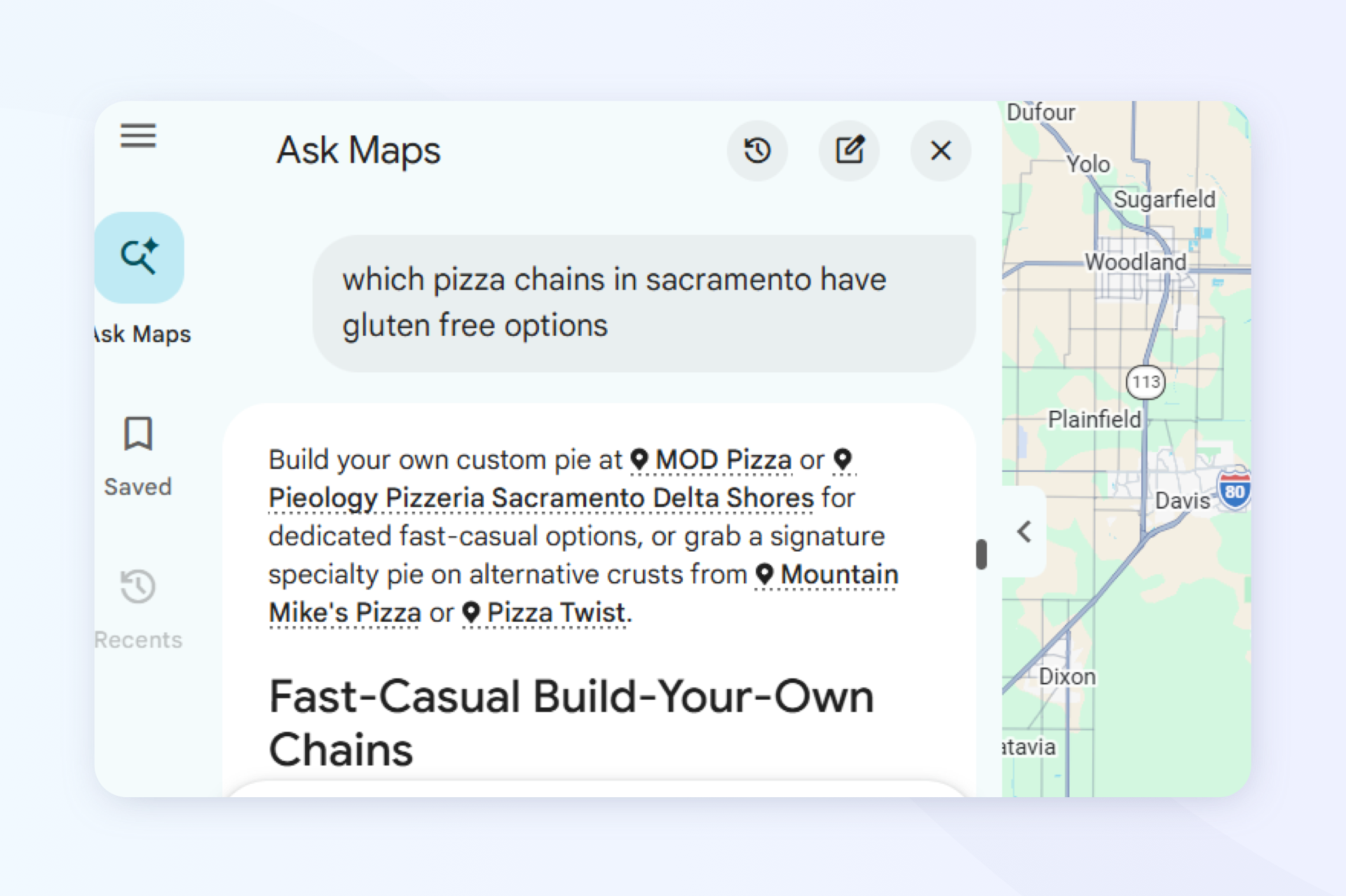
And even mapping applications like Google Maps now come with built-in AI features, like Ask Maps, which depend heavily on local business listings and local business information publishers:
Lastmile asked consumers how often they are now using AI applications to shop:
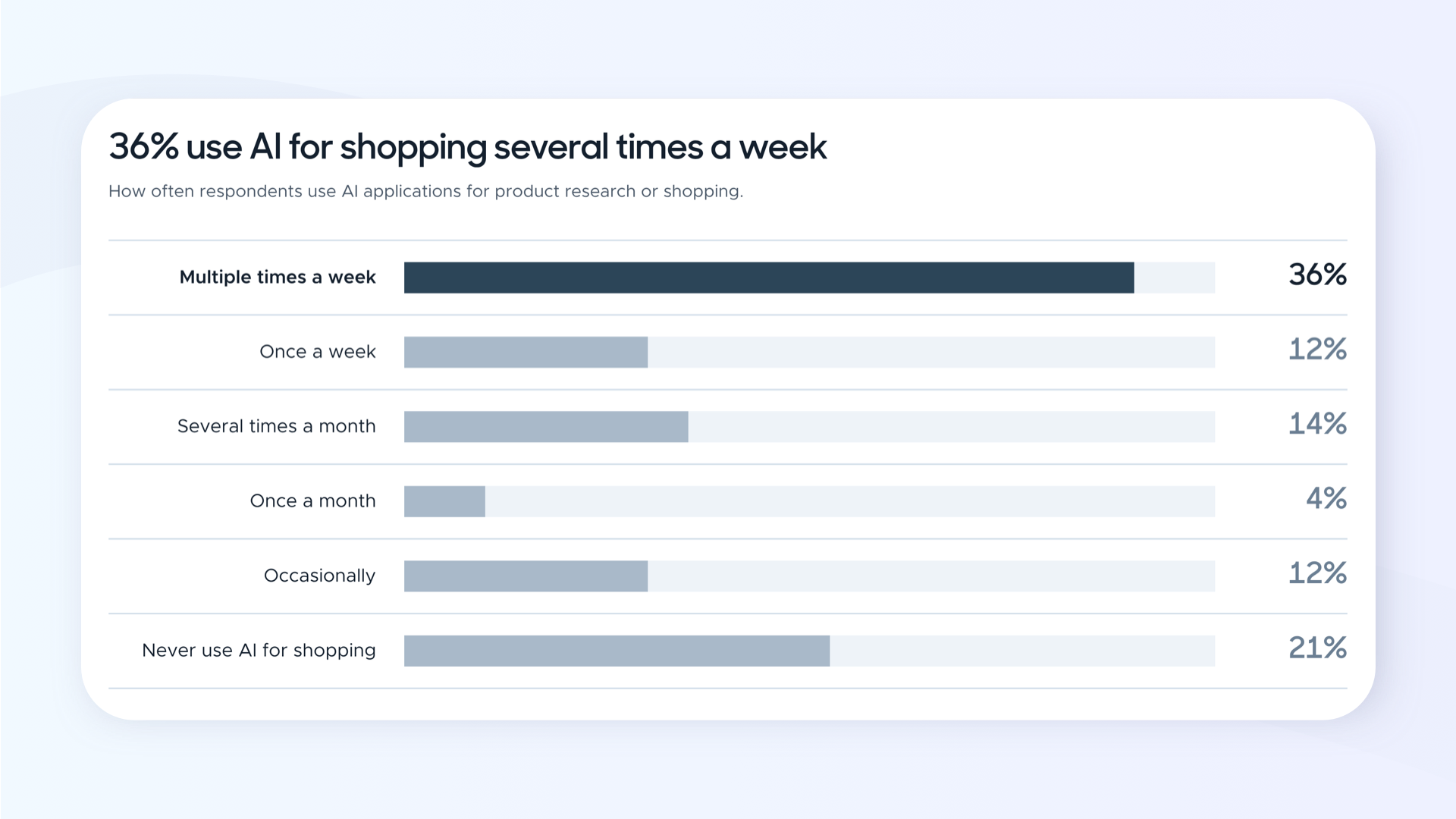
Just 21% have never yet used AI as part of their transactional journeys. 36% now use it multiple times a week, 12% report weekly usage, and 14% are turning to AI several times a month to shop.
Given the density of local business data in these contexts, whether within the search engine results (SERPs) or in dedicated AI spaces like AI Mode and ChatGPT, AI can be said to make local business data more important than ever, rather than dooming it to obsolescence.
What are the strengths and weaknesses of AI in local consumer journeys?
Lastmile asked consumers to gauge whether AI is “more helpful” or “less helpful” across a variety of digital tasks:
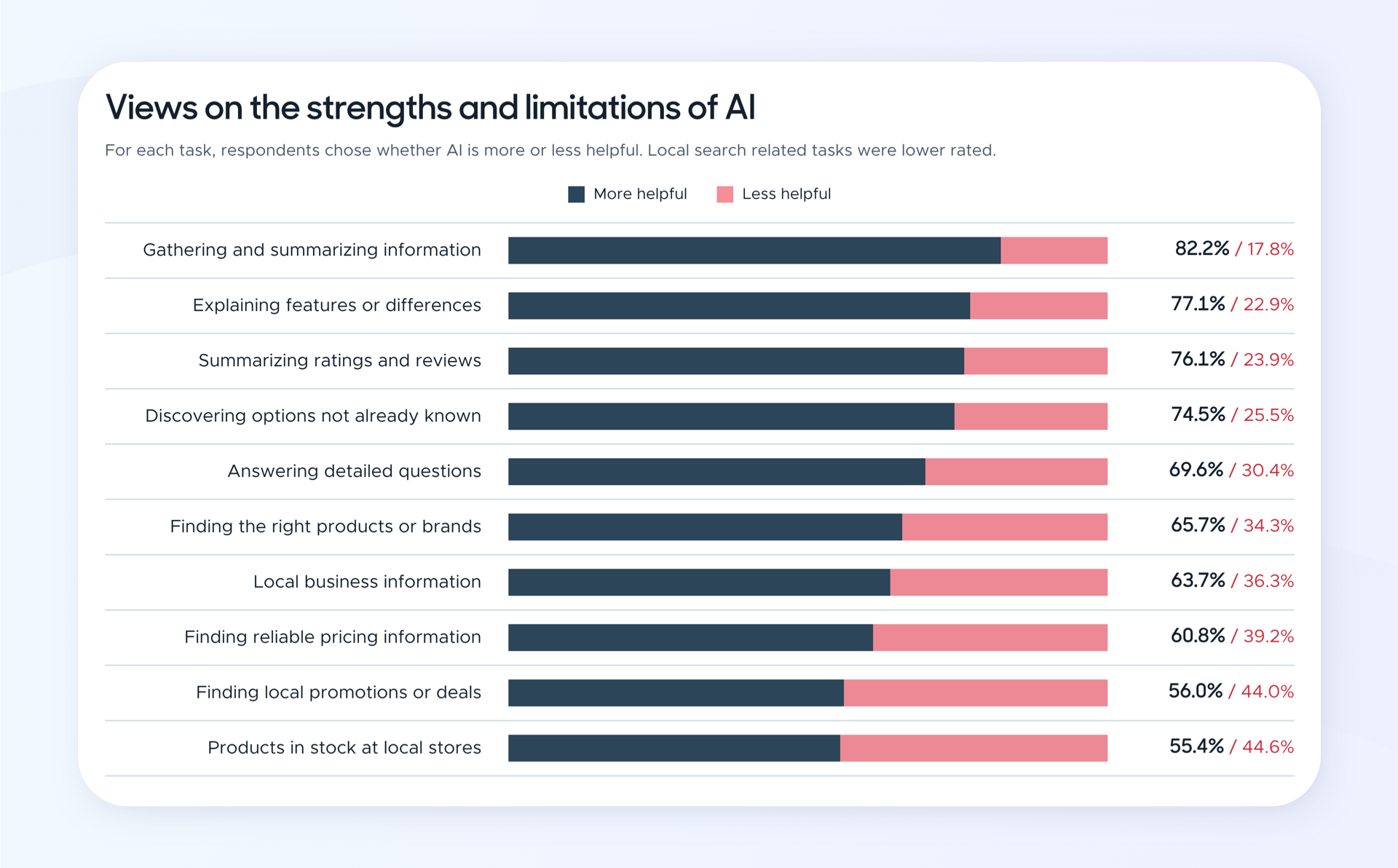
Consumers find AI most helpful for gathering and summarizing information (including ratings and reviews), for explaining features and differences, discovering new options, answering detailed questions, and finding the right products and brands.
Unfortunately, despite the fact that 53% of consumer searching is local, the public is experiencing the least help in this major activity when turning to AI. People find the technology least-assistive for core tasks, including finding local business information, finding reliable pricing information, finding local promotions or deals, and discovering which products are in stock at local stores. This is precisely the kind of data that transforms AI tools into lead-and-sale engines for multi-location brands, but too few enterprises are investing in the necessary local data layers to facilitate helpfulness.
The anatomy of AI results in local contexts
When a consumer who has come to depend on search to navigate their local commercial landscape turns to conversational AI with a typical local query like “family friendly pizza restaurants near me”, this is what they see:
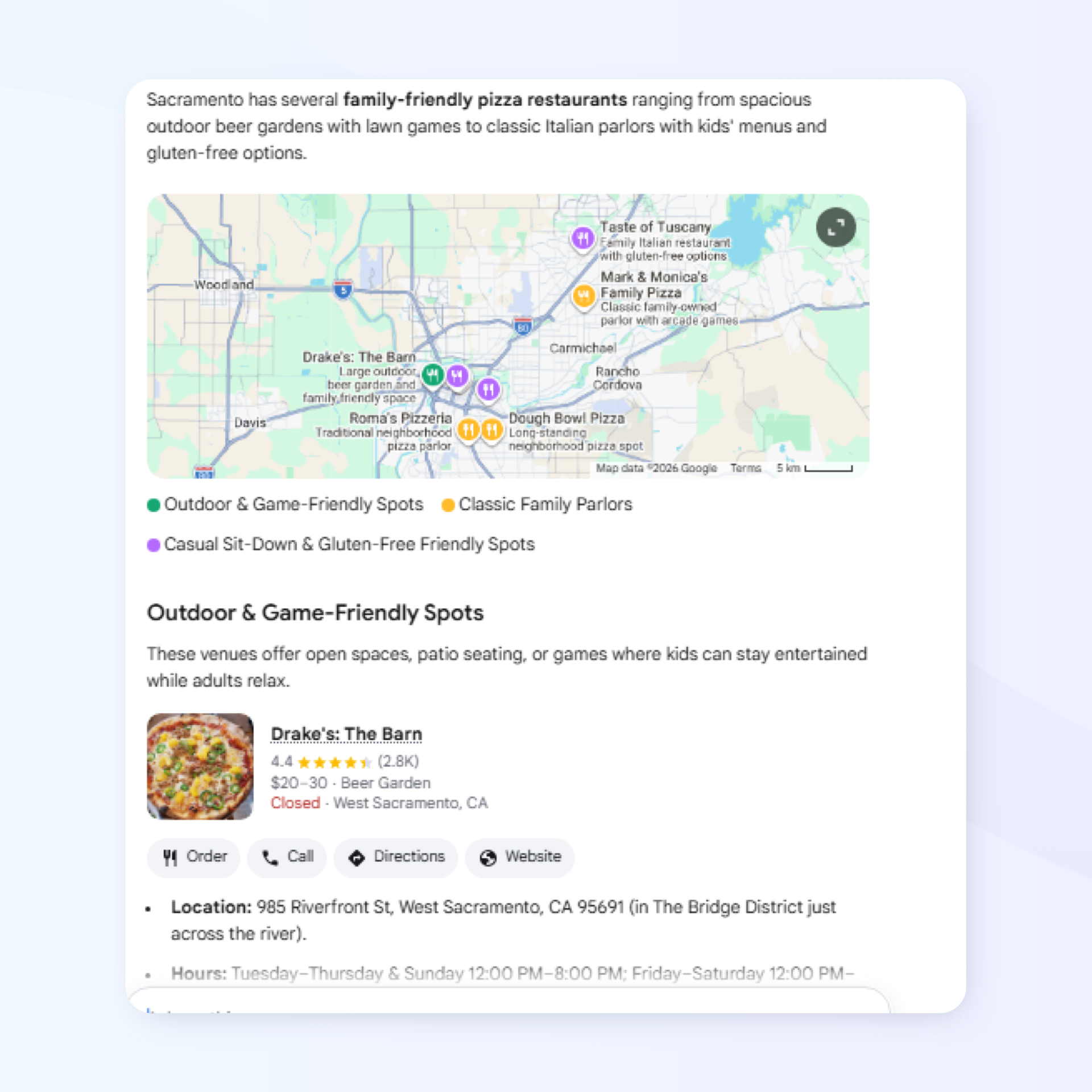
AI delivers:
- A map
- A summary of what it understand the consumer is asking about
- Lists of relevant businesses
- Images
- Average star ratings
- Review counts
- Price estimates
- Google Business Profile categories
- Engagement buttons for ordering, phoning, getting directions, and visiting websites
- Address and other location information
- Hours of operations
- Highlights
- And more
Local business information in AI results typically derives from one or more of the following sources:
- Google Business Profiles
- Third-party local indexes (like Yelp, TripAdvisor, etc.)
- Review platforms
- Brand websites
- Citations of the brands on third-party websites
- Social media
- Enrollment in programs like Google Merchant Center and OpenTable
What emerges from analyzing AI results for traditional keyword-oriented local searches (e.g. “pizza near me”) and the newer, more complex AI questions (e.g. “where can I get a gluten free pizza at a family friendly restaurant in downtown sacramento”) is a matrix of data layers that must be actively managed and tracked to maximize brand intelligence about local consumer journeys.
The 53% of consumers for whom “most” or “almost all” of searching has a local intent aren’t going to abandon the Internet due to the advent of AI. Instead, these prospective customers are trying to make their needs fit within the emergent AI contexts. But as Lastmile’s data shows, they are finding this experience less helpful than it should be because reliable data is in short supply.
Tracking: what needs to change to transform local enterprise identity
A brand that’s envisioned itself as a major corporate enterprise for decades and even generations faces multiple internal challenges when called on to transform how it sees itself to meet the moment we’re in. When headquarters are seen as the hub of business, cash registers and communities on Main Street can seem very distant instead of occupying the heart of the brand’s identity.
Meeting the reality that the majority of search activity is local may require substantial proofs before a company like yours feels ready to invest in full management of the data layers that power both traditional search and conversational AI. Such proofs depend on being able to track local consumer journeys with unprecedented depth, accuracy, and insight. Tracking must comprise both paid advertising and SEO for maximum attribution, and to quell departmental fears of cannibalization. It needs to be able to follow the customer from an ad or search result right through to the shopping cart and repeat transactions. It needs to be multi-seat, and granular, right down to the single-location level, building business intelligence over time about how each town and city wants to be helped.
Right now, the marketing sector is zeroing in on how evidence-based optimization is the right match for feeding AI what it needs to answer countless, complex questions about brands. Lastmile concurs with this philosophy, but we are also deeply interested in the evidence major multi-location enterprises need to re-envision themselves as city-by-city local resources. We believe that superior tracking of true local customer journeys offers the insights decision-makers need to fully localize their marketing.
We’re inviting conversations about this timely topic and have institutional knowledge to share from our daily practice of partnering with some of the world’s best-known brands, like Hyatt and T-Mobile. Reach out to Lastmile with your questions, and expect a helpful answer.
Request a Demo
Drive more local sales by pairing shoppers with real-time inventory and promotions through seamless online-to-offline capabilities that help clients transact now.